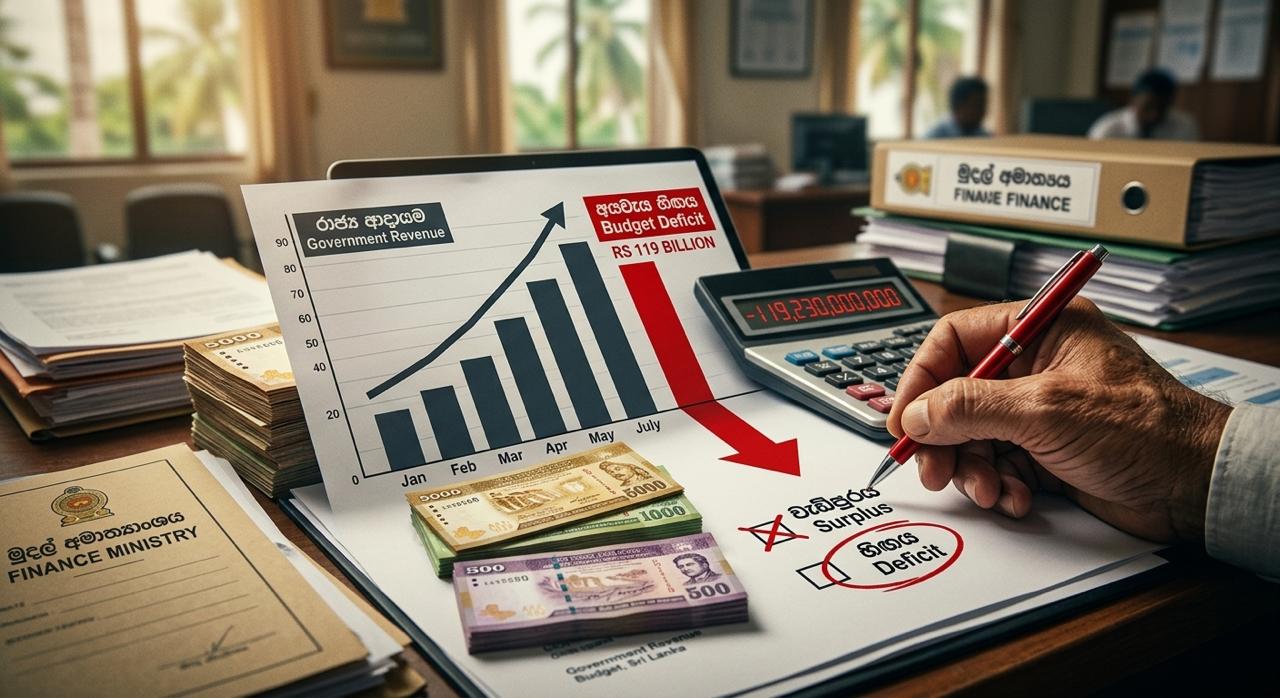
Sri Lanka’s public finances have improved markedly this year. But July produced a warning: a Rs 119.23 billion Budget deficit wiped out the small surplus accumulated up to June. The Government is collecting substantially more money. The question remains whether it can control what happens after the money arrives.
Sri Lanka’s fiscal recovery has produced an uncomfortable reminder that improved revenue does not automatically mean the Budget problem has disappeared.
The Government recorded a Budget deficit of approximately Rs 119.23 billion in July, reversing the Rs 9.51 billion cumulative surplus it had managed to record during the first six months of the year.
Submit Your Press Release
Get your company news, announcements, launches, appointments and events in front of a wider audience.


By the end of July, the cumulative Budget position had consequently swung back into deficit by approximately Rs 109.72 billion.
There is an important qualification.
The overall fiscal performance during the first seven months of 2026 remains considerably stronger than during the corresponding period last year. Government revenue has increased sharply and the primary balance which measures the Budget position before interest payments remains positive.
That is significant for a country whose fiscal indiscipline was one of the ingredients of the economic catastrophe of 2022.
But July tells another story.
A Government can improve tax collection, widen the revenue base and pursue delinquent taxpayers, but ultimately fiscal recovery depends on both sides of the ledger.
Money coming in matters. So does money going out.
Sri Lanka is now collecting substantially more from its citizens and businesses. VAT, income tax and other revenue measures introduced during the economic adjustment have imposed a considerable burden on households and companies, many of which are still recovering from the collapse in real incomes that followed the crisis.
That creates a corresponding obligation on the State.
Every additional rupee collected must be treated as public money rather than government money. The distinction is important.
Higher revenue cannot become an invitation for ministries, departments, corporations and political authorities to rediscover the spending habits that helped create the problem in the first place.
Nor should improved headline fiscal numbers obscure the extraordinary burden of interest payments. Sri Lanka continues to spend an enormous proportion of Government revenue servicing debt accumulated over decades.
The country therefore remains trapped between two realities.
It needs enough taxation to repair the State’s finances.
But excessive taxation can suppress investment, consumption and economic activity ultimately weakening the very revenue base the Government is attempting to strengthen.
That is why the Rs 119 billion July deficit deserves attention without panic.
One month’s figure does not reverse Sri Lanka’s fiscal recovery. But it does provide a useful warning. The public has already been asked to tighten its belt.
Government must make certain it has not quietly loosened its own.