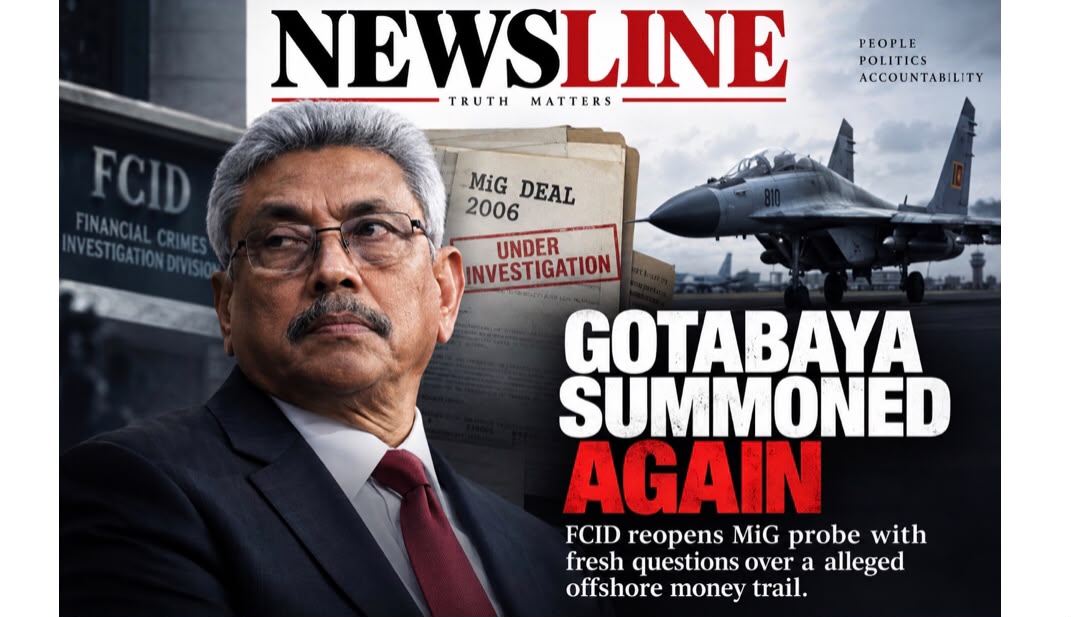
Twenty years after Sri Lanka bought and refurbished MiG-27 fighter aircraft from Ukraine, former President and then Defence Secretary Gotabaya Rajapaksa has been questioned by the FCID. Former Air Force Commander Roshan Goonetileke was questioned a day earlier. The aircraft belong to history, but questions surrounding the money apparently do not.
Twenty years after one of Sri Lanka’s most controversial defence procurements, investigators are once again asking questions about the MiGs. Former President Gotabaya Rajapaksa appeared before the Financial Crimes Investigation Division on Friday to provide a statement concerning the 2006 purchase and refurbishment of MiG-27 fighter aircraft for the Sri Lanka Air Force.
The development followed the questioning on Thursday of former Air Force Commander and Marshal of the Air Force Roshan Goonetileke, whose statement was reportedly recorded for more than five hours. Gotabaya Rajapaksa was Defence Secretary when the transaction took place.
Submit Your Press Release
Get your company news, announcements, launches, appointments and events in front of a wider audience.


The transaction concerned the purchase and refurbishment of MiG aircraft from Ukraine and was presented at the time as a government-to-government arrangement involving Ukrainian State-owned enterprise Ukrinmash. Subsequent investigations, however, focused upon Bellimissa Holdings Limited, an intermediary company registered in the British Virgin Islands through which Sri Lankan payments were allegedly routed.
The FCID previously informed court that only part of the money paid by Sri Lanka ultimately reached the Ukrainian State entity and alleged that approximately US$7 million was misappropriated. Investigators also alleged following an extensive inquiry that an agreement dated July 26, 2006 connected with the transaction was fraudulent.
These remain allegations and should be treated as such. Gotabaya Rajapaksa and others associated with the transaction have previously rejected allegations of wrongdoing, and renewed questioning by investigators does not establish criminal liability.
The significance of the investigation lies elsewhere. If Sri Lanka understood itself to be conducting a direct government-to-government transaction, the involvement of an offshore company raises legitimate questions about precisely what Bellimissa Holdings was contracted to do, who ultimately controlled it and why payments connected with a State defence procurement were allegedly routed through it.
Investigators must establish how much money Bellimissa received, how much ultimately reached Ukraine and what happened to any difference between those amounts. Those questions are fundamentally separate from whether the Sri Lanka Air Force required operational combat aircraft during the conflict with the LTTE.
A government fighting a war may legitimately conclude that its military requires aircraft, weapons or other equipment. That does not remove the obligation to establish what was purchased, from whom it was purchased, how much the State paid and where the public money ultimately went.
That distinction has often been obscured because controversies surrounding wartime procurement quickly become arguments about the war itself. The legality and financial integrity of a procurement transaction should instead be capable of examination on their own evidence, regardless of whether the equipment purchased was subsequently used effectively.
The MiG affair has survived changes of government, criminal investigations, political accusations and two decades of public controversy. That longevity is itself a reason why the renewed investigation must eventually reach something more substantial than another round of statements from prominent figures.
If investigators possess documentary and financial evidence establishing that public money was diverted, the evidence should be followed through the courts. If the available evidence cannot sustain criminal proceedings, the public is equally entitled to know that rather than watch an investigation continue indefinitely.
Gotabaya Rajapaksa has now given his statement and Roshan Goonetileke has given his. The aircraft themselves belong to another period in Sri Lankan history, but the banking records, contracts, company registrations and payment instructions should still be capable of answering the question that has kept the controversy alive for twenty years: where did the MiG money go?