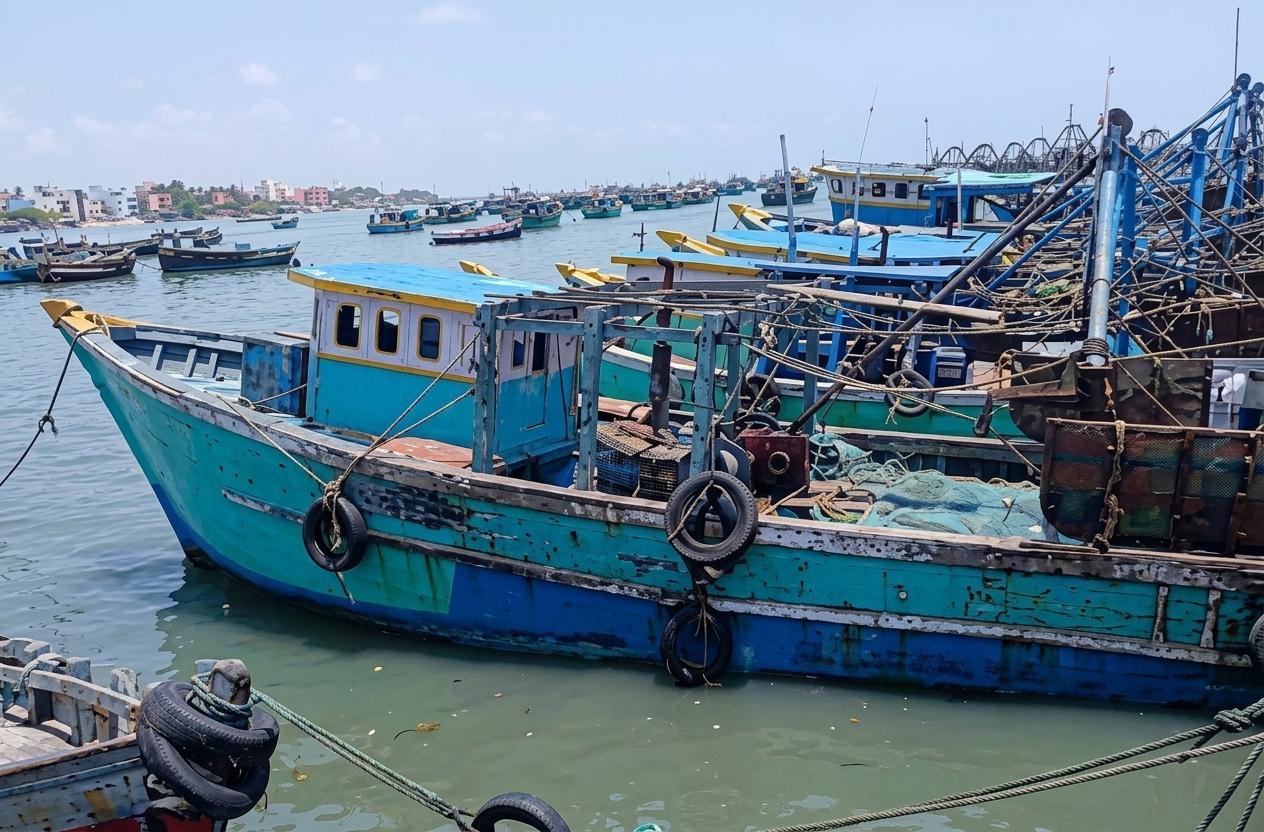
Another fishermen’s strike has been called off in Rameswaram. Another assurance has been given by the Tamil Nadu Government. Another demand will travel to New Delhi. Another conversation will presumably take place with Colombo. Then, if experience is any guide, another fishing boat will cross the International Maritime Boundary Line, another arrest will be made and the entire performance will begin again.
The Palk Bay fishing dispute has acquired the depressing permanence of a problem which governments on both sides have learned to manage without actually solving.
Rameswaram’s mechanised boat fishermen had threatened an indefinite strike following recent arrests and seizures of vessels by Sri Lankan authorities. They withdrew that threat after meeting Tamil Nadu Fisheries Minister A. Srinath, who assured them that the State Government would intervene. Their demands include the release of detained fishermen and boats, compensation for vessels allegedly damaged while in Sri Lankan custody and, most importantly, a permanent diplomatic solution.

On that last demand at least, there should be agreement on both sides of the Palk Strait.
A permanent solution is long overdue.
The difficulty is that the story changes according to which shore tells it. In Tamil Nadu it is frequently presented as a humanitarian issue involving poor fishermen pursuing traditional fishing grounds only to be arrested by the Sri Lankan Navy. In northern Sri Lanka it is presented very differently: Indian mechanised trawlers crossing the maritime boundary, engaging in bottom trawling and damaging fishing grounds upon which Sri Lankan fishermen depend.
Both governments then enter the argument carrying their respective political burdens.
Tamil Nadu politicians cannot appear indifferent when Indian fishermen are detained in Sri Lanka. Colombo cannot tell northern fishermen, many of whom rebuilt their livelihoods after decades of war, that foreign trawlers should simply be permitted to exploit their waters.
There is also an important distinction which political rhetoric frequently obscures. The Indian fishermen are not the enemy of Sri Lanka, just as the fishermen of northern Sri Lanka are not the enemy of Tamil Nadu. They are communities trying to earn livelihoods from a relatively small and increasingly stressed marine environment.
The problem is the method, the economics and the failure of governments to construct a workable transition.
Bottom trawling is particularly destructive because heavy nets are dragged across the seabed, disturbing habitats and scooping up marine life with relatively little discrimination. Sri Lanka has prohibited the practice in its waters. Northern fishermen therefore have an entirely legitimate grievance when mechanised trawlers cross the maritime boundary and engage in a fishing method they themselves are prohibited from using.
That reality must be acknowledged in Tamil Nadu.
But Colombo should acknowledge another reality. Simply arresting fishermen, seizing boats and sending them through courts cannot constitute a permanent fisheries policy between two neighbouring countries.
Enforcement may be necessary. It is not a settlement. The geography makes the present arrangement particularly absurd. Sri Lanka and India are separated at their closest points by a remarkably narrow stretch of sea.
The communities on either side possess centuries of cultural, religious, commercial and family connections. Yet governments have somehow permitted this relatively confined maritime dispute to become one of the most durable irritants in the bilateral relationship.
There have been talks before. There have been joint working groups, ministerial discussions, diplomatic interventions and promises to examine alternatives. Fishermen’s representatives have met. Governments have issued statements. Prisoners have been released as gestures of goodwill.
Then the boats return.
That is because the economics which send them across the boundary have not disappeared.
A durable solution therefore requires considerably more than another diplomatic request for the release of arrested fishermen. Tamil Nadu needs a properly funded transition away from destructive bottom trawling in the Palk Bay. Fishermen who have invested heavily in mechanised trawlers cannot simply be ordered to abandon their livelihoods without viable alternatives.
India possesses the financial capacity to support such a transition. Deep-sea fishing programmes, vessel conversion, alternative gear, compensation and retraining should form part of a serious settlement rather than appearing intermittently after the latest arrests.
Sri Lanka, for its part, must provide clarity and consistency in enforcement. Fishermen should know the consequences of crossing the maritime boundary and those consequences should be proportionate, predictable and focused upon deterring illegal fishing rather than producing diplomatic theatre.
The interests of Sri Lanka’s northern fishermen must also be placed at the centre of negotiations. Too often the dispute is described as though it exists principally between Colombo and New Delhi, with Chennai providing political pressure from the side.
The people most directly affected live much closer to the water.
A fisherman from Jaffna whose catch and fishing ground are threatened has as much right to a livelihood as a fisherman from Rameswaram whose family depends upon the boat that has just been seized. Protecting one community by sacrificing the other is not a solution. There should therefore be a formal, time-bound bilateral transition plan involving New Delhi, Colombo, Tamil Nadu and representatives of fishing communities from northern Sri Lanka. It should establish measurable reductions in bottom trawling, provide economic alternatives for affected Indian fishermen, strengthen sustainable fishing practices on both sides and create a mechanism for dealing rapidly with accidental or minor incursions without allowing every incident to become a diplomatic crisis.
There should also be honesty about Katchatheevu.
The island is repeatedly resurrected in Indian politics as though transferring sovereignty back to India would magically solve the fishing problem. It would not. Fish do not observe political slogans, and changing ownership of a tiny island would not replenish depleted fishing grounds or make bottom trawling environmentally sustainable.
Sri Lanka should equally resist treating every Indian fisherman as though he were engaged in some hostile territorial enterprise. Most are not interested in changing international borders. They are interested in catching enough fish to make their boats economically viable.
That is precisely why governments must solve the economic problem rather than endlessly prosecute its symptoms.
The Rameswaram fishermen have now called off their strike. That is welcome. It should not be mistaken for progress.
The dispute remains exactly where it was before the strike was announced.
Another boat can cross tomorrow. Another crew can be arrested. Another Chief Minister can write another letter to India’s External Affairs Minister. Another delegation can seek another assurance. Another group of fishermen in Jaffna can complain that their waters are being plundered.
Sri Lanka and India are capable of considerably more sophisticated diplomacy than this.
The Palk Strait should be one of the great economic and human bridges between the two countries. Instead, every few weeks it becomes a courtroom, a political platform and occasionally a prison route.
That is a failure of policy on both shores.
Be that as it may, the sea between us is narrow. After all these years, it is the political distance that remains unnecessarily wide.
The underlying dispute is very much alive: Sri Lanka’s Navy says the August 12 seizure involved a trawler and nine fishermen allegedly crossing the IMBL and engaging in bottom trawling, while the Tamil Nadu side said 49 Indian fishermen remained in Sri Lankan custody as of mid-August.