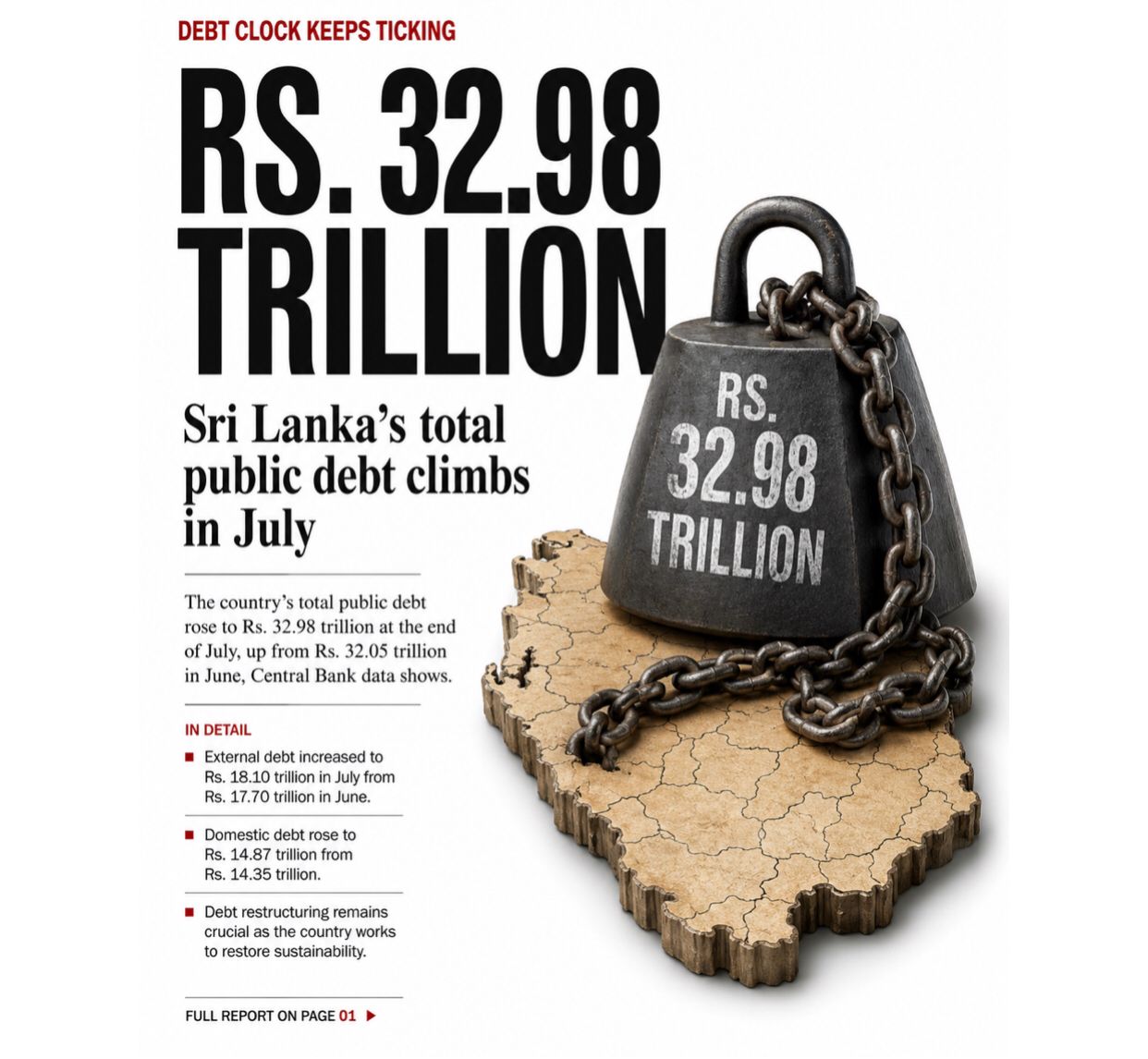
Sri Lanka’s public debt climbs Rs. 744 billion in three months to Rs. 32.98 trillion, even as its dollar value falls
Sri Lanka may have emerged from the worst of its economic collapse, but the arithmetic sitting behind the recovery remains formidable.
The country’s gross public debt increased by approximately Rs. 744 billion during the second quarter of 2026, reaching Rs. 32.98 trillion by the end of June, according to figures contained in the Public Debt Management Office’s latest Statistical Debt Bulletin.
Submit Your Press Release
Get your company news, announcements, launches, appointments and events in front of a wider audience.


At the end of March the corresponding figure was Rs. 32.23 trillion. In three months, therefore, the rupee value of the debt stock increased by about 2.3 percent.
There is an important qualification. Measured in US dollars, Sri Lanka’s gross public debt actually declined from approximately US$102.27 billion at the end of March to US$97.95 billion at the end of June, a reduction of about US$4.32 billion.
That apparent contradiction matters.
Debt expressed in rupees can rise while its dollar equivalent falls because exchange rates, the composition of borrowing, repayments and new financing all affect the numbers. It would therefore be misleading simply to declare that Sri Lanka borrowed another Rs. 744 billion and leave it there.
But it would be equally misleading to pretend that Rs. 32.98 trillion is merely an accounting curiosity.
Sri Lanka has undergone one of the most painful economic adjustment programmes in its modern history. Taxes have risen, subsidies have been reduced, electricity and fuel pricing have been restructured, State spending has been constrained and ordinary households have been repeatedly told that fiscal discipline is the price of preventing another collapse.
Against that background, the size and direction of public debt deserve considerably more public attention.
The Government’s challenge is no longer simply to demonstrate that Sri Lanka can service its obligations following restructuring. It must show that the economy can grow sufficiently quickly, generate sufficient revenue and attract sufficient productive investment to make the debt burden progressively less threatening.
That is a much harder test than stabilising a currency or rebuilding reserves.
There are positive signs elsewhere. Sri Lanka has regained a degree of macroeconomic stability and the rupee has been relatively steady in recent trading. But stability is the starting line, not the finishing tape.
The danger is that Sri Lanka becomes comfortable with recovery statistics while overlooking the enormous liability sitting underneath them.
Rs. 32.98 trillion is ultimately not owed by a Government in the abstract. Governments do not earn money independently of the country they govern.
The bill belongs, directly or indirectly, to Sri Lanka and its taxpayers.
That makes the next phase of economic policy crucial. Borrowing that finances productive infrastructure, exports and economic expansion can help enlarge the economy from which tomorrow’s debt must be serviced. Borrowing that finances inefficiency simply moves today’s problem into somebody else’s tomorrow.
Sri Lanka has already discovered what happens when that tomorrow finally arrives.
The country therefore has every reason to welcome the progress made since 2022. It has just as much reason to keep watching the debt clock.
Because at Rs. 32.98 trillion, it is still very much ticking.
be that as it may
The underlying debt figures are reported from the Public Debt Management Office bulletin: Rs. 32.23 trillion at end-March rising to Rs. 32.98 trillion at end-March rising to Rs. 32.98 trillion at end-June, while the dollar value fell from US$102.27 billion to US$97.95 billion.