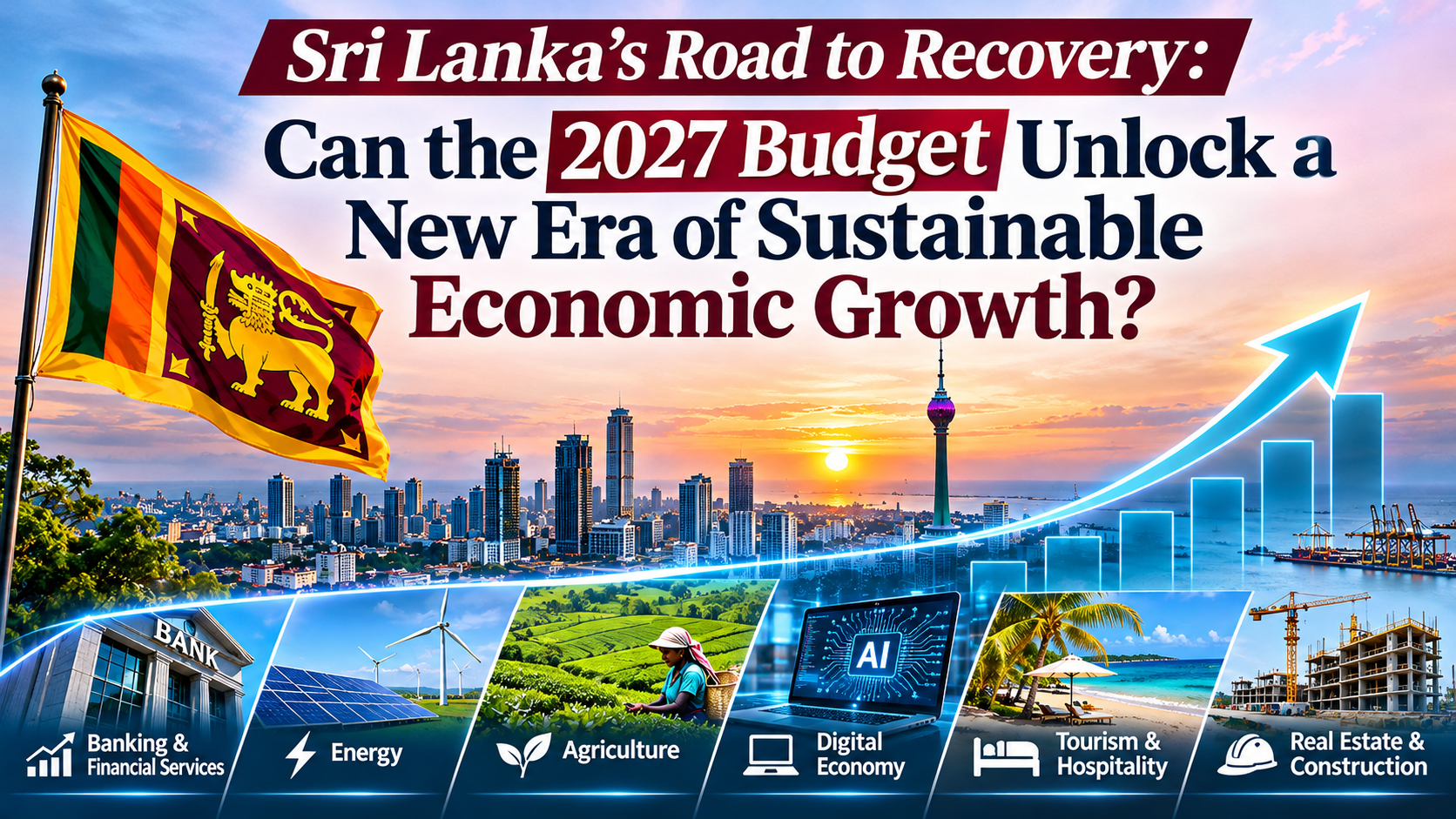
After navigating one of the most severe economic crises in its history, Sri Lanka has made significant progress in restoring macroeconomic stability. But the real test lies ahead: turning recovery into stronger investment, higher productivity, export competitiveness and sustainable prosperity.
Sri Lanka stands at a defining moment in its economic journey. The country has moved considerably away from the financial and economic turmoil of 2022, when collapsing foreign exchange reserves, soaring inflation, shortages of essential goods and a severe contraction in economic activity exposed deep structural weaknesses in the economy.
Four years later, the economic landscape looks markedly different. Growth has returned, inflation has moderated, government revenue has increased, foreign exchange reserves have recovered and the country has made substantial progress in restructuring its external debt.
Submit Your Press Release
Get your company news, announcements, launches, appointments and events in front of a wider audience.


Yet economic recovery and economic transformation are not the same thing.
The challenge facing Sri Lanka is no longer simply to restore stability. It is to establish a growth model capable of generating employment, attracting investment, strengthening exports and improving household incomes without recreating the fiscal and external vulnerabilities of the past.
Against this backdrop, the 2027 Budget assumes particular significance. It must move beyond short-term fiscal management and become a strategic instrument for transforming the country’s productive capacity.
From economic crisis to stabilisation
The scale of Sri Lanka’s economic collapse was unprecedented in recent decades. Real GDP contracted by 7.3% in 2022, while Colombo’s National Consumer Price Index inflation reached 69.8% in September of that year.
The crisis exposed the consequences of weak public finances, declining foreign exchange liquidity, policy uncertainty and structural dependence on imports.
Since then, the country has made measurable progress. Economic growth reached 5.0% in both 2024 and 2025, while GDP expanded by 4.2% in the second quarter of 2026. Inflation has moderated substantially, and unemployment declined from 4.7% in 2022 to 3.9% in 2025.
Fiscal performance has also improved. Government tax revenue increased from approximately LKR 1.75 trillion in 2022 to LKR 5.05 trillion in 2025. The government recorded a primary surplus equivalent to 5.4% of GDP in 2025, reflecting a significant improvement in fiscal discipline.
These developments demonstrate that stabilisation measures have begun to produce results.
However, the sustainability of the recovery will depend on whether the economy can generate stronger private-sector activity, expand its productive base and create sufficient employment opportunities.
The external sector: A recovery that must be protected
Sri Lanka’s external position has improved considerably, supported by tourism, worker remittances and the recovery of foreign exchange inflows.
Worker remittances reached approximately USD 8.1 billion in 2025, while tourism earnings amounted to around USD 3.2 billion. Gross official reserves increased to approximately USD 6.8 billion by the end of 2025, compared with USD 1.9 billion in 2022.
These developments have strengthened the country’s ability to meet external obligations and manage currency pressures.
Nevertheless, external stability remains exposed to international developments. The increase in the fuel import bill to approximately USD 4.5 billion during January–September 2026, representing a 51.5% year-on-year increase, highlights the vulnerability created by energy imports and international commodity price movements.
Sri Lanka must therefore strengthen its foreign exchange earning capacity rather than depend predominantly on remittances and tourism.
The expansion of merchandise exports, IT services, professional services, logistics and higher-value manufacturing will be essential to building a more resilient external sector.
Debt restructuring is not the end of the journey
Sri Lanka’s debt restructuring programme has reached an important stage, with more than 94% of the restructuring process implemented, according to the KPMG analysis.
The improvement in sovereign creditworthiness is reflected in Fitch Ratings’ upgrade to B- with a Stable Outlook on 22 September 2026.
This is an important development for investor confidence and the country’s future access to international capital markets.
However, debt restructuring provides breathing space; it does not automatically create economic growth.
The country must maintain fiscal discipline, improve public-sector efficiency and ensure that new borrowing supports investments capable of generating long-term economic returns.
The priority should be to avoid a return to debt-financed consumption and politically motivated projects that do not generate sufficient economic value.
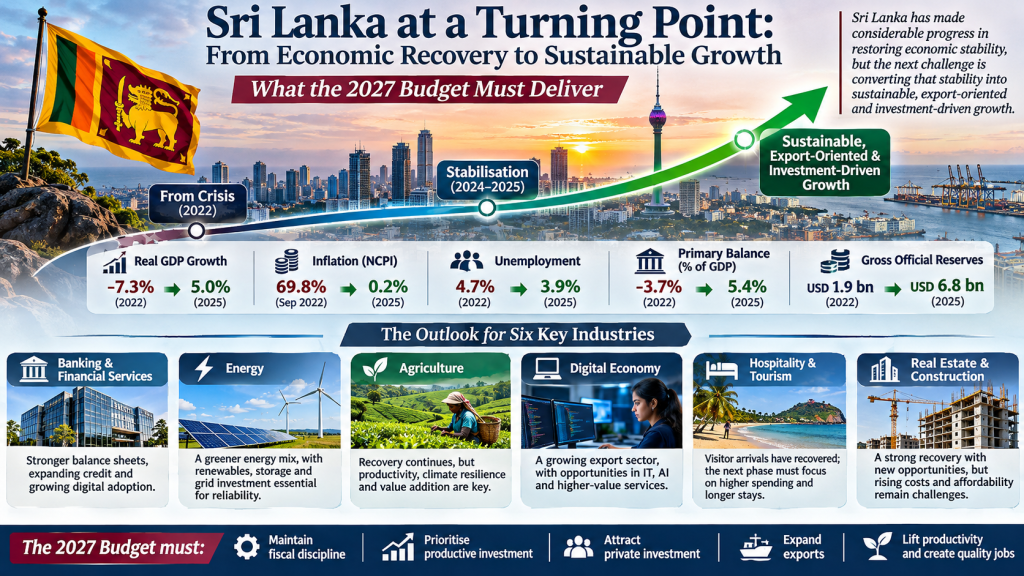
Six sectors that could drive the next phase of growth
The country’s future economic performance will depend heavily on its ability to unlock opportunities across key productive sectors.
1. Banking and financial services: Financing the next growth cycle
Sri Lanka’s banking sector remains central to economic recovery. Banking assets reached approximately LKR 24.9 trillion by the end of 2025, while profit before tax amounted to LKR 742.6 billion.
The improvement in financial performance reflects the stabilisation of the economy and the gradual recovery of business activity.
Nevertheless, asset quality remains an important concern. The non-performing loan ratio stood at 9.1% in the second quarter of 2026, highlighting the continuing pressure on borrowers and financial institutions.
The next phase of banking-sector development should focus on financing productive businesses, supporting SMEs, improving digital financial services and expanding access to capital for export-oriented industries.
A stronger financial sector must do more than generate profits. It must become an effective channel for directing capital towards economic development.
2. Energy: Building the foundation for industrial competitiveness
Energy security is one of the most important determinants of Sri Lanka’s future competitiveness.
The country’s installed electricity generation capacity reached approximately 7,267 MW in the second quarter of 2026. Renewable sources accounted for 60.2% of electricity generation in 2025.
At the same time, electricity demand is projected to increase to 22,927 GWh by 2030.
This creates both a challenge and an opportunity.
Sri Lanka has considerable potential to expand solar, wind and other renewable energy sources. However, renewable generation must be supported by reliable transmission infrastructure, energy storage and effective grid management.
The 2027 Budget should prioritise investment in renewable energy infrastructure, private-sector participation and technology that improves energy efficiency.
Affordable and reliable electricity will be essential for attracting manufacturing investment, expanding digital industries and improving the competitiveness of local businesses.
3. Agriculture: Moving beyond production towards value addition
Agriculture continues to play an important role in employment, rural incomes and export earnings.
Paddy production reached approximately 5.29 million metric tonnes in 2026. Meanwhile, coconut exports generated around USD 942.5 million during January–September 2026, demonstrating the potential of agricultural value chains.
Fisheries exports also contributed approximately USD 225.5 million during January–August 2026.
However, the sector continues to face challenges relating to productivity, climate resilience, technology adoption, logistics and market access.
Sri Lanka must move beyond treating agriculture primarily as a domestic food-production activity.
The opportunity lies in developing commercially competitive agricultural industries through mechanisation, modern irrigation, improved seeds, food processing, cold-chain facilities and export-oriented production.
Greater value addition in tea, coconut, rubber, spices, seafood and processed agricultural products could significantly strengthen rural incomes and foreign exchange earnings.
4. Digital economy: An opportunity to create a new export industry
The digital economy could become one of Sri Lanka’s most important long-term growth drivers.
The country has made progress in digital adoption, with digital literacy reaching approximately 72%, although computer literacy remained at 39.2%.
Digital government initiatives have also expanded. GovPay had recorded transactions exceeding LKR 7 billion by November 2026.
However, the real economic opportunity extends far beyond digital payments and public-sector technology.
Sri Lanka has the potential to develop a stronger international presence in information technology, artificial intelligence, software development, cybersecurity, fintech, business-process outsourcing and professional services.
The development of AI-related capabilities creates a further opportunity for local companies to build products and services for international markets.
To capture this opportunity, the country must invest in digital infrastructure, technical education, research and development, intellectual property protection and a business environment that encourages innovation.
The 2027 Budget should treat the digital economy as an export-generating industry rather than simply another area of public-sector modernisation.
5. Tourism and hospitality: Increasing value rather than merely arrivals
Tourism has regained considerable importance in Sri Lanka’s economic recovery.
The country recorded approximately 2.36 million tourist arrivals in 2025, generating tourism earnings of around USD 3.2 billion. Registered accommodation capacity reached approximately 59,578 rooms.
These figures demonstrate the sector’s recovery and its importance to foreign exchange generation.
However, the next stage of tourism development should not be measured only by the number of visitors.
Sri Lanka needs to increase average visitor spending, encourage longer stays, improve service quality and diversify tourism products.
Opportunities exist in wellness tourism, eco-tourism, cultural tourism, adventure travel, luxury hospitality, marine tourism and destination-based experiences.
Better transport connectivity, infrastructure, environmental management and destination planning will be essential.
The country must also ensure that tourism growth benefits local communities and creates sustainable employment.
6. Real estate and construction: Converting recovery into investment
The construction industry has shown a strong recovery, recording growth of 13.9% in the second quarter of 2026.
The Colombo Land Valuation Indicator reached 271.6 in the first half of 2026, reflecting developments in the property market.
A recovery in construction can create substantial economic benefits through employment, demand for building materials, financial services and related industries.
However, rising construction costs and affordability remain important challenges.
The next phase of development should focus on commercially viable projects, urban infrastructure, industrial facilities, logistics centres and affordable housing.
Policy stability, access to long-term financing and transparent planning procedures will be important in attracting both local and foreign investment.
What the 2027 Budget must deliver
The 2027 Budget should be judged not simply by the amount of government revenue collected or expenditure allocated, but by its ability to improve the economy’s long-term productive capacity.
Five priorities stand out.
First, maintain fiscal discipline. Sri Lanka cannot afford to return to unsustainable public spending, weak revenue collection or excessive borrowing. Fiscal credibility remains essential for investor confidence.
Second, prioritise productive investment. Public expenditure should support infrastructure, energy, education, technology, transport and projects that improve economic efficiency.
Third, attract private investment. A predictable regulatory environment, transparent public institutions, efficient approvals and consistent policies are necessary to encourage businesses to invest and expand.
Fourth, expand exports. Sri Lanka needs a broader export base, including higher-value agriculture, manufacturing, tourism, IT services and professional services.
Fifth, improve productivity and employment. Economic growth must translate into better incomes, stronger businesses and meaningful employment opportunities. Education and vocational training must be aligned with the needs of emerging industries.
These priorities require more than budgetary allocations. They require consistent implementation, institutional coordination and measurable outcomes.
The investment opportunity: Confidence must translate into capital
Improving macroeconomic stability provides an opportunity to reposition Sri Lanka as an attractive investment destination.
The country’s strategic location in the Indian Ocean, established financial sector, tourism potential, skilled workforce and growing digital capabilities provide a foundation for future development.
However, investors will look beyond economic growth figures. They will assess policy consistency, taxation, regulatory transparency, infrastructure, access to foreign exchange and the ability to repatriate returns.
The government must therefore focus on creating an environment in which investment decisions can be made with confidence.
Domestic businesses also have an important role. Companies must improve productivity, strengthen corporate governance, adopt technology and identify opportunities in regional and international markets.
A stronger private sector will be indispensable to achieving sustainable economic growth.
From stabilisation to transformation
Sri Lanka has made considerable progress since the economic crisis of 2022. The recovery in GDP, improvement in public finances, growth in remittances and tourism earnings, rebuilding of foreign exchange reserves and progress in debt restructuring represent important achievements.
But these achievements should be viewed as the foundation for the next stage of development, not as the final destination.
The country now faces a different economic challenge: how to convert stabilisation into sustained prosperity.
The 2027 Budget provides an opportunity to establish that direction. It must support a transition from an economy driven heavily by consumption, imports and public expenditure towards one driven increasingly by investment, productivity, exports, technology and private enterprise.
Ultimately, Sri Lanka’s success will not be determined solely by the speed at which it recovers from the crisis. It will be determined by whether it can build a more competitive, diversified and resilient economy.
The next chapter of Sri Lanka’s economic story must be about creating value, attracting investment, expanding exports and generating opportunities. The challenge is no longer just to recover. It is to transform.