
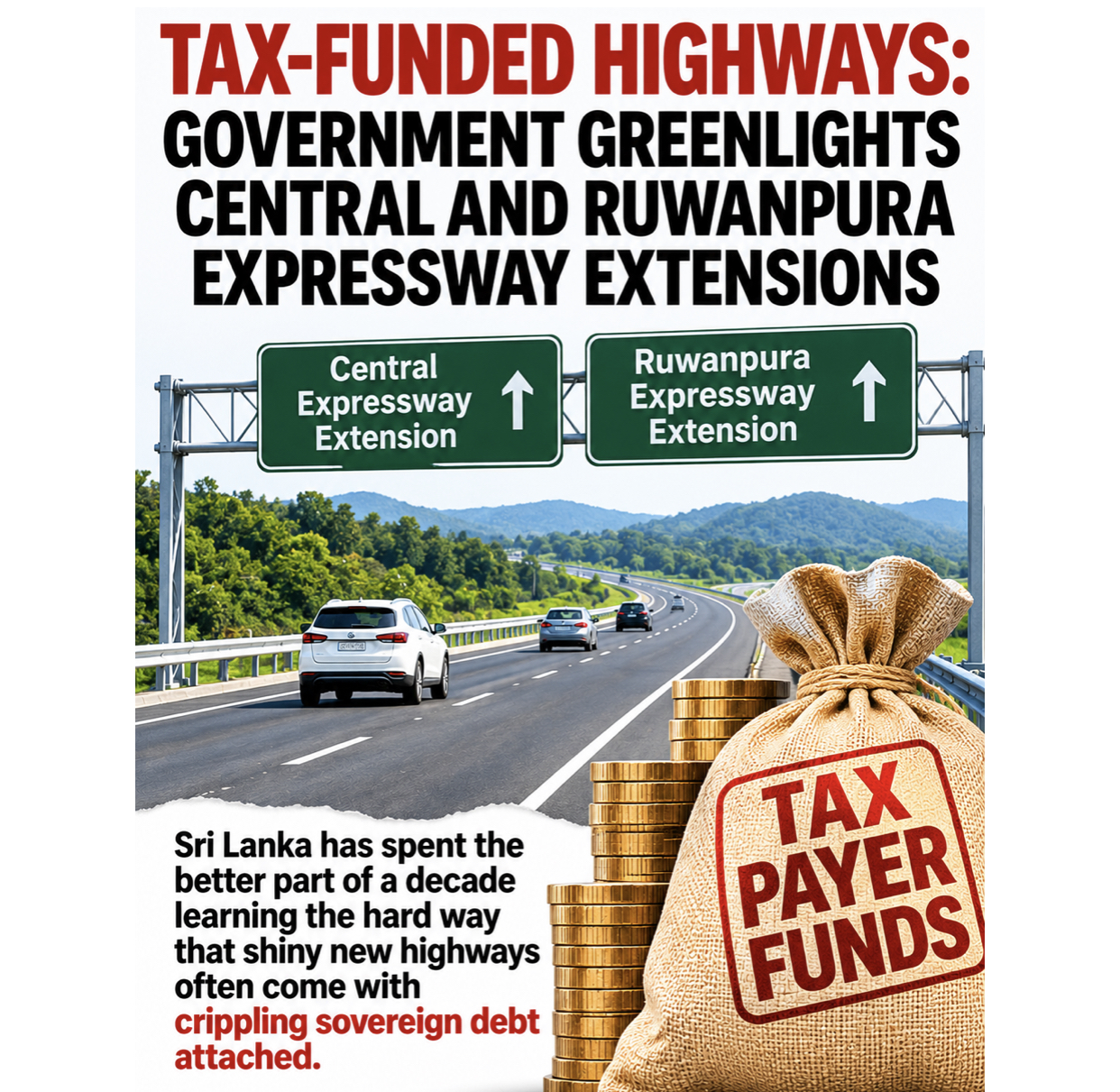
Sri Lanka has spent the better part of a decade learning the hard way that shiny new highways often come with crippling sovereign debt attached. Yesterday, November 17, Transport, Highways and Urban Development Minister Bimal Rathnayake announced that the Cabinet has approved two major expressway projects carrying a combined price tag of Rs. 451 billion, pledging that every rupee will come directly from domestic tax revenue rather than foreign loans.
The green light covers two long-stalled corridors designed to unclog bottlenecks toward the central and Sabaragamuwa provinces. The first is the Kurunegala to Galewela stretch, which forms the initial section of Phase Four of the Central Expressway leading toward Dambulla. The second is the 24-kilometer Kahathuduwa to Ingiriya segment, marking the first phase of the proposed Ruwanpura Expressway intended to link the Southern Expressway with Ratnapura and Pelmadulla.
On paper, funding capital infrastructure through current fiscal receipts rather than external borrowing represents a notable departure from past administrations, which routinely relied on high-interest bilateral loans that ultimately strained the national balance sheet. Initial groundwork is already reflected in the 2027 Budget estimates, with Rs. 30 billion earmarked for the Kurunegala-Galewela stretch and Rs. 27 billion set aside for the Kahathuduwa-Ingiriya phase to get construction rolling.
Submit Your Press Release
Get your company news, announcements, launches, appointments and events in front of a wider audience.


Yet, an ambitious road-building drive financed entirely out of the Treasury pocket carries its own set of economic trade-offs. Committing Rs. 451 billion in tax collections to asphalt and concrete inevitably raises questions about fiscal opportunity costs at a time when public healthcare, education, and cost-of-living relief remain under intense pressure. Furthermore, because the projects rely on annual budgetary allocations rather than a dedicated external credit line, construction timelines will remain strictly tethered to the state’s ability to sustain tax collection targets over the next several years.
Sri Lanka’s recent history is littered with half-built highway pillars, cancelled contracts, and massive cost overruns caused by funding freezes. Avoiding new debt is undoubtedly good news for a country still recovering from sovereign default. Now the government faces the harder test of proving it can actually finish two massive expressways on cash flow alone without letting budgets balloon or public services starve.



