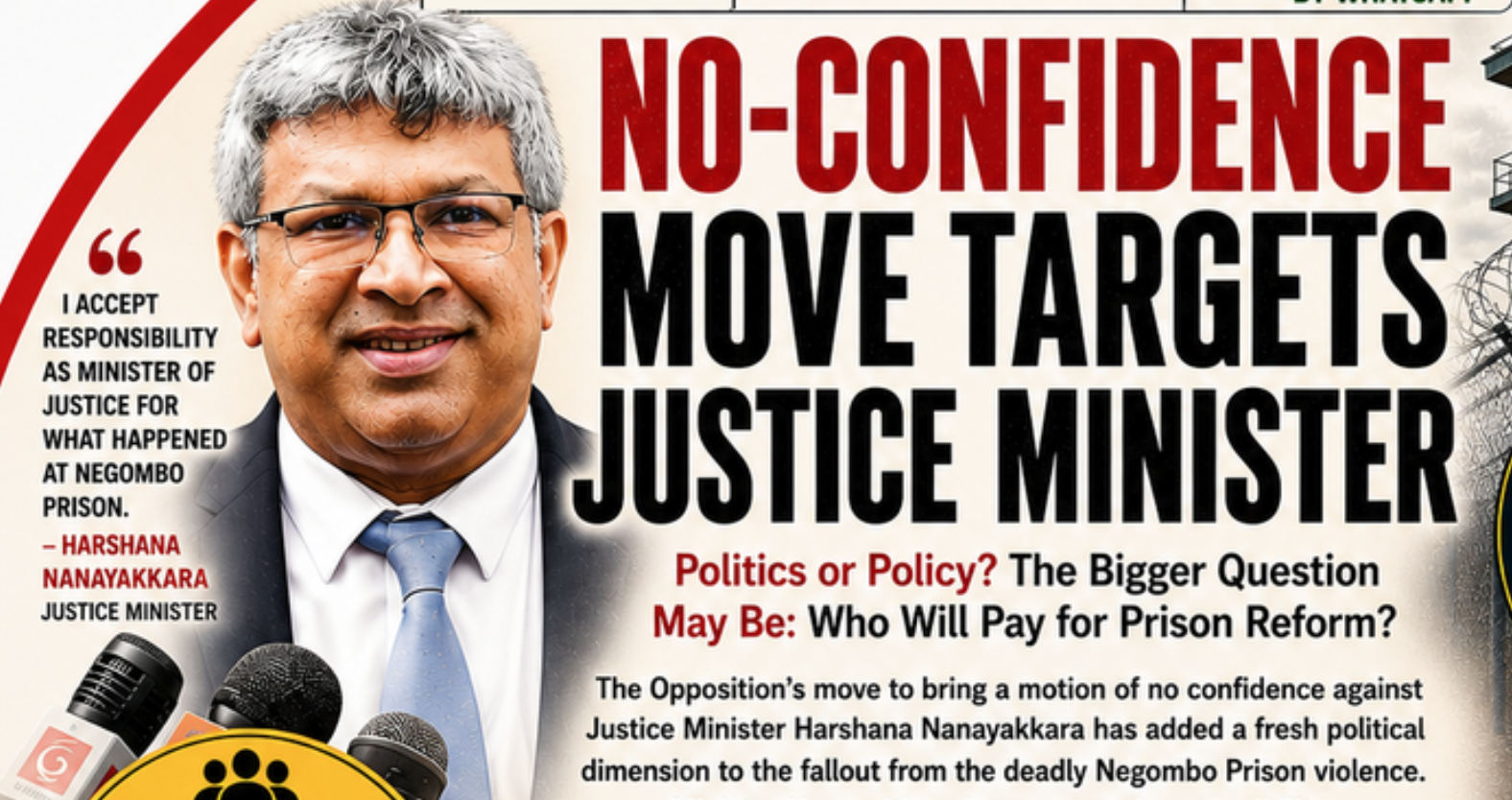
Politics or Policy? The Bigger Question May Be: Who Will Pay for Prison Reform?
The Opposition’s move to bring a motion of no confidence against Justice Minister Harshana Nanayakkara has added a fresh political dimension to the fallout from the deadly Negombo Prison violence.
Yet beyond the inevitable parliamentary confrontation lies a larger question that, surprisingly, has received relatively little attention: if Sri Lanka genuinely intends to reform its prisons, where will the money come from? This question is not being answered by the Opposition which many label as weak and struggling to play its role.
Submit Your Press Release
Get your company news, announcements, launches, appointments and events in front of a wider audience.


The Communist Party too criticised the government but did not provide a solution to the question of where’s the money whilst the flip side quite often is that the government is maintaining stability but not increasing the economic growth – meaning there’s precious little ‘extra’ to fund infrastructure regeneration.
Minister Nanayakkara, who comes from a family long associated with public service, has publicly accepted ministerial responsibility following the deaths of 19 inmates during the violence at Negombo Prison. In doing so, he assumed political accountability for one of the most serious prison disturbances in recent memory, even as investigations continue into the circumstances that led to the tragedy.
Political opponents argue that accepting responsibility is insufficient. They question the pace of reform, point to what they describe as inadequate engagement with correctional institutions across the country and contend that stronger ministerial oversight was required long before the crisis erupted.
Government sources, however, paint a different picture. They maintain that President Anura Kumara Dissanayake’s – inspite of his public silence – confidence in the Minister remains unwavering and that support within senior levels of the National People’s Power administration, including among Cabinet colleagues, remains strong.
According to those sources, the Government intends to press ahead with a broader programme of prison reform rather than allow policy to be dictated by political pressure.
The deaths at Negombo were tragic. Nineteen lives of inmates and seven officers were lost. Families have been left grieving, including the children who must now grow up without fathers. Those realities cannot and should not be minimised. Equally, they expose longstanding weaknesses that have accumulated over decades rather than months – overcrowded prisons, ageing infrastructure, organised criminal influence and limited rehabilitation facilities.
If there is one question Parliament should now be asking, it is not simply whether a minister should remain in office. It is whether Sri Lanka is prepared to finance the reforms that successive governments have acknowledged are necessary.
Expanding prison capacity, recruiting and training correctional officers, strengthening intelligence, improving rehabilitation programmes, modernising security systems and constructing new facilities will require substantial public investment. None of these measures can be delivered through political slogans alone.
As the no-confidence debate gathers momentum, perhaps Members of Parliament should ask one additional question before demanding solutions:
Show us the money.
Without a credible funding strategy, prison reform risks becoming another promise made in the aftermath of tragedy only to fade until the next crisis forces the country to confront the same uncomfortable realities once again.
NEWSLINE SAYS
Accountability matters. So too does honesty. If Sri Lanka wants safer prisons, better rehabilitation and lasting reform, the debate cannot end with who carries the blame. It must also answer who will fund the change. Be that as it may, no prison system can be transformed by resolutions in Parliament alone; it will require sustained political commitment, realistic budgeting and the courage to invest before – not after – the next tragedy.