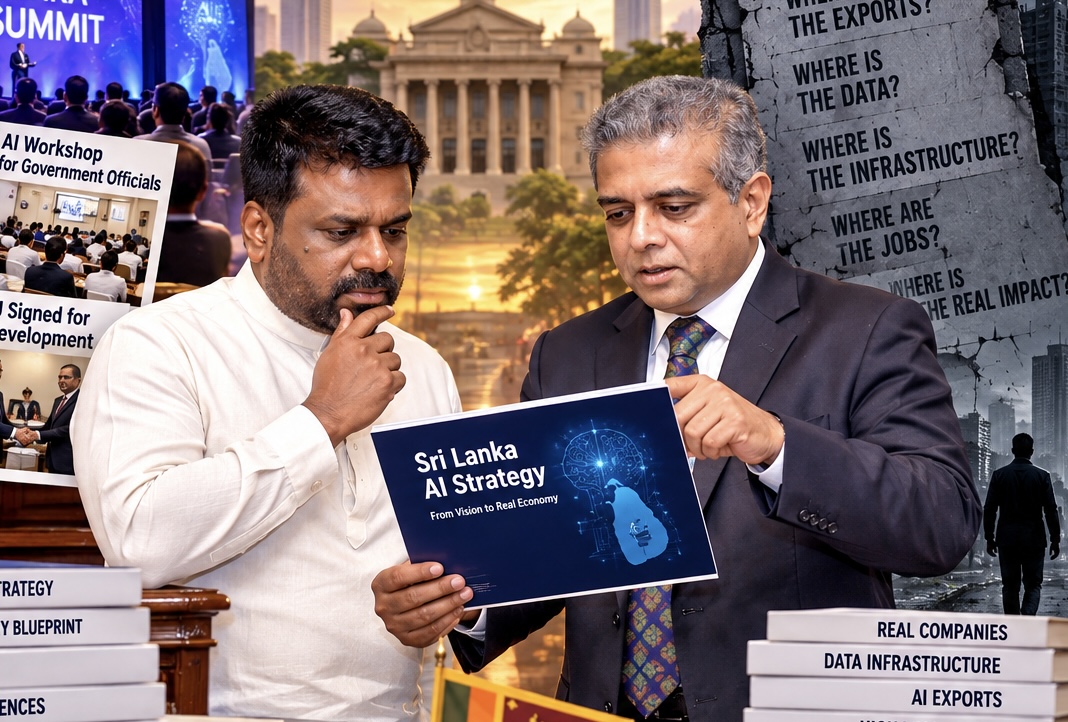
Sri Lanka has strategies, conferences, advisors, AI launches and digital-payment platforms. What it still needs is the harder thing: an economic machine capable of turning data, talent and technology into intellectual property, companies, exports and new national income.
COLOMBO – Sri Lanka may be approaching another one of those moments that future historians will find painfully familiar. A new technology has arrived. The opportunity is enormous. The country has talented people. Government has produced a strategy. Industry is talking enthusiastically about the future. Conferences are being organised. Experts are appearing on panels. Companies are announcing AI initiatives. Politicians are speaking about transformation. And yet, beneath all the excitement, a much more uncomfortable question remains unanswered: Is Sri Lanka actually building an artificial intelligence industry or merely building the appearance of one?
The distinction is not academic. It could determine whether artificial intelligence becomes one of Sri Lanka’s most important opportunities to generate foreign exchange, productivity, intellectual property and high-value employment, or whether AI becomes another technology revolution that Sri Lanka watches, discusses and eventually imports. Sri Lanka’s National AI Strategy itself describes the country as being at a pivotal juncture and seeks to establish Sri Lanka as a regional hub for AI development, testing, deployment and scaling. The strategy identifies infrastructure, data, talent, governance, innovation and adoption as fundamental pillars. The policy direction is therefore not the problem. The question is whether Sri Lanka possesses the execution machinery to turn that ambition into an industry.
Sri Lanka has a particular weakness when it comes to emerging technologies: the country is often very good at creating the language of transformation before creating the economic foundations that make transformation possible. Artificial intelligence is now producing an unusually large amount of this language. There are AI summits, AI forums, AI workshops, AI awards, AI panels and AI strategy discussions. There are people whose professional profiles increasingly revolve around explaining artificial intelligence. There are consultants explaining how businesses can use ChatGPT, executives talking about AI transformation and entrepreneurs announcing AI products. There is nothing inherently wrong with any of this. Awareness matters. Education matters. Adoption matters. But awareness is not an industry, and knowing how to use ChatGPT is not the same thing as knowing how to build an AI economy.
Submit Your Press Release
Get your company news, announcements, launches, appointments and events in front of a wider audience.


The country is therefore in danger of confusing AI literacy with AI capability. Teaching thousands of people how to prompt an existing global model can improve productivity, but it does not automatically create intellectual property, export revenue or a domestic AI industry. The economic question is much harder. Where are the proprietary datasets? Where are the AI infrastructure companies? Where are the research laboratories? Where are the Sinhala and Tamil language technologies operating at scale? Where are the specialised AI models? Where are the companies selling AI products internationally? Where are the Sri Lankan AI companies attracting serious global capital? Where are the companies generating tens or hundreds of millions of dollars in foreign exchange?
Those questions matter because the global AI race is not being won through seminars. It is being won through computing infrastructure, data, research, capital, engineering talent, intellectual property and distribution. The United States and China are investing at extraordinary scale. India is attempting to combine its enormous technology workforce with domestic AI infrastructure. Gulf economies are deploying sovereign capital into data centres and AI. Singapore is positioning itself as a regional technology and AI hub. The competition is not theoretical anymore. The infrastructure of the AI economy is being built now.
Sri Lanka, meanwhile, risks developing what could eventually be called an AI conference economy. Every technology boom creates an ecosystem around it: conferences, sponsors, consultants, speakers, awards, panels, networking events, government representatives and corporate publicity. Again, none of this is necessarily negative. The problem begins when the activity itself becomes mistaken for economic development. The real question should be what happens after the conference. Was a company funded? Was a government dataset released? Was a foreign contract signed? Was a new product commercialised? Was computing infrastructure created? Was intellectual property generated? Did a university laboratory receive resources? Did a startup obtain its first international customer? Did the event produce anything that remains after the banners have been removed?
Sri Lanka has seen this pattern before. The country developed an impressive IT and BPM industry and demonstrated that Sri Lankan engineers could compete internationally. MillenniumIT was perhaps the most powerful demonstration. The company developed capital-market technology that attracted the attention of the London Stock Exchange, which acquired MillenniumIT in 2009. Its technology subsequently became part of the global exchange group’s infrastructure. That was not a theoretical success. Sri Lankan engineers had demonstrated that sophisticated global technology could be developed from Sri Lanka. Yet the country did not subsequently produce an ecosystem containing dozens of companies of comparable global scale.
That is one of the great lessons Sri Lanka should carry into the AI era. The problem was never necessarily the absence of talent. Sri Lanka has repeatedly demonstrated that its people can build technically sophisticated products. The problem has been converting individual successes into a continuously compounding technology industry. Sri Lanka has often created islands of excellence rather than an industrial ecosystem around those islands.
The same issue can be seen in the country’s long-running technology-export ambitions. Sri Lanka has been discussing multi-billion-dollar ICT export targets for years. Earlier ambitions targeted US$5 billion in ICT exports within much shorter timeframes, while current policy continues to target US$5 billion in digital exports by 2030. The Export Development Board estimated ICT/BPM export earnings at approximately US$1.64 billion in 2025. Ambitious targets are useful, but they also provide a reminder that announcing an economic ambition and building the machinery to achieve it are two very different things.
This is where Sri Lanka’s AI strategy needs to become much more aggressive. The country should stop thinking primarily about becoming a consumer of AI and start thinking about where it can own part of the AI value chain.
Sri Lanka does not need to build the next OpenAI from scratch. That would be an extraordinarily expensive undertaking and is unlikely to be the most rational use of national resources. Sri Lanka can instead build around the assets it actually possesses. One of the most important is data.
Sri Lanka has enormous quantities of potentially valuable local information. Court judgments, legislation, gazettes, parliamentary documents, tax information, company records, land information, agricultural data, education data, tourism information, economic statistics, government records and multilingual content represent potential raw material for specialised artificial intelligence. Sinhala and Tamil are particularly important because local-language data is difficult to reproduce outside the country.
This could create an important opportunity. Sri Lanka could become exceptionally good at building domain-specific AI around its own information environment. Legal intelligence, tax intelligence, corporate intelligence, agricultural intelligence, education technology, government AI, tourism intelligence, financial intelligence and multilingual AI are all areas where local knowledge can provide a competitive advantage.
The country’s own AI strategy recognises the importance of data. The policy framework calls for stronger data governance, machine-readable government datasets, data-sharing mechanisms and infrastructure capable of enabling innovation. That should not be treated as a secondary government digitisation project. It should be treated as industrial infrastructure.
Government data could become the raw material from which an entirely new generation of Sri Lankan technology companies is built.
Imagine a government that made properly governed datasets available through standard APIs and created transparent mechanisms through which startups could develop commercial applications. A Sri Lankan company could build legal intelligence and sell it internationally. Another could develop agricultural forecasting. Another could build tax-compliance technology. Another could create multilingual AI systems. Another could develop corporate intelligence. Another could build disaster-management technology. Another could develop AI for tourism.
Government would not need to build every company. It would need to create the infrastructure and procurement environment that allows companies to emerge.
That is the difference between government digitisation and an AI economy.
This distinction becomes particularly important when Sri Lanka talks about digital payments and platforms such as GovPay. GovPay is an important step in modernising public administration and making government payments more convenient. But the country needs to be careful about how it measures digital economic progress. If a citizen previously paid a government fine at a post office and now pays the same fine through a digital platform, the transaction has become more efficient. That is valuable. But the country has not necessarily created new economic activity. The government was already collecting the revenue.
Sri Lanka should therefore stop treating the movement of existing transactions from physical channels to digital channels as sufficient evidence of digital economic transformation. The harder question is whether digitalisation is generating new economic value.
Is it creating new companies? Is it generating new exports? Is it creating intellectual property? Is it attracting foreign investment? Is it creating high-value jobs? Is it increasing productivity? Is it reducing government expenditure? Is it creating new tax revenue from economic activity that previously did not exist?
If the answer is no, Sri Lanka may have digitised the existing economy without actually building a new digital economy.
The same principle should apply to AI.
A chatbot placed on a government website is not automatically an AI industry. A company adding an AI button to an existing application is not necessarily an AI company. A startup integrating a foreign API is not automatically developing proprietary AI technology. A press release announcing an AI product does not demonstrate commercial traction.
The country needs to become much more sophisticated in distinguishing between AI adoption, AI integration and AI creation.
There is also a deeper problem within the startup ecosystem. Sri Lanka needs entrepreneurs, but it also needs capital capable of supporting companies long enough to become significant businesses. AI is not necessarily a cheap software experiment. Serious AI companies require computing, specialised engineers, data, research, product development, cybersecurity and international sales. These require money.
Sri Lanka’s startup ecosystem has made progress, but the scale of available capital remains small compared with the requirements of an international AI industry. The country cannot realistically expect to create global AI companies if founders are continually forced to spend their time looking for small grants, competition prizes and short-term funding.
There is an even more uncomfortable phenomenon: the celebration of the export of founders rather than the export of products.
Internationalisation is essential. Sri Lankan companies must become global. Founders must be able to raise international capital and establish operations wherever commercial reality requires. But Sri Lanka should ask what economic value remains inside the country when a successful startup moves its headquarters, intellectual property, capital and senior talent overseas.
If the founder leaves, the headquarters leaves, the intellectual property leaves, the high-value employment leaves and the tax base leaves, Sri Lanka may have produced a successful entrepreneur without producing a successful Sri Lankan technology company.
That distinction is critical.
The objective should not be to prevent founders from going global. The objective should be to make Sri Lanka strong enough that going global does not require abandoning the country.
This requires a different government role.
The Government should become an anchor customer for Sri Lankan technology, rather than simply an organiser of technology events. Sri Lanka has thousands of genuine problems that could become commercial AI opportunities: tax leakage, customs risk, agriculture, health, education, court administration, public procurement, fraud detection, disaster management, energy forecasting, transportation, tourism and government services.
Instead of paying large amounts for imported technology solutions whenever possible, government could create competitive procurement programmes through which qualified Sri Lankan AI companies solve defined national problems. The successful systems could then be exported to countries facing similar problems.

Sri Lanka could effectively use its own public sector as an AI laboratory.
That is how national technology ecosystems have historically developed: not through speeches alone, but through demanding customers, difficult problems and companies capable of solving them.
The regulatory environment is equally important. Sri Lanka needs strong privacy, cybersecurity and responsible-AI rules. The Personal Data Protection Act provides an important foundation, and the country has continued developing its digital regulatory framework. But regulation must not become another barrier that only large foreign technology companies can afford to navigate.
A small Sri Lankan AI company should be able to understand the rules, access legitimate datasets, test products, raise capital and sell internationally without being buried under regulatory uncertainty.
At the same time, government must answer increasingly important questions about public data. Who owns government-generated data? Under what circumstances can anonymised datasets be used commercially? Can government data be accessed through APIs? How can startups lawfully train systems on public information? How should government procure AI? Who is responsible when an automated system makes a consequential error?
These are not merely legal questions. They are industrial-policy questions.
The proposed evolution of Sri Lanka’s digital institutional architecture therefore matters enormously. Government has been moving toward a stronger GovTech and Digital Economy Authority framework, while the country’s digital strategy has set ambitious objectives around digital exports and the size of the digital economy. But institutional reform will only matter if it changes what companies can actually build.
Sri Lanka has limited public resources. That makes prioritisation essential.
If public money is allocated to AI, the Government should demand measurable economic outcomes. A programme should not be considered successful because it trained 20,000 people. It should be judged by whether those people subsequently generated productivity, businesses, exports or intellectual property.
A programme should not be celebrated because it held 50 workshops. It should be celebrated because companies were created.
A government AI programme should not be judged by how many officials attended an event. It should be judged by how much time, money and productivity it saved.
A national AI programme should not be judged by how many press releases were issued. It should be judged by how much foreign exchange was generated.
This is where Sri Lanka’s current AI conversation needs to become considerably more uncomfortable.
There is a growing class of people whose professional identity is increasingly connected to being an AI visionary. There are people talking about the future of artificial intelligence without necessarily demonstrating that they understand the industrial foundations required to build it. There are people whose principal AI contribution appears to be explaining how businesses should use existing global AI tools. There are companies announcing products that may have limited proprietary technology behind them. There are organisations competing to occupy the centre of the national AI conversation.
The answer is not to attack individuals.
The answer is to change the standard by which the ecosystem measures success.
Sri Lanka should stop asking who speaks most convincingly about AI and start asking who builds.
Who owns the data?
Who owns the model?
Who owns the intellectual property?
Who has paying customers?
Who exports?
Who employs engineers?
Who has survived three years?
Who has raised serious capital?
Who has built infrastructure?
Who has created measurable productivity?
Who has created new national income?
Those questions would immediately change the character of the industry.
The country’s AI ecosystem also needs to be protected from political theatre. Artificial intelligence should not become another area where political leaders seek visibility through events while the underlying economic architecture remains weak. Politicians naturally want achievements they can announce. Events produce photographs. Launches produce headlines. Digital platforms produce transaction numbers. But AI development is measured in years, not ceremonies.
The political incentive is therefore almost the opposite of what the country needs.
A minister can receive immediate recognition for launching a platform.
A politician can receive attention for announcing a national AI programme.
But building a globally competitive AI company may take five or ten years and may produce little political visibility in the first three years.
That is precisely why Sri Lanka needs institutions that can operate beyond electoral cycles.
The country has already paid a high price for failing to compound opportunities. Sri Lanka’s early advantages in technology, education, telecommunications and software services created the foundations for a much larger industry, but the country did not turn those foundations into an ecosystem on the scale of India’s technology sector. The country developed successful individual technology companies but did not produce enough of them. It produced talented engineers but also encouraged significant outward migration. It developed government digital infrastructure but did not fully transform public data into an innovation economy.
AI represents another chance.
And this time the window may be considerably shorter.
The global AI industry is moving at a speed that makes conventional government timelines dangerous. A five-year delay is not a small delay in AI. It can represent several generations of technology, capital accumulation and ecosystem development.
Sri Lanka therefore does not need another document telling it that AI is important.
It needs an AI industrial machine.
That machine needs data at its foundation, infrastructure underneath it, researchers and engineers inside it, startups and established companies building on top of it, government as an intelligent customer, universities feeding research into industry, investors supplying growth capital and exports providing the ultimate test of competitiveness.
Most importantly, the country needs a completely different scoreboard.
The question should no longer be how many AI conferences Sri Lanka has held.
It should be how much AI export revenue Sri Lankan companies generated.
How much private capital was invested.
How many global customers were acquired.
How many proprietary datasets were created.
How many AI companies survived.
How many high-value jobs were created.
How much intellectual property was retained in Sri Lanka.
How much government productivity improved.
How much new tax revenue was generated.
How many Sinhala and Tamil AI technologies became commercially successful.
And ultimately, how many globally significant technology companies emerged from Sri Lanka.
That is the scoreboard that matters.
Sri Lanka does not need to win the global AI race. It does not need to outspend America, China or the Gulf. It does not need to build a frontier model that competes head-on with the world’s largest technology companies.
It needs to find the parts of the AI value chain where Sri Lanka can become exceptionally good — and then build companies around those advantages.
The opportunity is enormous.
But so is the danger.
The country could spend the next five years discussing AI while other countries build the infrastructure. It could produce hundreds of AI experts who teach businesses to use foreign models while foreign companies capture the economic value. It could digitise government services while leaving the underlying data economically underutilised. It could launch AI products that disappear after their press conference. It could hold increasingly sophisticated conferences while the number of globally competitive AI companies remains unchanged.
And then, five years from now, Sri Lanka could once again announce that it is preparing to become a regional technology hub.
That would be the real failure.
The problem is not that Sri Lanka lacks intelligent people. It does not lack entrepreneurs. It does not lack engineers. It does not lack ideas. It does not even lack strategies.
Sri Lanka’s problem is that it has repeatedly struggled to convert capability into scale.
Artificial intelligence will expose that weakness mercilessly.
The country now has a choice.
It can build an ecosystem in which data becomes infrastructure, infrastructure becomes products, products become companies, companies become exporters and exporters become national wealth.
Or it can build an ecosystem in which strategies become conferences, conferences become photographs, photographs become press releases and press releases become another record of an opportunity that was once available.
The global AI revolution is not waiting for Sri Lanka.
The technology is already being built. The capital is already moving. The infrastructure is already being deployed. The companies are already being valued in billions. The markets are already forming.
Sri Lanka’s question is therefore no longer whether it should participate in AI.
The question is whether it will participate as an owner, builder and exporter — or remain a consumer, spectator and conference audience.
Sri Lanka has missed technological opportunities before.
It should not allow artificial intelligence to become another one.
Because the greatest AI risk facing Sri Lanka is not that AI will leave the country behind.
It is that Sri Lanka will spend so much time talking about the AI future that somebody else builds it first.