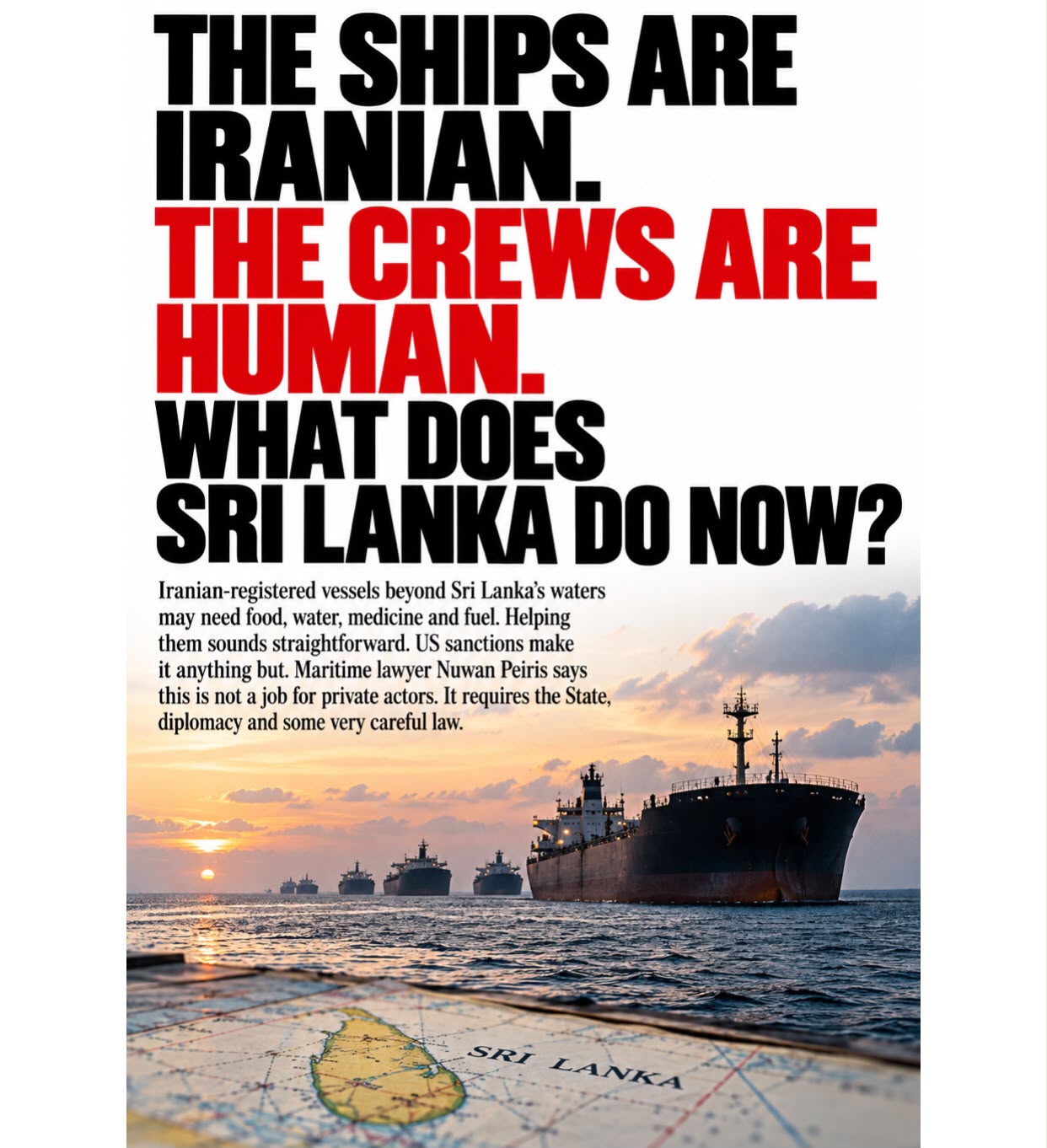
Iranian-registered vessels sitting beyond Sri Lanka’s waters may need food, water, medicine and fuel. Helping them sounds straightforward. US sanctions make it anything but straightforward. Maritime lawyer Nuwan Peiris says this is not a job for private Sri Lankans acting alone. It requires the State, diplomacy and some very careful law.
Sri Lanka has spent centuries looking out at the Indian Ocean. Occasionally the Indian Ocean looks back and presents us with a problem.
Reports that between 15 and 19 Iranian-registered vessels, primarily oil tankers, are lying in international waters beyond Sri Lanka’s Exclusive Economic Zone present precisely such a problem. If their crews are genuinely running short of fresh water, medicine, food or other necessities, the humanitarian instinct is obvious.
Submit Your Press Release
Get your company news, announcements, launches, appointments and events in front of a wider audience.


Send them what they need. Unfortunately, international politics is rarely that simple.
Iran is subject to extensive unilateral sanctions imposed by the United States, including measures directed at its petroleum and shipping sectors. That means a Sri Lankan company or individual contemplating supplying an Iranian-linked vessel must consider something beyond the humanitarian merits of the transaction.
What happens to them afterwards?
Attorney-at-Law and maritime law specialist Nuwan Peiris, speaking to NEWSLINE, was distinctly uncomfortable with the idea of private Sri Lankan citizens or businesses simply loading supplies onto a vessel and heading out to help.
“I don’t think the individual should venture out and give any humanitarian support the way I see it at this moment,” Peiris said, warning that those involved could expose themselves to secondary sanctions.
That distinction matters.
There is a considerable difference between saying that distressed seafarers should receive humanitarian assistance and saying that any private person is legally and commercially safe to provide it.
A Sri Lankan businessman may regard a consignment of drinking water and medicine as an act of humanity. A sanctions authority examining the identity, ownership, cargo or commercial activity of the receiving vessel may have rather more questions.
That is why Peiris believes the matter should be handled at State level.
“Sri Lanka is a neutral state,” he told NEWSLINE, arguing that humanitarian assistance to civilian merchant vessels need not, by itself, amount to taking sides in an international conflict.
But neutrality is not a magic word.
The identity of each vessel matters. Its ownership matters. Its cargo matters. Whether it has itself been specifically designated under sanctions matters. The nature of the assistance matters. Who supplies it, who pays for it and how any transaction is processed may matter as well.
Before Sri Lanka sends so much as a bottle of water, therefore, it should know exactly whom it is helping and under what legal framework.
That requires the Government, not an enthusiastic private flotilla.
Peiris believes Sri Lanka should consider an officially supervised humanitarian mechanism, with appropriate international visibility and monitoring. Regional states could be consulted, while international maritime institutions could provide another avenue through which the problem is addressed transparently.
There is considerable sense in that approach.
If this is genuinely a humanitarian emergency involving civilian seafarers, Sri Lanka should not have to choose casually between allowing human beings to suffer offshore and exposing its citizens or businesses unnecessarily to sanctions consequences.
Diplomacy exists precisely because some problems cannot safely be solved by simply doing what appears morally obvious.
Peiris suggested engagement with countries including India, Pakistan and the Maldives, together with international maritime institutions. He also emphasised quieter diplomacy behind the scenes.
“What you need is a big strategy and some sharpness,” he said. “A multifaceted diplomatic strategy would certainly put even the Government of Sri Lanka on track.”
That may be the most important point of all.
Sri Lanka does not need to make a geopolitical declaration simply because sailors may need drinking water. Nor should humanitarian assistance become an accidental mechanism for facilitating sanctioned commercial activity.
The two issues can and must be separated.
First establish the facts.
How many vessels are actually there? Which vessels are they? Who owns and operates them? Are any individually sanctioned? What cargoes are aboard? What precisely do their crews require? Have formal distress or assistance requests been made? And through whom?
Then establish what humanitarian assistance can lawfully and safely be provided.
If necessary, Sri Lanka can communicate with the relevant governments and international institutions before acting. It can make clear that any assistance is humanitarian, transparent and confined to the welfare and safety of civilian crews.
That is considerably safer than leaving individual Sri Lankan companies to discover the boundaries of American sanctions policy after they have crossed them.
There is also a principle here worth defending.
Sanctions are directed at states, entities, commercial networks and individuals. Sailors aboard merchant vessels remain human beings. Their need for drinking water or urgent medicine does not disappear because of the flag flying above them or the government sitting thousands of kilometres away.
But compassion without legal preparation can create another problem rather than solve the first one.
Sri Lanka therefore needs neither bravado nor paralysis. It needs verification, law and diplomacy.
If there are seafarers sitting beyond our waters without adequate food, water or medicine, their circumstances deserve attention. If sanctions make assistance complicated, then the Government must establish how assistance can be delivered without exposing Sri Lankan citizens and businesses unnecessarily.
That is what governments are for.
Be that as it may, the ships may be Iranian, the sanctions may be American and the waters may be international. The people aboard them are still people. Sri Lanka’s challenge is to remember that without forgetting the law.