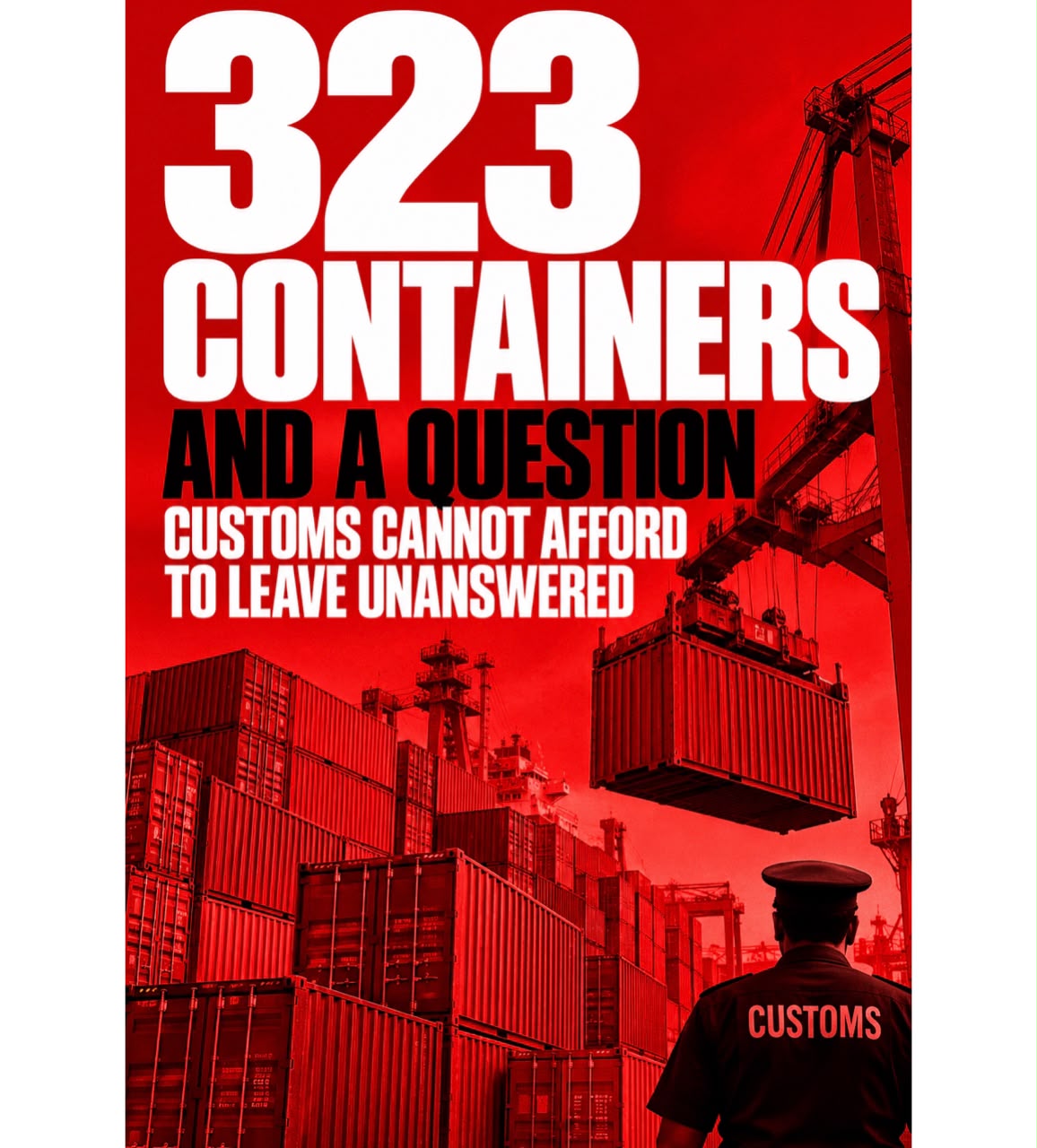
Parliament’s investigation into the release of 323 containers has been given additional time. The controversy is not simply about whether cargo was physically inspected. It concerns the integrity of Customs procedures, the protection of public revenue and the public’s confidence that the rules apply equally to everyone.
Sri Lanka Customs occupies an exceptionally important position in the national economy. The department is responsible for collecting substantial public revenue, enforcing import regulations and preventing prohibited or improperly declared goods from entering the country. Its decisions affect government finances, commercial competition and the confidence of businesses operating within the law.
Against that background, the controversy surrounding the release of 323 containers without proper inspection deserves rigorous examination. The Parliamentary Select Committee investigating the matter has been granted additional time to complete its work, extending the process until December 21. That extension should provide an opportunity to establish precisely what occurred, who authorised the relevant procedures and whether established safeguards were followed.
Submit Your Press Release
Get your company news, announcements, launches, appointments and events in front of a wider audience.


It would be irresponsible to conclude that the release of the containers necessarily involved criminal conduct or revenue losses. Modern Customs administrations routinely employ risk-based clearance systems under which consignments assessed as presenting limited risk may be released without comprehensive physical examination. Such arrangements are necessary for efficient international trade and the timely movement of goods.
The central issue is therefore not whether every container should always be opened. It is whether the decisions concerning these particular consignments complied with established procedures and whether the relevant authorisations were properly documented. If exceptions were made, the public is entitled to know the legal and administrative basis upon which those exceptions were permitted.
The investigation should examine the applicable risk assessments, release instructions and records of any departures from ordinary clearance procedures. It should also establish whether the consignments were associated with particular importers, whether unusual patterns existed and whether any public officials intervened in decisions that should ordinarily have been determined through established administrative processes.
These questions are particularly important because Sri Lanka Customs has reported exceptionally strong revenue performance during 2026. The department exceeded its annual revenue target ahead of schedule, collecting more than Rs. 2.2 trillion. That achievement deserves recognition, but strong aggregate revenue collection does not automatically establish that every aspect of Customs administration is functioning effectively.
A department may collect substantial revenue while still experiencing weaknesses in valuation, enforcement or internal controls. Conversely, an individual clearance decision that attracts public controversy may ultimately prove to have been entirely lawful. The purpose of a credible investigation is to distinguish evidence from suspicion and establish conclusions that can withstand independent scrutiny.
There is also a broader question concerning the relationship between Customs administration and legitimate business. Importers who comply with the law have a right to expect that competitors will not receive improper advantages through preferential treatment. Where such advantages occur, the consequences extend beyond possible revenue losses to the distortion of commercial competition.
Sri Lanka’s economic circumstances make the protection of public revenue especially important. Citizens and businesses have been required to accept substantial taxation as part of the country’s financial recovery. They are therefore entitled to expect that government institutions will exercise equal diligence in preventing avoidable revenue leakage and ensuring that all commercial operators meet their lawful obligations. The Parliamentary Select Committee must resist the temptation to produce a report consisting primarily of procedural descriptions and general recommendations. Its findings should identify the decisions examined, the evidence considered and the applicable legal framework Where wrongdoing is established, responsibility must be determined through appropriate legal processes.
Equally, if the investigation establishes that the releases complied with the law, that conclusion should be supported by sufficient documentary evidence to restore public confidence. The purpose of parliamentary scrutiny should not be to manufacture guilt but to establish the truth. Neither political convenience nor public pressure should determine the outcome.
The government has repeatedly placed accountability at the centre of its political identity. This investigation provides an opportunity to demonstrate that accountability is not confined to high-profile political prosecutions but extends to the ordinary administration of public institutions. Effective governance requires consistent standards, transparent procedures and a willingness to acknowledge deficiencies wherever they arise.
Be that as it may, the public is entitled to more than an assurance that the matter has been investigated. It deserves to know whether the system worked, whether the rules were followed and whether anyone received treatment unavailable to others. The credibility of Customs cannot be protected by silence. It must be protected by evidence.