
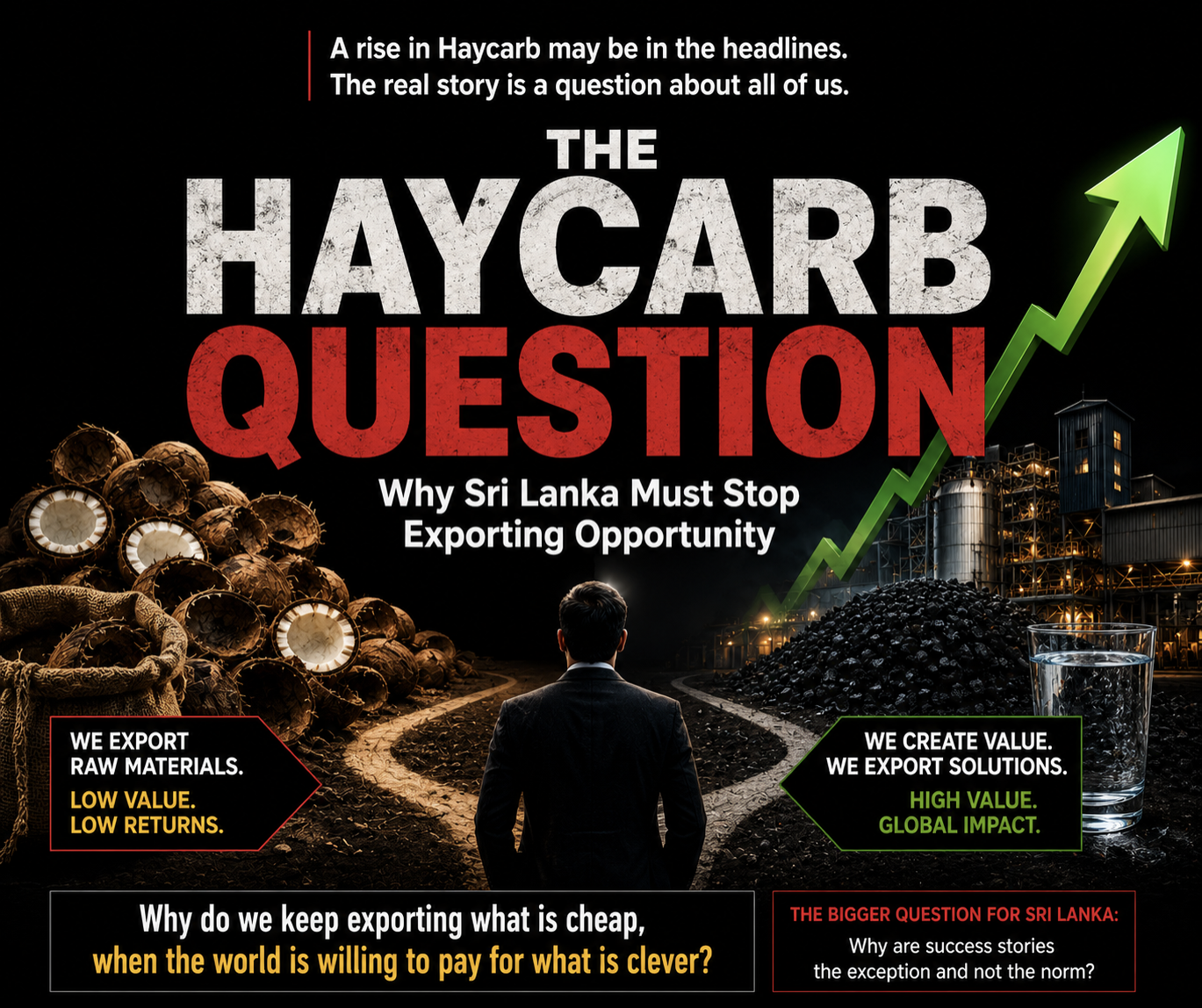
Why Sri Lanka Must Stop Exporting Opportunity
There are moments when a single company, a single investment or even a single movement in the stock market tells us something much larger about the direction of a country’s economy. This week, Haycarb appears to be one such example. Not because its share price has risen, but because it reminds us of a question Sri Lanka has been asking itself for decades without ever fully answering it.
Why do we continue to export so much value instead of creating it ourselves?
For generations Sri Lanka has been blessed with natural resources that many countries would envy. We produce tea admired across the world. Our cinnamon is regarded among the finest available. We possess graphite of exceptional quality, natural rubber, coconut, mineral sands and an educated workforce capable of remarkable innovation. Yet despite these advantages, the country has too often remained content to export raw materials while purchasing back finished products at many times their original value.
It is an economic paradox that has stubbornly survived successive governments, economic plans and political slogans.
The country’s debate, meanwhile, has increasingly centred on taxation. Every budget discussion eventually returns to the same familiar questions. How can revenue be increased? Which taxes should rise? How can compliance improve? These are legitimate questions. Following the financial collapse of 2022, restoring fiscal discipline became unavoidable and few would seriously dispute that government finances required urgent repair.
But taxation, by itself, has never made a nation prosperous.
Governments can redistribute wealth. They can borrow against future wealth. They can tax existing wealth. Yet none of those actions actually creates new wealth. That responsibility falls upon entrepreneurs, manufacturers, innovators and exporters capable of producing goods and services that the rest of the world is willing to buy.
This is where the Haycarb story becomes relevant not because it is unique, but because it illustrates what value addition looks like in practice.
Instead of exporting coconut shells, the company manufactures specialised activated carbon used in industries ranging from water purification and pharmaceuticals to environmental engineering and advanced industrial applications.
The raw material itself is not especially valuable. The knowledge, engineering, research, manufacturing capability and global customer relationships are.
That distinction matters.
The largest profits in modern economies rarely arise from extracting natural resources alone. They arise from transforming those resources into sophisticated products that command higher prices and build long-term competitive advantages. It is the difference between exporting logs and exporting furniture, exporting cocoa beans and exporting premium chocolate, or exporting crude oil and exporting advanced petrochemicals.
Sri Lanka has demonstrated repeatedly that it possesses the technical capability to compete internationally when businesses are encouraged to innovate. The question is why these success stories remain the exception rather than becoming the norm.
Imagine an economy where Sri Lankan graphite became battery components instead of simply a mineral export. Where rubber evolved into advanced medical products. Where cinnamon supplied pharmaceutical manufacturers rather than merely supermarket shelves. Where agricultural products increasingly became branded consumer goods carrying Sri Lankan intellectual property rather than anonymous commodities shipped abroad.
Such an economy would look very different from the one we know today.
Export earnings would be higher. Salaries would improve. Skilled graduates would find greater opportunities at home. Government revenues would rise naturally as businesses expanded, rather than through repeated increases in taxation.
This is perhaps the conversation Sri Lanka should now be having.
The challenge before policymakers is no longer simply balancing the budget. It is creating an environment where innovation, manufacturing and investment become the country’s defining characteristics rather than isolated achievements.
Companies will rise and fall. Share prices will fluctuate. Markets will always have their cycles.
The larger lesson is that Sri Lanka cannot tax its way to prosperity. It must build its way there.
If one company’s recent performance prompts that national conversation, then the real story has very little to do with the company itself.
It has everything to do with the country.
Be that as it may.


