
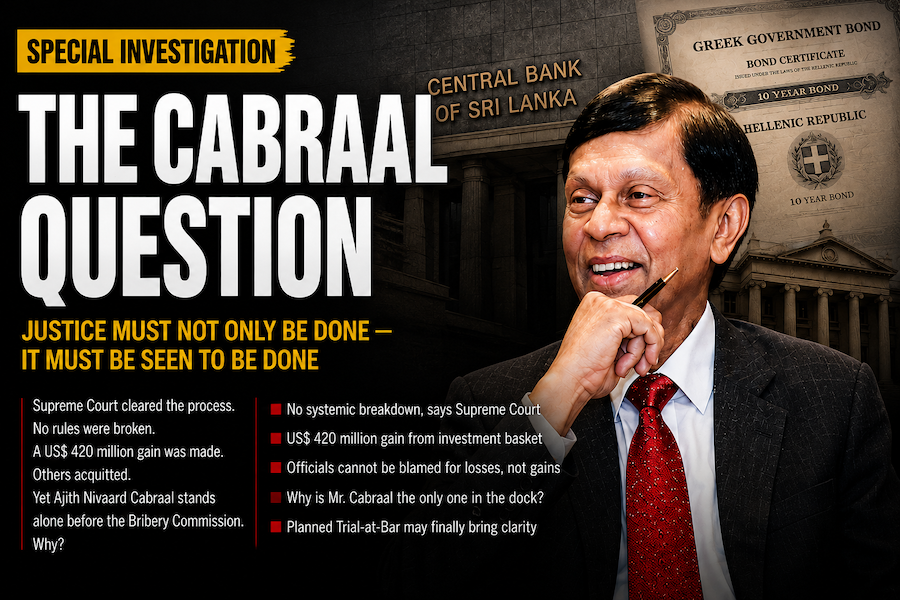
JUSTICE MUST NOT ONLY BE DONE – IT MUST BE SEEN TO BE DONE
Among the many accountability cases now moving through Sri Lanka’s legal system, few have generated as much debate among financial and legal observers as the proceedings involving former Central Bank Governor Ajith Nivard Cabraal.
The reason is not difficult to understand.
Unlike many corruption investigations that revolve around allegations of personal enrichment, the controversy surrounding the Greek Bonds investment has long centred upon a question of judgment, investment policy and decision-making within the Central Bank.
Supporters of Mr Cabraal point to a number of facts that have entered the public domain over the years. They note that the Supreme Court previously examined matters connected to the Greek Bonds investment and concluded that there had been no breach of applicable procedures by the Governor, the Monetary Board or the responsible officials of the Central Bank.
They further point to findings that there had been no systemic breakdown in the investment process and that the relevant rules and procedures had been followed.
Equally significant is the argument frequently advanced by those defending the former Governor that the wider investment portfolio managed during that period reportedly generated realised gains running into hundreds of millions of US dollars.
If officials are not personally credited for successful investment decisions, they ask, on what basis should they alone be held personally responsible for losses arising from investments made within an approved framework?
These questions deserve careful consideration.
At the same time, it is equally true that the Bribery Commission is entitled to bring proceedings where it believes evidence exists to support a prosecution. That is the function of an independent investigative and prosecutorial process.
The mere existence of a prosecution is not proof of guilt, just as a defence is not proof of innocence.
What concerns many observers is not that the case is proceeding before the courts. It is whether the public can clearly see the basis upon which responsibility is being assigned.
The issue becomes particularly sensitive when other individuals connected with the broader decision-making framework have reportedly been acquitted or otherwise fallen out of the legal spotlight, while Mr Cabraal finds himself standing alone before the courts.
The ordinary citizen is entitled to ask a simple question.
If the investment decision was taken collectively within a framework approved by the Central Bank’s governance structure, why does accountability now appear concentrated upon a single individual?
That question may ultimately have a perfectly satisfactory legal answer.
The public, however, has yet to hear it articulated clearly.
There is also a broader issue at stake. Financial markets operate on risk. Every investment carries the possibility of profit and loss. If public officials who act within established procedures face personal criminal exposure whenever markets move adversely, future decision-makers may become reluctant to exercise judgment at all.
“In April 2011, when the CBSL purchased Greece Government Bonds, Greece’s Credit Rating by Fitch Rating Agency was BB+, which is three rating notches higher than Sri Lanka’s present credit rating of B+ (Negative). Thereafter, on 20th May 2011, Fitch downgraded Greece to B+ (Negative), which is the same rating as that of Sri Lanka at present. About seven weeks later, on 13 July 2011, Fitch downgraded Greece further to CCC when Greece was on the verge of default.
Therefore, if it is now contended (in hindsight, of course) that Greece Government Bonds were not a viable option to invest in April 2011, it logically follows that Sri Lankan Government Bonds, at the present time, will be a worse investment option, as per the International Rating Agencies’ ratings. If a contention is made by a person in authority to that effect, it will be noted that such assertion could also place the Sri Lankan Government’s current outstanding debt (Government debt as at 30/06/16 was Rs. 9,062.2 billion as per Central Bank data) in a highly vulnerable position, as well.” (2016 article)
After the matter regarding the investment in Greece Bonds by the CBSL was raised at the Committee on Public Enterprise (COPE), the circumstances surrounding the investment were examined in depth by the Auditor General (AG). Thereafter, the AG confirmed that no irregularity had occurred and gave a report on 11 October 2012 to the Chairman of COPE, while also acknowledging that the CBSL had made a substantial profit in that year.
Equally, if evidence exists that rules were knowingly circumvented or that improper benefits were obtained, accountability must follow without fear or favour.
That is why the forthcoming proceedings assume considerable importance. The public deserves clarity. The markets deserve certainty.
And the legal system deserves the opportunity to explain precisely where the line lies between an unsuccessful investment decision and criminal misconduct.
Be that as it may, justice is not measured solely by convictions or acquittals. It is measured by public confidence that similar cases are treated similarly, that accountability is applied consistently and that equity is visible not only in law but in practice.
Perhaps the planned Trial-at-Bar will finally provide the answers that have thus far remained elusive.


