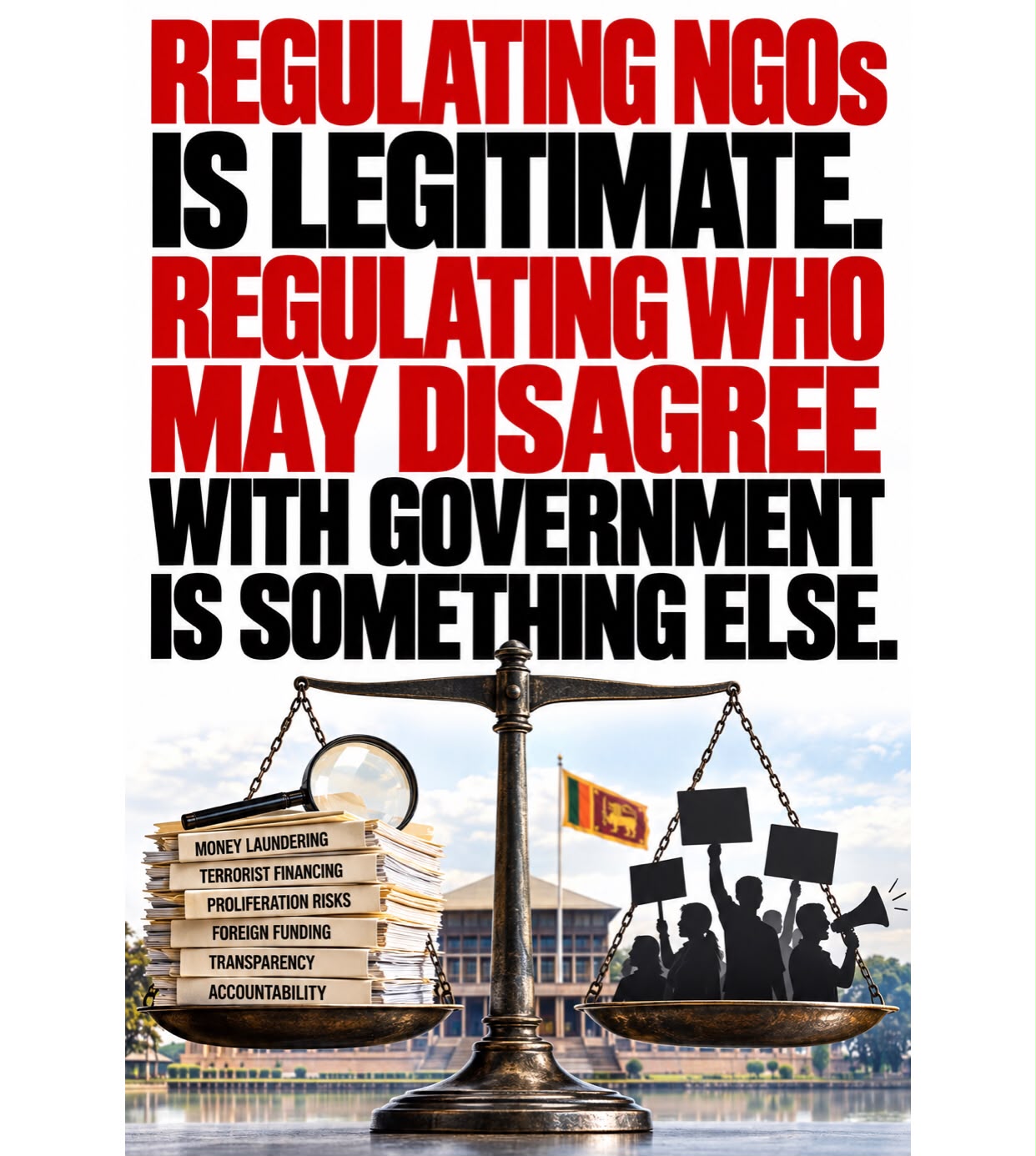
Sri Lanka is working on new legislation governing non-governmental organisations, with the Government citing money laundering, terrorist financing and proliferation-financing risks among the reasons for stronger oversight. Those are legitimate concerns. The test will be whether the eventual law regulates money and accountability without giving the State unnecessary authority over lawful civil society activity.
Non-governmental organisations occupy an occasionally uncomfortable position in Sri Lankan public life. They can perform valuable humanitarian, developmental, environmental and human-rights work. They can also receive substantial foreign funding and operate in areas touching politics, governance and public olicy.
The State therefore has a legitimate interest in knowing who they are, where their money comes from and what they do with it.
Submit Your Press Release
Get your company news, announcements, launches, appointments and events in front of a wider audience.


The Government is developing a new Non-Governmental Organization Registration and Supervision Bill. In July, the National Secretariat for NGOs provided an amended draft to representatives of civil society organisations and held consultations over provisions that had caused concern. The Ministry said the proposed framework is intended to strengthen regulation while minimising risks associated with money laundering, terrorist financing and proliferation financing.
There is nothing inherently sinister about that objective.
Banks are regulated. Charities are regulated. Companies file accounts. Political parties operate under electoral law. Organisations receiving substantial sums of money, particularly from overseas, cannot reasonably claim that transparency requirements constitute an assault on freedom.
The difficult question is where financial accountability ends and State control begins.
A democratic government should be able to ask an NGO to disclose its funding. It should be able to insist that accounts are maintained, money is spent for lawful purposes and organisations do not serve as vehicles for criminal financing.
It becomes considerably more problematic if administrative discretion allows officials to determine whether an organisation’s legitimate activities are politically desirable.
That distinction matters because civil society exists partly to do things government may not particularly enjoy.
An environmental organisation may challenge a government development project. A human-rights organisation may document alleged abuses by State agencies. A governance group may question appointments or expenditure. A media organisation may investigate public officials.
Government irritation cannot become the legal definition of improper activity.
Sri Lanka’s history should make us particularly careful about this.
Every government believes its own intentions are reasonable. Legislation, however, survives governments. Powers created for an administration that promises restraint remain available to the administration that comes next.
The correct question is therefore not whether the present minister or official can be trusted with a particular discretionary power. It is whether we would be comfortable giving precisely the same power to the politician we trust least.
That is usually a more useful test of legislation.
The Government deserves credit for consulting affected organisations rather than simply placing a finished Bill before Parliament. The NGO Secretariat says representatives were invited to submit observations and recommendations on specific clauses and that amendments would be considered where feasible.
That consultation now needs to produce legislation with clearly defined boundaries.
Registration requirements should be objective. Financial reporting should be proportionate. Decisions should be reviewable. Sanctions should follow identifiable violations rather than vague judgments about whether an organisation’s activities are acceptable.
Sri Lanka certainly does not need an unaccountable NGO sector.
Neither does it need a civil society that survives according to the administrative tolerance of the government of the day.
Be that as it may, transparency cuts both ways.
Government is entitled to ask NGOs where their money comes from and what they do with it.
Citizens are equally entitled to ask government precisely what powers it wants over the people who sometimes disagree with it.