
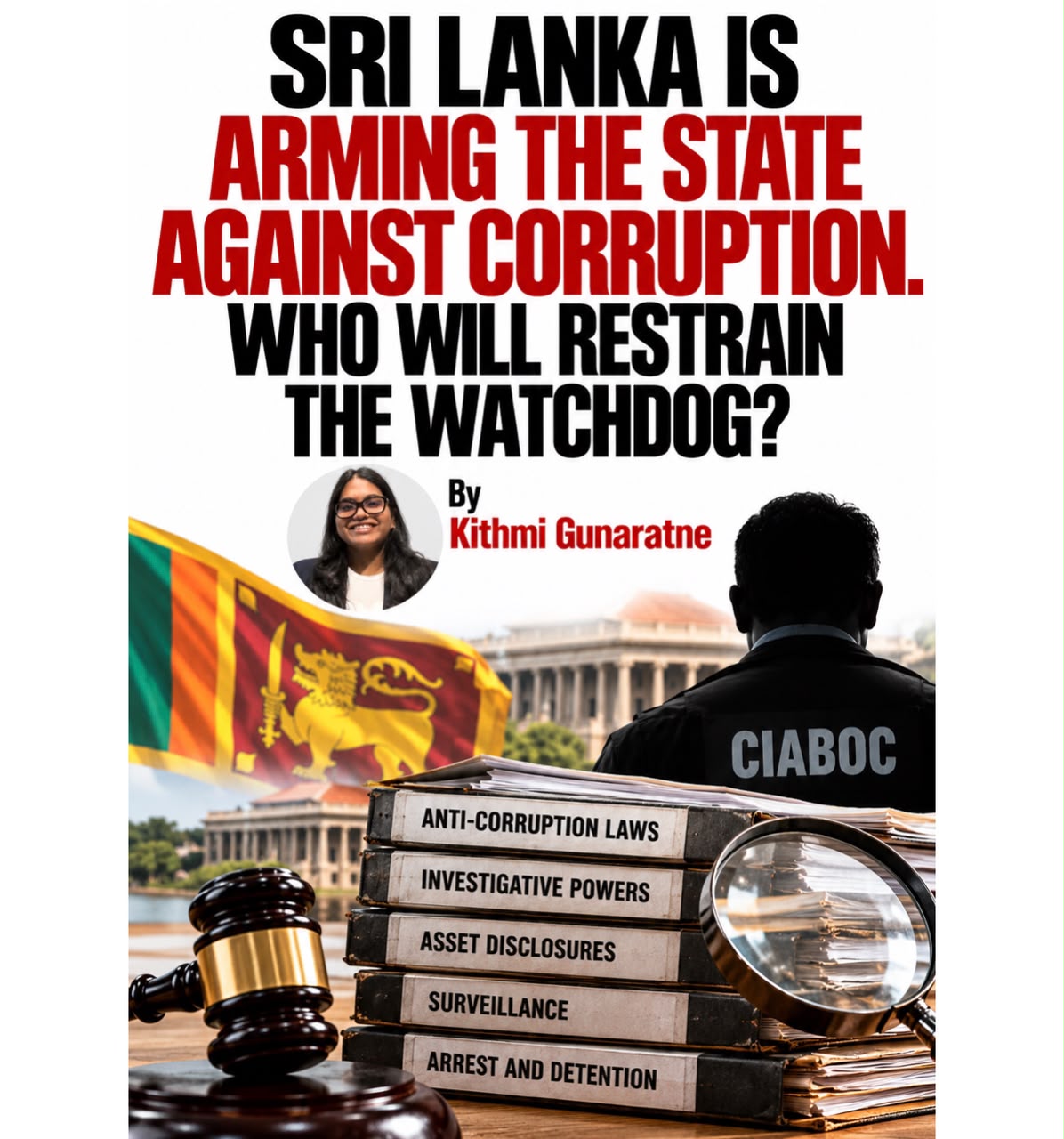
Sri Lanka has spent years demanding tougher action against bribery, illicit wealth and political impunity. But as parliament expands the machinery of anti-corruption enforcement, a harder democratic question is emerging: can the state acquire greater powers over liberty, wealth and private information without weakening the safeguards that make those powers legitimate?
By Kithmi Gunaratne
Sri Lanka has no shortage of reasons to demand a harder fight against corruption. Allegations of patronage, opaque procurement, unexplained wealth and political interference have followed successive governments, while the collapse of 2022 deepened public anger over how the state had been governed. The International Monetary Fund’s governance diagnostic identified corruption vulnerabilities across procurement, tax administration, state-owned enterprises and high-level decision-making, while Transparency International currently gives Sri Lanka a score of 35 out of 100 on its Corruption Perceptions Index, placing it 107th among 182 countries.
Against that background, stronger anti-corruption institutions are not merely desirable; they are necessary. But the difficulty begins when stronger enforcement is treated as though it automatically produces stronger democracy. An anti-corruption system derives legitimacy not only from how many people it investigates or prosecutes, but from whether those powers are exercised consistently, transparently and within the same constitutional limits that govern every other arm of the state. That tension now sits at the centre of Sri Lanka’s Anti-Corruption (Amendment) Bill, introduced to revise the Anti-Corruption Act No 9 of 2023. The government says the amendments are intended to address practical problems involving investigations, prosecutions, asset declarations and the administration of the Commission to Investigate Allegations of Bribery or Corruption, or CIABOC. Those objectives are understandable. The more difficult question is how far the state should be allowed to go in the name of fighting corruption.
Submit Your Press Release
Get your company news, announcements, launches, appointments and events in front of a wider audience.


When tougher law becomes weaker democracy
Fifteen petitions challenged provisions of the amendment bill, including applications by Transparency International Sri Lanka, the Media Law Forum and former minister GL Peiris. On 22 September, the Speaker informed parliament of the Supreme Court’s determination. Several clauses were found to require special parliamentary majorities, while clause 17, in its existing form, was held to require both a special majority and approval at a referendum.
The importance of that ruling lies less in the technicalities than in the principle behind it. Sri Lanka is being forced to confront a democratic paradox: the more powerful an anti-corruption institution becomes, the more important the restraints on that institution become as well. A body capable of investigating hidden wealth, examining personal finances and pursuing politically influential suspects needs significant authority, but the same powers that make enforcement effective can become dangerous when they are insufficiently supervised.
In countries where corruption has become synonymous with impunity, procedural safeguards can easily appear to be obstacles. A suspect released on bail can look like proof of elite privilege; restrictions on investigators can appear weak; privacy protections can look like concealment. Yet those safeguards exist precisely because state power is most dangerous when public anger makes exceptional treatment seem justified.
The strength of anti-corruption law should therefore not be measured only by how severely it can act against suspects. It should also be measured by how effectively it prevents enforcement itself from becoming arbitrary.
Bail cannot become punishment before conviction
One of the clearest areas of conflict concerns pretrial detention. Critics of the amendments argued that parts of the bill risked narrowing judicial discretion and making remand more routine in corruption cases. The political appeal of such measures is obvious in a country where the public has repeatedly watched powerful suspects emerge from courtrooms on bail and concluded that privilege remains stronger than justice.
But frustration cannot erase the distinction between accusation and conviction. Bail does not mean that an accused person has been cleared, just as remand should not function as punishment before guilt has been established. Courts retain discretion because detention is supposed to depend on identifiable risks, such as flight, interference with witnesses or obstruction of justice, rather than on the political popularity of keeping a suspect behind bars.
This matters especially in corruption cases because they are often inseparable from politics. Governments change, alliances shift and prosecutorial priorities change with them. A detention rule that appears acceptable when used against an unpopular former minister may look considerably more troubling when applied by another administration against critics, rivals or inconvenient officials.
Good legislation must therefore be judged not simply by whether present office-holders intend to misuse it, but by whether its protections would remain adequate in the hands of governments yet to come. A serious anti-corruption regime needs powerful investigators and independent judges at the same time. Judicial discretion does not weaken enforcement; it gives enforcement legitimacy by ensuring that coercive powers remain reviewable.
Transparency cannot become selective visibility
The second major dispute concerns asset declarations. Sri Lanka’s 2023 law significantly expanded the declaration regime, requiring a wide range of office-holders to disclose assets, liabilities, income and interests. CIABOC now administers the system and makes redacted declarations available to the public, reflecting the principle that corruption often reveals itself not through an obvious bribe but through wealth that cannot be reconciled with legitimate income. Asset declarations therefore serve a purpose far beyond bureaucratic compliance. They allow investigators, journalists and citizens to compare an official’s public income with property, financial interests and changes in wealth over time. But transparency becomes meaningless if disclosure is so heavily restricted that outsiders can no longer identify conflicts of interest or unexplained enrichment.
Transparency International Sri Lanka objected to changes affecting the scope of declarations, including provisions involving people who share a household with an office-holder. Its concern is straightforward: if the law examines only assets directly held in an official’s own name, sophisticated corruption can be concealed through relatives, associates or intermediaries.
There are legitimate reasons to protect private information. Current law already requires sensitive details such as bank account numbers, identification numbers and full residential addresses to be withheld from publicly accessible declarations. The issue is therefore not transparency versus privacy. It is whether redaction protects genuine privacy or removes information the public needs in order to hold officials accountable.
That distinction matters because public access is itself part of enforcement. Journalists can compare declarations across years, civil society groups can examine links between office-holders and private interests, and citizens can identify property or business relationships that deserve scrutiny. A declaration system that technically publishes information while making meaningful examination impossible would amount to visibility without accountability.
A watchdog cannot operate in darkness
This is the deeper weakness in many anti-corruption systems: they focus almost entirely on the people being investigated and too little on the institutions doing the investigating. CIABOC needs operational independence, but it also needs institutional transparency. Investigative powers should be clearly defined, prosecutorial decisions should be insulated from political pressure, redaction rules should follow objective standards and detention powers should remain subject to judicial review.
That is not bureaucratic caution. It is how legitimacy is built.
The IMF’s governance diagnostic repeatedly identified opacity and discretionary authority as enabling conditions for corruption in Sri Lanka. It would therefore be a profound irony if an anti-corruption system designed to combat discretionary power were itself structured around vague or weakly reviewed discretion. Sri Lanka does not merely need institutions capable of punishing corruption. It needs institutions designed so that corruption is harder to hide, harder to protect and harder to weaponise politically. That requires open procurement, usable asset declarations, independent courts, accessible public information and prosecutors capable of pursuing complex financial cases. It also requires accepting that anti-corruption agencies themselves should be exposed to scrutiny.
A credible watchdog cannot demand transparency from everyone else while operating behind a veil of its own. The authority to examine private wealth, compel evidence or initiate criminal proceedings is too significant to depend entirely on institutional goodwill. The more power an agency possesses, the clearer its own standards of accountability must become.
Sri Lanka has seen what unchecked powers become
Sri Lanka has particular historical reasons to understand this danger. Its recent history is full of laws and institutions created in response to genuine crises that later became controversial because extraordinary powers survived long after the conditions that produced them had changed. Emergency regulations and counter-terrorism measures were repeatedly defended on the basis of necessity, demonstrating how easily temporary powers can become embedded in ordinary government.
Anti-corruption enforcement is not counter-terrorism, and the comparison should not be overstated. The constitutional lesson, however, remains relevant: good intentions do not permanently guarantee good use. Institutions naturally prefer authority; investigators prefer broader access to evidence, prosecutors prefer fewer procedural barriers and administrators prefer greater discretion. The role of democratic law is not to make their work impossible, but to define where useful power ends and unreviewable power begins.
That boundary becomes especially important when anti-corruption acquires enormous political popularity. The more widely supported an anti-corruption campaign becomes, the easier it is to portray procedural objections as attempts to protect corrupt officials. Yet that is precisely when scrutiny matters most, because rule-of-law protections are designed to ensure that accountability does not become selective, arbitrary or politically convenient.
The real test is equal enforcement
Ultimately, the credibility of Sri Lanka’s anti-corruption project will not be determined by how sweeping its legislation appears on paper. It will depend on whether institutions can investigate politically connected individuals without fear, prosecute strong cases without favour, respect the rights of the accused and expose public officials to meaningful scrutiny regardless of which party holds power.
That requires more than dramatic arrests, raids or declarations that nobody is above the law. It requires investigators with operational independence, prosecutors capable of handling complex financial cases, courts free to exercise discretion, journalists with access to usable information, whistleblowers who can speak safely and procurement systems that make public spending visible before scandals erupt.
It also requires consistency. A system that pursues opponents aggressively while hesitating around allies would simply reproduce the political inequality that anti-corruption reform is supposed to dismantle. The most convincing proof of independence will not be how fiercely the state moves against people who have already lost power, but whether the same standards apply when allegations concern those close to power now.
Sri Lanka is right to build stronger institutions against corruption. But those institutions only become credible when they remain constrained by the same rule of law they are supposed to defend. A democracy does not prove its commitment to accountability by giving watchdogs unlimited authority; it proves it by creating watchdogs powerful enough to pursue the powerful while remaining answerable to courts, transparent procedures and clearly defined law themselves.
For years Sri Lanka has asked who will hold corrupt officials to account. As the state acquires greater authority to investigate wealth, restrict liberty and collect personal information, it must now ask the question that will determine whether anti-corruption reform strengthens democracy or merely enlarges the state: who watches the watchdog?



