
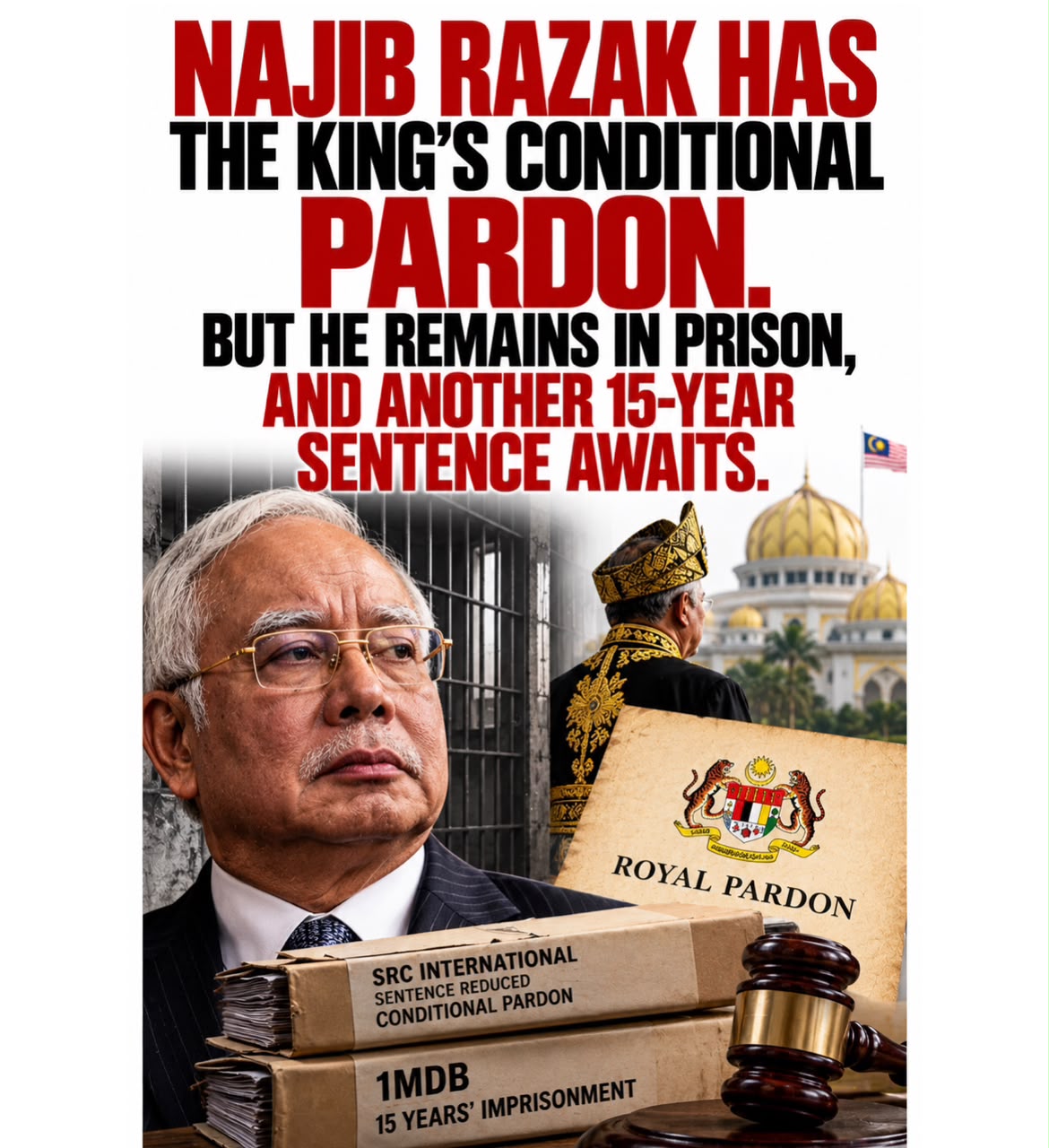
Malaysia’s former Prime Minister Najib Razak remains at the centre of an extraordinary legal and constitutional controversy. A conditional royal pardon has opened the possibility of serving the remainder of his SRC International sentence under house arrest, but a substantial financial condition remains unresolved. Meanwhile, a separate conviction arising from the 1MDB scandal carries a further 15-year prison sentence. The courts, the monarchy and the criminal justice system must now confront the consequences of decisions operating on different legal tracks.
Former Malaysian Prime Minister Najib Razak remains in prison despite a conditional royal pardon permitting him to serve the remainder of his sentence in the SRC International case under house arrest, subject to the fulfilment of specified conditions.
The decision, announced on 18 September 2026, has generated considerable debate about the constitutional powers of Malaysia’s monarchy, the administration of criminal sentences and the treatment of politically prominent prisoners.
Submit Your Press Release
Get your company news, announcements, launches, appointments and events in front of a wider audience.


Najib’s position is complicated by the existence of two separate criminal cases.
The first concerns SRC International, a former subsidiary of the state investment fund 1Malaysia Development Berhad, commonly known as 1MDB.
Najib was convicted of offences including abuse of power, criminal breach of trust and money laundering involving RM42 million belonging to SRC International.
He originally received a 12-year prison sentence and a substantial fine. In February 2024, Malaysia’s Pardons Board reduced his prison sentence to six years and lowered the fine.
The subsequent conditional pardon created the possibility of Najib completing the remaining portion of that sentence under house arrest until 23 August 2028.
However, the arrangement was subject to payment of a RM50 million fine.
Najib’s lawyers subsequently indicated that he did not possess sufficient funds to satisfy the financial condition. The Attorney-General also confirmed that payment had not been made at the time of the relevant announcement.
As of Monday, 12 October, NEWSLINE has not independently established that the payment has subsequently been completed or that Najib has been transferred from Kajang Prison.
The distinction matters because the existence of a conditional pardon does not necessarily mean that every condition required for its implementation has been fulfilled.
There is also the separate 1MDB conviction.
In December 2025, Najib was sentenced to 15 years’ imprisonment following convictions involving abuse of power and money laundering connected to the wider 1MDB financial scandal.
That sentence was ordered to commence after completion of the SRC International sentence.
Najib has challenged the conviction, and the Kuala Lumpur High Court is scheduled to hear an application for a stay of execution on Wednesday, 14 October.
The proceedings are separate from the conditional royal pardon affecting the SRC sentence.
This distinction is central to understanding the legal position.
A royal pardon or commutation concerning one criminal sentence does not automatically extinguish a conviction or sentence imposed in another case.
Malaysia’s constitutional arrangements provide for the exercise of royal clemency through established procedures. Those powers are significant, but their exercise must be understood within the legal framework governing the particular offence and sentence.
The present controversy therefore raises questions about the interaction between executive clemency, judicial authority and the practical administration of imprisonment.
There is also a broader question concerning equality before the law.
Malaysia’s former prime minister is entitled to seek every remedy available under the Constitution and the criminal justice system. His previous office does not remove those rights.
Equally, the public is entitled to expect that the conditions attached to a pardon will be applied according to law rather than adjusted through informal political arrangements.
The issue of house arrest has attracted particular attention because it changes the circumstances under which a convicted individual serves a sentence.
Home detention may constitute a legitimate component of a criminal justice system when authorised by law and administered according to transparent criteria.
But such arrangements inevitably raise questions when they concern a former head of government convicted of serious financial offences.
Would an ordinary prisoner in comparable circumstances have access to the same legal remedies? Are the relevant procedures sufficiently transparent? Can the public understand the conditions governing the decision?
These are legitimate questions about the administration of justice, not arguments against the constitutional authority of the monarchy.
The financial dimension adds another complication.
A pardon conditioned upon payment of a substantial fine creates a practical distinction between the legal possibility of release and the ability to satisfy the conditions imposed.
If the required payment is not made, the legal consequences must be determined according to the terms of the pardon and the applicable law.
Meanwhile, the separate 1MDB proceedings continue.
The scandal attracted international attention because of allegations concerning the diversion of enormous sums from a state investment fund, complex financial transactions and the use of international banking systems.
Its consequences extended beyond Malaysia, generating investigations and proceedings in several jurisdictions.
For Malaysians, the case has become an important test of whether the criminal justice system can deal consistently with individuals who once exercised extraordinary political authority.
Najib remains entitled to pursue his appeal and any other remedies available under law.
The prosecution and the courts must discharge their responsibilities independently, while the monarchy’s constitutional role must be respected.
The challenge is to ensure that these different institutions operate according to clearly understood legal principles.
Malaysia’s experience offers lessons for other countries, including Sri Lanka, where questions about the treatment of former political leaders have become increasingly prominent.
The existence of legal remedies for powerful individuals is not itself evidence of privilege. The relevant question is whether those remedies are available and administered according to consistent standards.
The next significant development is expected on 14 October, when the court considers Najib’s application concerning the separate 1MDB sentence.
Be that as it may, Najib Razak has discovered that receiving a conditional royal pardon and satisfying the conditions necessary to benefit from it are two different matters. A further 15-year sentence makes the distinction considerably more consequential.



