
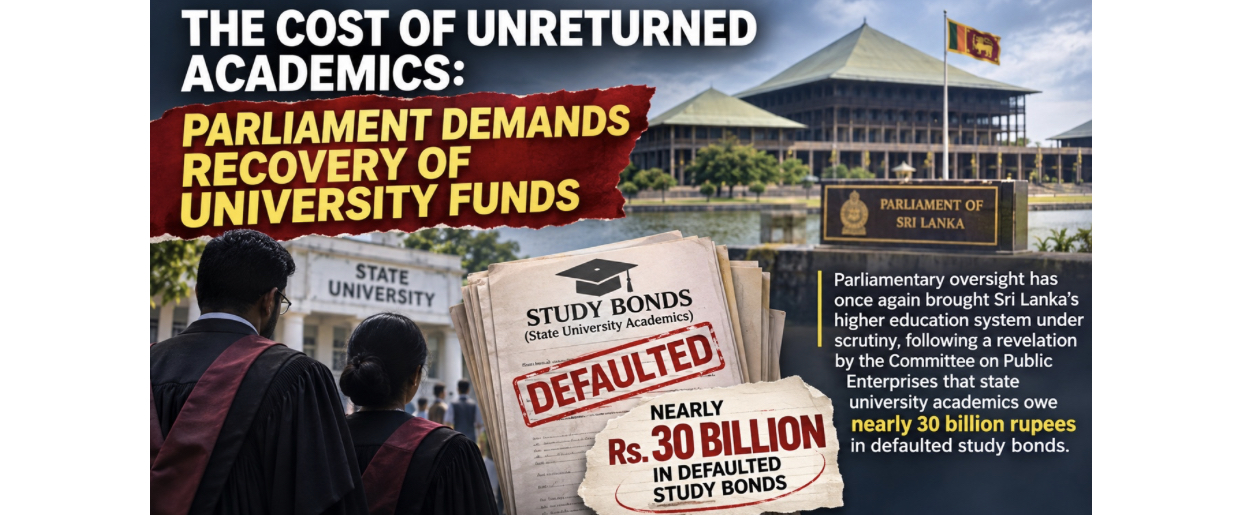
Parliamentary oversight has once again brought Sri Lanka’s higher education system under scrutiny, following a revelation by the Committee on Public Enterprises that state university academics owe nearly 30 billion rupees in defaulted study bonds.
The disclosure came during a COPE session chaired by Parliamentarian Dr. Nishantha Samaraweera to examine the financial performance and audit reports of Eastern University of Sri Lanka for 2023 and 2024. State-funded universities regularly grant academic staff paid leave and financial backing to pursue doctoral and postgraduate research at international institutions. In return, lecturers sign legal bonds pledging to return and serve the state higher education system for a specified tenure, or reimburse the state for their tuition, allowances, and salaries.
However, systemic non-return has left an enormous financial hole. COPE revealed that across the entire national university network, unrecovered bond defaults have breached 30 billion rupees. The committee instructed the Ministry of Higher Education and university officials to immediately establish a centralized, legal mechanism to trace and recover monies from academics who defaulted on their contracts after settling overseas.
Submit Your Press Release
Get your company news, announcements, launches, appointments and events in front of a wider audience.


The proceedings surrounding Eastern University offered a window into the administrative weaknesses compounding these losses. Audit reviews revealed that despite receiving nearly 3 billion rupees annually in public funding, the institution lacked a Treasury representative on its Audit and Management Committee. Auditors flagged glaring conflicts of interest, including a Senior Assistant Internal Auditor managing financial operations while concurrently serving as Chief Internal Auditor. Additional irregularities included missing personnel files, contradictory qualification certificates used for academic promotions, unapproved study leave, and unrecovered overpayments amounting to millions of rupees. In one notable instance, a lecturer resigned to contest an election, received an overpayment of 3.6 million rupees, and subsequently returned to the staff without settling the balance.
Systemic discipline was also called into question regarding support staff attendance. COPE highlighted that 38 employees bypassed mandatory biometric fingerprint systems to take excessive leave ranging from 5 to 83 days, resulting in over 99 million rupees in unrecovered salaries. Rejecting administrative attempts to attribute missing records to historic conflicts, tsunamis, and regional floods, COPE urged immediate legislative amendments to the Universities Act No. 16 of 1978 to grant the University Grants Commission direct powers to intervene in university council mismanagement.
While lawmakers view the defaulted billions as unpunished financial breach, higher education analysts point out that the bond crisis is fundamentally tied to the nation’s severe economic contraction and ongoing brain drain. Decreased academic remuneration, soaring living costs, and limited research funding have driven thousands of professionals to seek permanent foreign appointments. When faced with lucrative overseas careers versus returning to underfunded domestic faculties, many scholars choose to break their agreements, knowing that international recovery mechanisms remain legally sluggish and poorly enforced.
Resolving the 30-billion-rupee deficit requires more than rhetoric. To safeguard public funds without choking off academic development, the state must pair aggressive legal recovery frameworks with structural incentives that make returning to Sri Lankan universities a viable and rewarding career path for global talent.



