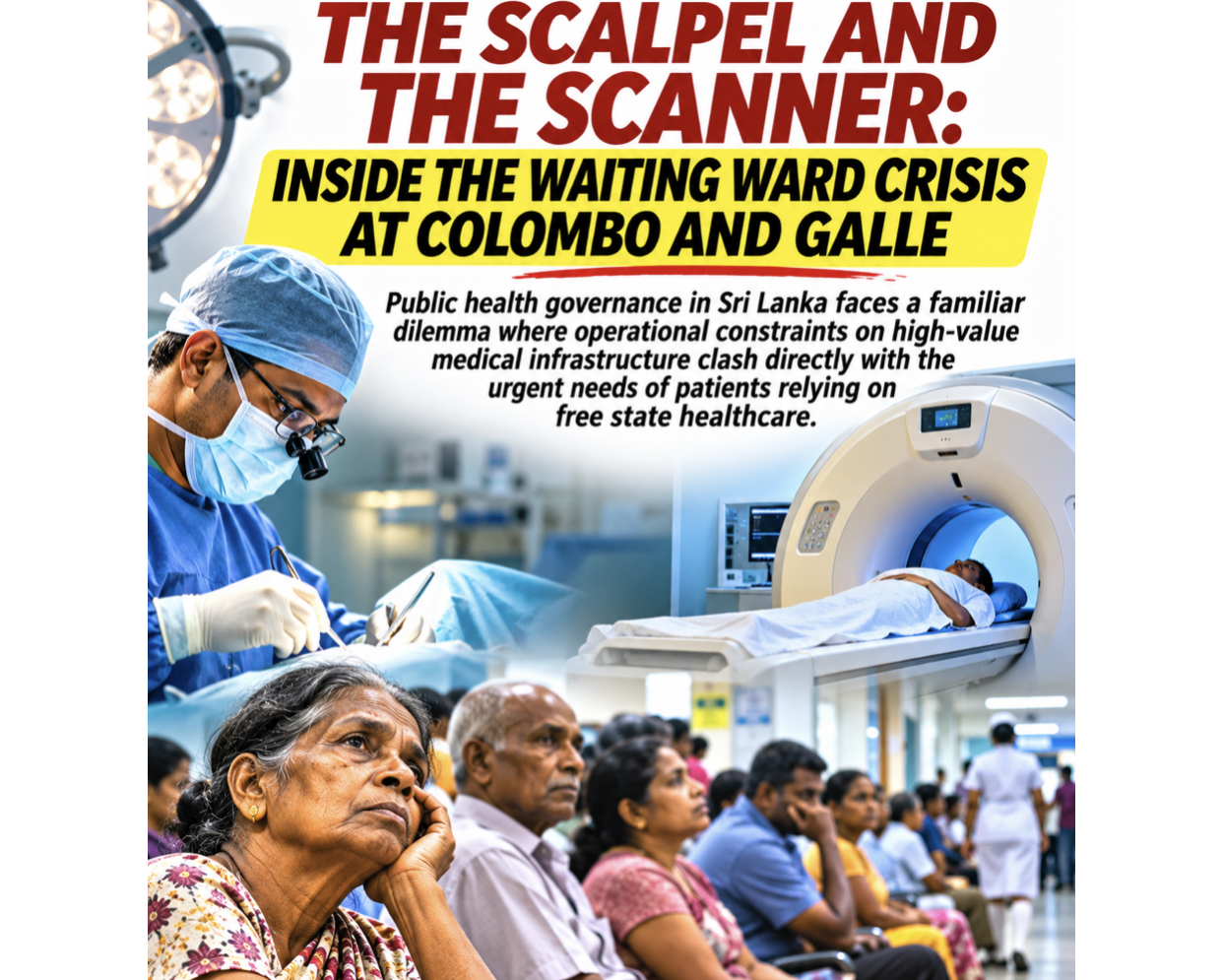
Public health governance in Sri Lanka faces a familiar dilemma where operational constraints on high-value medical infrastructure clash directly with the urgent needs of patients relying on free state healthcare.
The debate intensified following public claims by medical specialist Dr. Chamal Sanjeeva, representing a prominent medical association, who alleged that patients admitted to the National Hospital of Sri Lanka in Colombo are enduring forced waits of two to three days for magnetic resonance imaging scans. According to Dr. Sanjeeva, daily scan quotas at certain units within the Colombo facility, as well as the Karapitiya National Hospital in Galle, have been capped at ten to twelve procedures per day. He argued that this artificial restriction leaves patients in Wards 8, 9, and 10, plus the Neurotrauma and Neurosurgical units, occupying beds for days while planned surgeries are postponed, often driving desperate families to spend over 100,000 rupees at private diagnostic clinics.
While the medical association points to official Ministry of Health directives mandating full utilization of state equipment, hospital administrators and biomedical engineering experts highlight a complex operational picture behind high-tech diagnostic management.
Submit Your Press Release
Get your company news, announcements, launches, appointments and events in front of a wider audience.


Running multi-million-rupee MRI scanners at continuous maximum capacity presents severe technical and logistical hurdles. Medical machinery of this caliber, valued at roughly 400 million rupees per unit, relies on specialized liquid helium cooling systems, complex software maintenance, and strict daily duty cycles to prevent catastrophic magnet overheating or component breakdown. Pushing machines beyond calibrated daily thresholds risks prolonged hardware failure, which would collapse diagnostic access entirely for weeks at a time.
Furthermore, state healthcare facilities operate under acute staffing shortages. Conducting high-resolution MRI scans requires qualified radiographers, specialized radiologists for immediate interpretation, and nursing staff for contrast administration and patient monitoring. Restricting daily throughput is frequently an operational necessity to ensure clinical safety, maintain meticulous reporting standards, and prevent diagnostic burnout among overworked medical staff.
The issue is further complicated by triage protocols. In tertiary referral hubs like Colombo and Galle, emergency trauma cases and acute stroke patients must take immediate precedence over elective inpatient scans. What appears as an administrative delay for ward patients is often the result of clinical prioritization keeping life-threatening cases moving through the scanners.
Ultimately, the MRI bottleneck reflects systemic resource strains rather than simple negligence. Resolving the crisis would require a balanced approach: expanding technical maintenance contracts, recruiting additional diagnostic personnel, and optimizing ward scheduling, so state-funded equipment operates efficiently without compromising safety or overburdening the public healthcare grid.