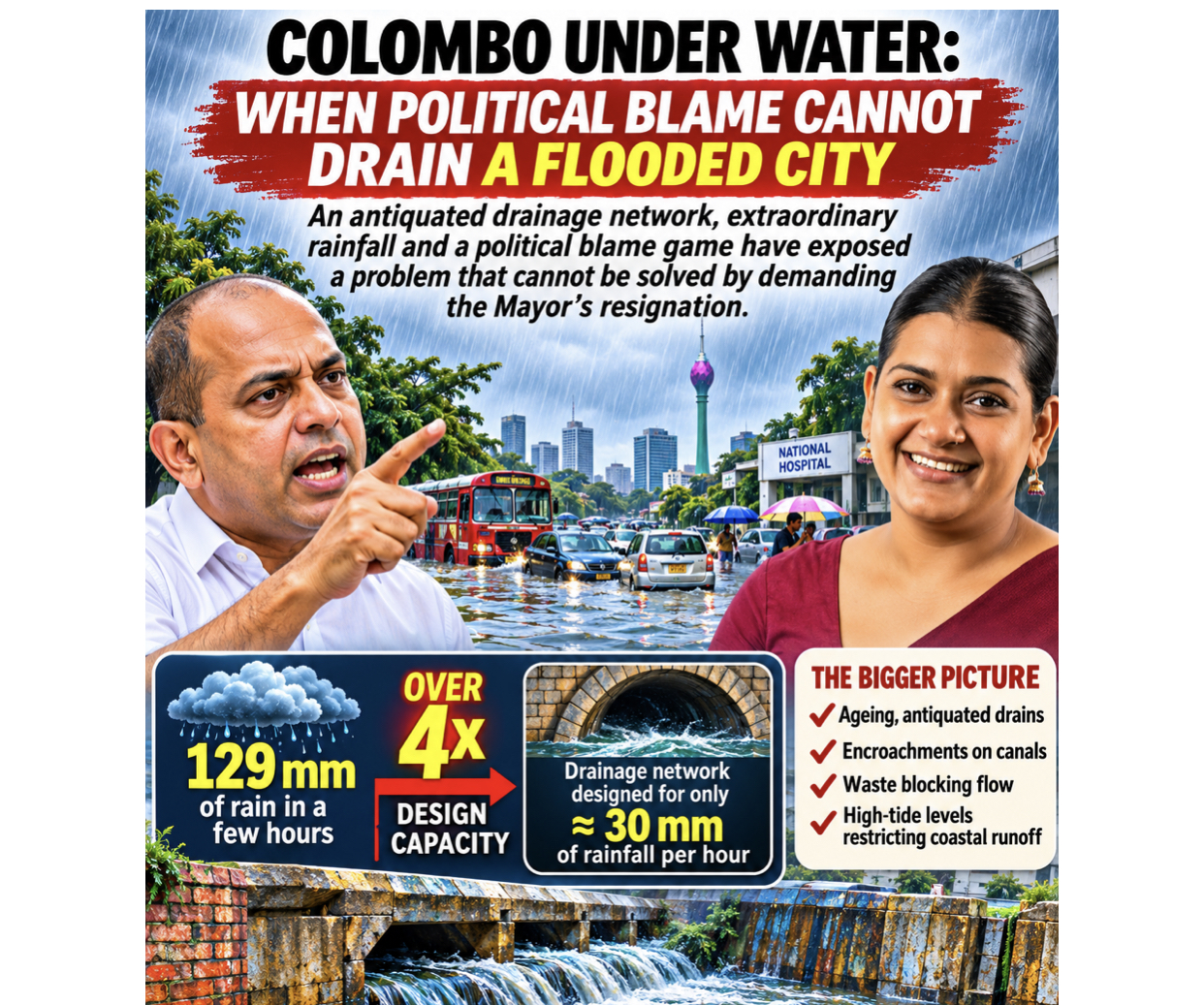
An antiquated drainage network, extraordinary rainfall and a political blame game have exposed a problem that cannot be solved by demanding the Mayor’s resignation.
Colombo’s latest flooding crisis has exposed an uncomfortable truth about the capital’s infrastructure. The city’s ageing subterranean drainage system was simply not designed to cope with the intensity of rainfall experienced on Friday evening. Yet, even as engineers attempted to explain the extraordinary pressures placed upon an antiquated network, political attention shifted towards an altogether more familiar exercise: finding someone to blame.
Opposition Parliamentarian S. M. Marikar wasted little time demanding the resignation or removal of Colombo Mayor Vraie Cally Balthazar, alleging that blocked drains, neglected culverts and inadequate municipal preparation had contributed to the inundation of roads, residential neighbourhoods and even the surroundings of the National Hospital.
Submit Your Press Release
Get your company news, announcements, launches, appointments and events in front of a wider audience.


The accusations were politically convenient. It was hard to miss the claimant’s politically based bias at Her Worship’s discomfort.
According to rainfall figures cited by municipal engineers, approximately 129 millimetres of rain fell within a relatively short period on Friday evening. Colombo’s underground drainage network, meanwhile, is reported to have been designed to accommodate rainfall intensities of approximately 30 millimetres per hour.
If the reported rainfall was concentrated within an hour, the intensity would have exceeded that nominal design capacity by more than four times. The precise comparison depends on the actual duration of the downpour and the capacity of individual drainage sections, but the underlying engineering problem is unmistakable.
Colombo was confronting a volume and intensity of rainfall that parts of its drainage infrastructure were never designed to accommodate.
Clearing a blocked drain can improve the passage of water. Desilting a canal can restore lost carrying capacity. Neither intervention, however, can magically transform an underground drainage network engineered for one level of rainfall into a system capable of accommodating four times that intensity.
That distinction is fundamental to understanding what happened.
Marikar pointed to historical rainfall events, including an episode in 1992 when Colombo reportedly experienced rainfall exceeding 400 millimetres without comparable flooding at certain critical locations. But comparing cumulative rainfall totals without examining the duration, intensity, geographical distribution, tidal conditions and subsequent changes to the built environment risks producing a misleading conclusion.
Four hundred millimetres spread over an extended period can present an entirely different hydraulic challenge from 129 millimetres concentrated into a short, violent downpour.
The relevant engineering measurement is not simply how much rain falls, but how quickly it falls and whether the drainage network can discharge that water before surface flooding occurs.
There are other complications. Colombo’s drainage network has been affected by decades of urban expansion, encroachment upon waterways, construction over natural drainage corridors, improper disposal of solid waste and the progressive reduction of permeable land surfaces.
High coastal tides can further restrict the discharge of stormwater into the sea, creating additional pressure within an already overloaded system.
These are structural challenges accumulated over successive municipal administrations and national governments. They cannot reasonably be attributed exclusively to a Mayor who has occupied office for only a comparatively short period.
This does not absolve the present administration of responsibility for maintaining drains, preparing for severe weather or coordinating an effective emergency response. Those are legitimate areas for scrutiny, and the public is entitled to know whether scheduled maintenance was completed and whether advance weather warnings prompted appropriate action.
But responsibility must be established through evidence rather than political theatre.
Marikar’s demand for the Mayor’s removal, without an accompanying technical explanation of how the existing drainage network could have accommodated such an intense rainfall event, risks being perceived as political brinkmanship rather than constructive oversight.
The public might reasonably ask what specific engineering solution the Opposition proposes. Would additional desilting alone have prevented the flooding? Which drainage sections were demonstrably obstructed? What evidence establishes that routine maintenance failures, rather than hydraulic overload, were the principal cause?
And perhaps most importantly, what investment programme would the Opposition support to prevent a recurrence? And in a struggling economy, where does the money come from?
These questions matter considerably more than another resignation demand.
Mayor Balthazar has reportedly initiated discussions with municipal engineers, government agencies, the Presidential Secretariat and military personnel following the flooding. Such coordination is necessary, but emergency meetings cannot substitute for a long-term infrastructure strategy.
Colombo needs a drainage solution, not merely a political explanation.
The immediate priority should be an independent engineering assessment of the city’s principal stormwater drainage corridors, identifying their actual carrying capacities, structural deficiencies, maintenance conditions and vulnerability to extreme rainfall.
That assessment should be made public.
The Colombo Municipal Council, working with the relevant national agencies, should establish a phased programme to modernise critical underground drains, remove verified obstructions, restore canal capacity and improve the discharge of stormwater during high-tide conditions.
Particular attention must be given to hospitals, major transport arteries, densely populated residential areas and commercial districts where flooding threatens lives, livelihoods and essential services.
Retention ponds, underground stormwater storage, pumping stations at critical outfalls and improved flood forecasting should form part of the evaluation. These measures require proper feasibility studies, realistic budgets and clearly assigned institutional responsibilities.
Modern rainfall modelling must also replace assumptions based on historical weather patterns that may no longer adequately reflect the intensity of contemporary extreme-weather events.
There is a further obligation upon the political establishment.
Successive governments have presided over Colombo’s urban development while the capacity of its underlying drainage infrastructure has struggled to keep pace. Roads have been widened, buildings have multiplied and natural absorption areas have disappeared.
The consequences of those decisions cannot be erased by changing the occupant of the Mayor’s office.
If the Opposition believes that municipal negligence materially worsened the flooding, it should present the evidence. If the Mayor believes the principal cause was infrastructure inadequacy, the Council should publish the engineering data supporting that conclusion.
Both positions deserve examination. Neither should be accepted merely because it suits a political narrative.
Be that as it may, Colombo’s residents are entitled to something considerably more useful than competing accusations.
They deserve a city capable of withstanding foreseeable extreme weather, a municipal administration that maintains its infrastructure and a national political leadership prepared to finance the improvements required.
The Mayor must be accountable for what her administration can reasonably control. Equally, the Opposition must be accountable for the credibility of its accusations and the practicality of its proposed remedies.
When rainfall overwhelms a drainage system by several times its intended capacity, the central question should not be which politician can shout the loudest.
It should be how quickly Sri Lanka can begin building a drainage network capable of protecting its capital.
Because the next storm will not distinguish between Government and Opposition voters. And floodwaters, unlike politicians, are entirely indifferent to who occupies City Hall.