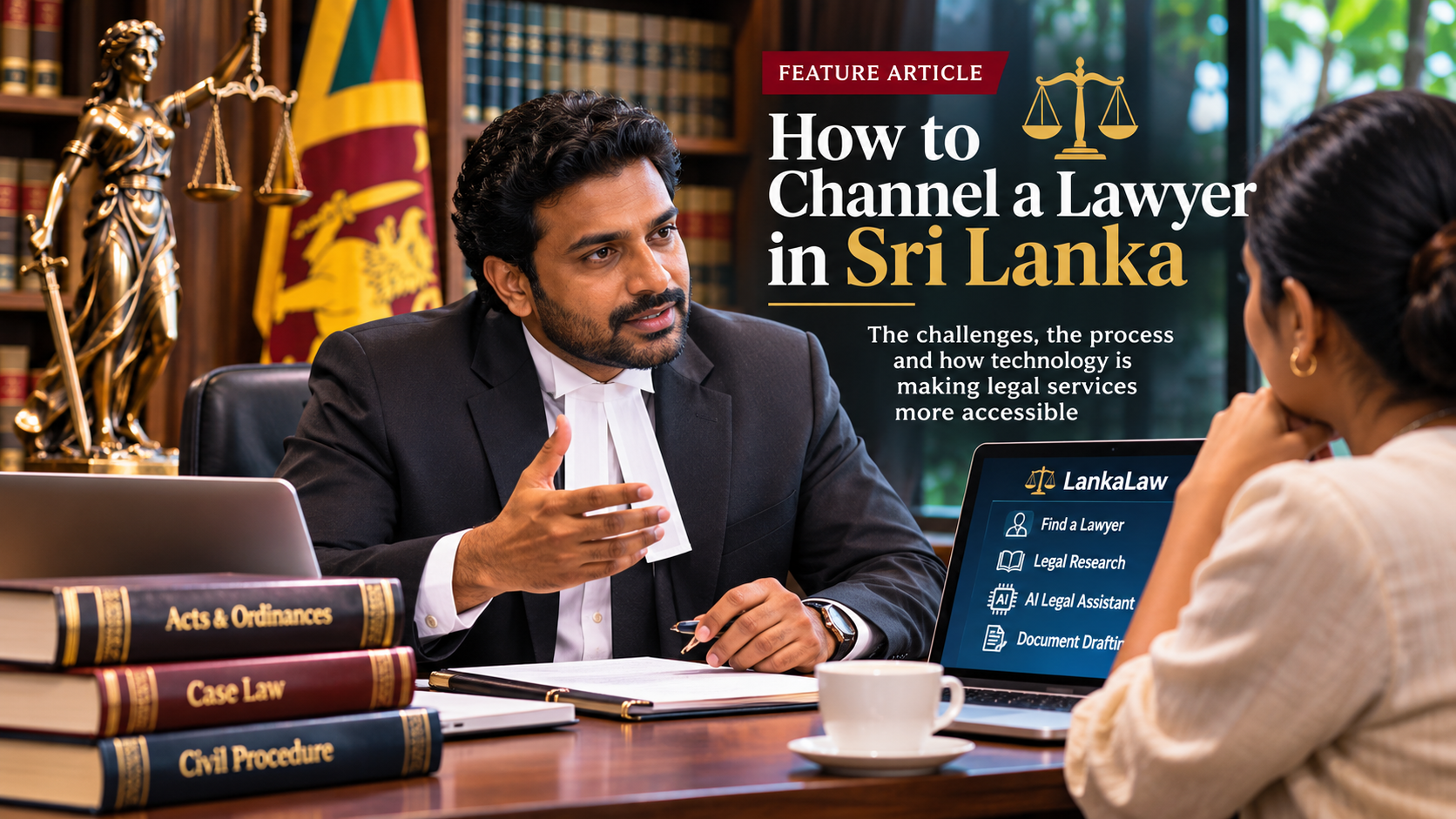
Finding the right lawyer, understanding legal fees and navigating the justice system remain challenges for many Sri Lankans. But a new generation of digital platforms, artificial intelligence and electronic court services is beginning to reshape how legal assistance is accessed and delivered.
For many people in Sri Lanka, finding a lawyer is the first and often one of the most difficult steps when facing a legal problem. Whether it involves a property dispute, divorce, employment issue, criminal allegation, business disagreement or contractual matter, knowing whom to contact, where to go and how much it will cost can be confusing.
Sri Lanka has an established legal profession comprising Attorneys-at-Law practising across numerous areas of law. Yet, for ordinary citizens, accessing the right professional assistance is not always straightforward. Personal recommendations remain a common way of finding lawyers, while reliable information about specialisations, consultation fees, availability and professional experience can be difficult to compare.
Submit Your Press Release
Get your company news, announcements, launches, appointments and events in front of a wider audience.


How do you find and channel a lawyer?
In Sri Lanka, legal practitioners are professionally recognised as Attorneys-at-Law. Individuals can find legal representation through personal referrals, law chambers, professional networks and the Bar Association of Sri Lanka (BASL). Online lawyer directories are also becoming an increasingly useful option.
The first step is identifying the nature of the legal issue. Someone dealing with a land dispute may require a lawyer experienced in property law, while a business facing a shareholder dispute may need commercial or corporate legal expertise.
Once a suitable lawyer has been identified, the client should arrange an initial consultation, explain the matter, provide relevant documents and clarify the professional fees.
Before engaging an Attorney-at-Law, clients should establish the scope of work, expected costs, court-related expenses and the proposed course of action. Checking professional credentials and ensuring that the lawyer has the relevant experience are equally important.
However, this seemingly simple process can become complicated for people unfamiliar with the legal system.
Why is accessing legal assistance so difficult?
One major challenge is identifying the right specialist. The legal profession covers civil litigation, criminal law, family law, commercial law, intellectual property, labour law, property transactions and many other disciplines. Clients often have little information to determine which professional is appropriate for their particular problem.
Financial uncertainty creates another barrier. Many clients approach lawyers without knowing the likely consultation charges, document preparation costs or expenses associated with litigation. A lack of clarity at the beginning can make it difficult to plan for legal representation.
There is also the challenge of understanding the law itself. Sri Lankan legislation, amendments, judicial decisions and Gazette notifications are distributed across different publications and institutions. Finding the applicable legal provision or understanding how a particular judgment affects an individual’s situation can require considerable research.
Geographical accessibility presents further difficulties. People outside Colombo may have to travel considerable distances to consult experienced legal professionals. Repeated visits to law chambers, physical document submissions and scheduling difficulties can increase both the financial and practical burden.
For many citizens, the problem is therefore not simply finding a lawyer. It is understanding their legal position, identifying the appropriate professional and accessing assistance efficiently.
Technology is transforming the legal profession
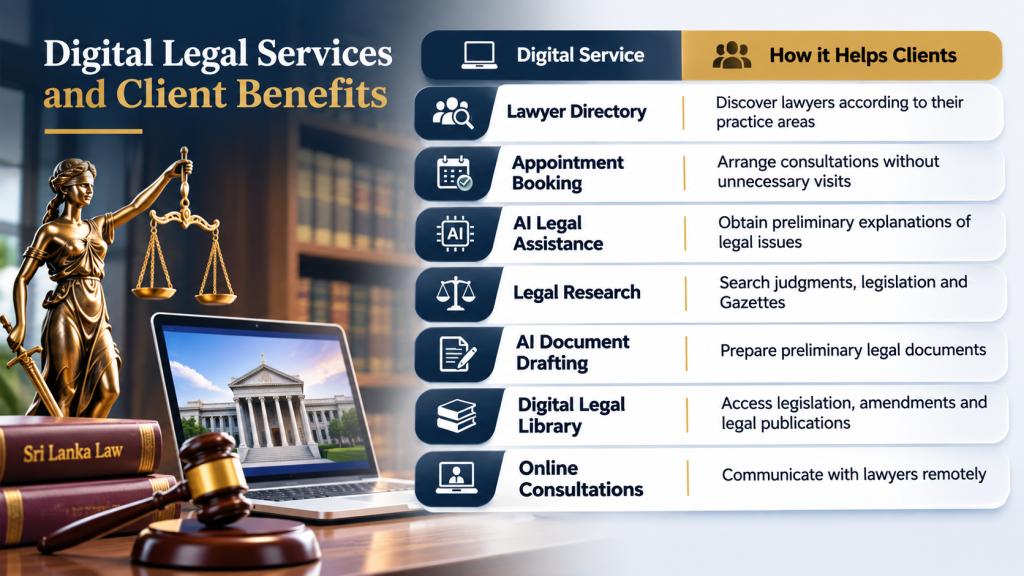
The legal industry is beginning to experience a significant digital transformation. Online lawyer directories, appointment booking systems, virtual consultations, digital legal libraries and artificial intelligence are changing how legal services can be accessed.
AI-powered legal research is particularly significant. Instead of manually searching through extensive collections of legislation and judgments, legal professionals can increasingly use technology to identify relevant cases, explore statutory provisions and organise legal research.
AI-assisted document preparation can also help produce preliminary legal letters, agreements and other documents, reducing repetitive administrative work.
Digital libraries provide another important development. Access to updated and consolidated legislation, amendments, judicial decisions and legal publications allows lawyers, researchers and students to conduct research more efficiently.
These technologies do not replace the professional judgement of an Attorney-at-Law. Rather, they provide tools that can improve research, preparation, productivity and communication.
Sri Lanka’s courts are embracing digitalisation
The transformation is also taking place within the judicial system.
The Government’s e-Courts initiative represents an important step towards modernising court administration. The Supreme Court officially opened its e-Filing Portal on 10 February 2026, enabling Attorneys-at-Law to submit cases electronically. On 26 March 2026, the Court conducted its first fully electronic, paperless proceeding.
The Supreme Court (Electronic Filing and Electronic Court Services) Rules, 2026, provide the regulatory framework for electronic filing and access to electronic case records.
Digitalisation is also extending to lower courts. The Colombo District Court has introduced electronic filing facilities, allowing attorneys and litigants to submit documents online and reducing the need for physical visits solely for document submission.
These developments could improve administrative efficiency, reduce paperwork and make judicial information more accessible. However, technology alone cannot eliminate court delays or resolve every structural challenge within the justice system.
The emergence of integrated legal technology platforms
An important development in this changing environment is the emergence of platforms that bring legal research, professional services and client access together.
Rather than requiring individuals to navigate multiple disconnected sources, integrated legal technology platforms can help users move from understanding a legal problem to finding relevant information and connecting with a professional.
One example is LankaLaw, a Sri Lankan legal technology platform that combines AI-assisted legal services, professional legal research and digital legal resources.
Its services include a Lawyer Directory through which users can explore Attorneys-at-Law by location and area of expertise, review available consultation information and submit appointment requests.
Its AI Legal Assistant helps users explore preliminary legal questions, while its Legal Research facilities provide access to Sri Lankan judgments, legislation, Gazettes and other legal materials.
The platform also offers AI-assisted legal drafting and an eLaw Library featuring legal publications and consolidated Acts. Its Law Reporter provides a digital space for legal developments, expert articles, analysis and updates.
The broader significance of such platforms is the integration of different stages of the legal journey. A person can begin by exploring a legal issue, access relevant legal information and then seek assistance from an appropriate professional.
For lawyers, these platforms offer opportunities to improve professional visibility, connect with prospective clients and use digital tools to support their practice.
What does the future hold?
Sri Lanka’s legal industry is entering a period in which technology will increasingly influence how legal services are delivered. Artificial intelligence, electronic filing, digital case management, online consultations and searchable legal databases are likely to become increasingly important.
Nevertheless, the relationship between a lawyer and a client remains built on professional responsibility, confidentiality, trust and independent legal judgement. AI-generated information must be verified, legal documents must receive appropriate professional review, and technology must operate within the standards governing the legal profession.
Ultimately, the objective of legal technology should be to make legal services easier to access, more transparent and more efficient.
The future of legal services in Sri Lanka is not about replacing lawyers with technology. It is about removing the barriers that prevent people from finding the right lawyer, understanding their rights and accessing justice.
As Sri Lanka moves towards a more digitally connected legal system, the real measure of progress will be how effectively these developments improve the everyday experience of citizens seeking justice.