
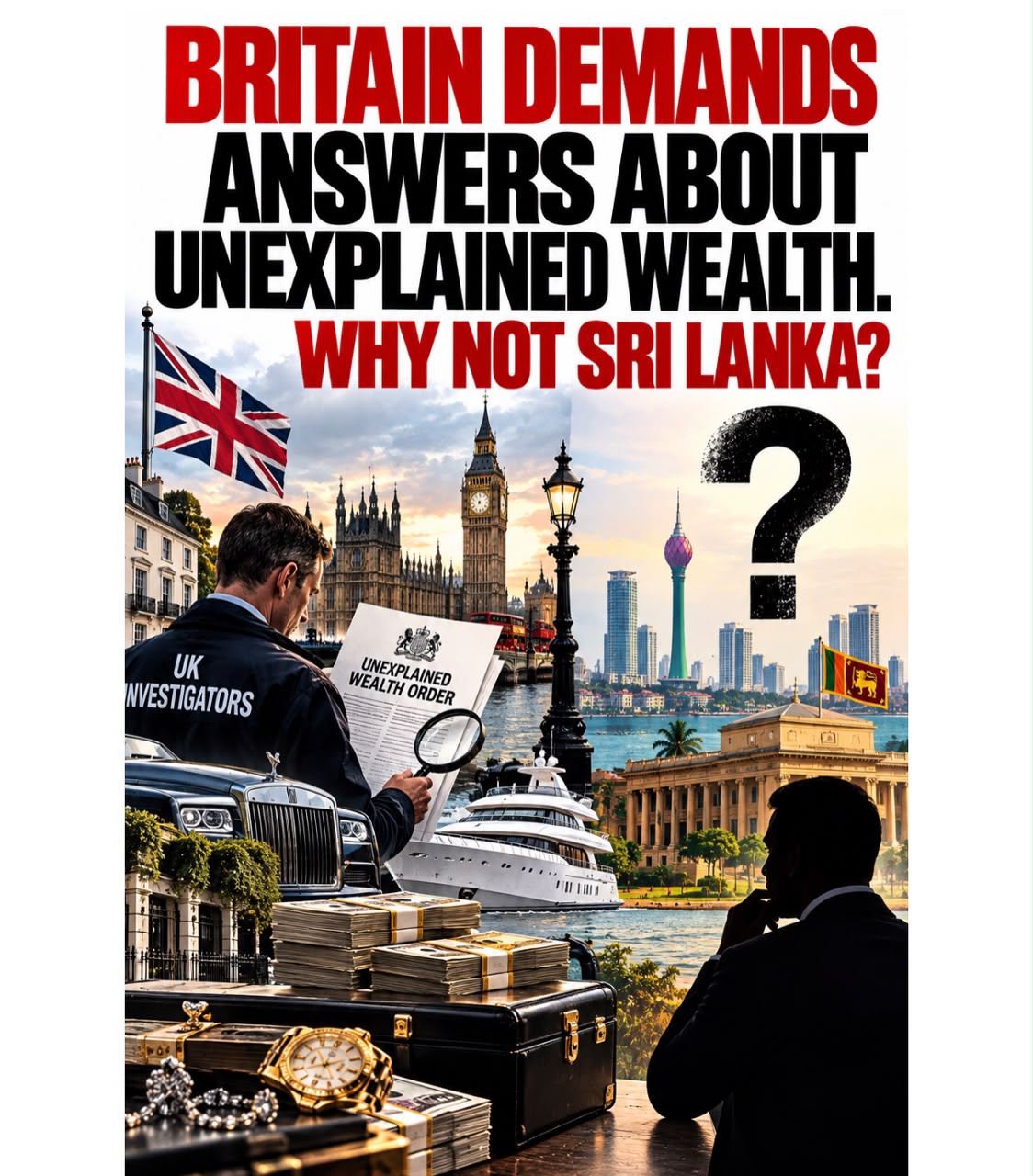
Britain has armed its investigators with powers to question fortunes that cannot be reconciled with legitimate earnings. Russian oligarchs, politically exposed individuals and owners of suspicious property can face judicial demands to explain where their money came from. Sri Lanka has its own laws against illicit enrichment. The uncomfortable question is whether those laws are being used with sufficient determination against the politically powerful.
Britain has discovered a remarkably straightforward principle in the fight against corruption. If somebody possesses a multimillion-pound mansion, an impressive collection of luxury vehicles and a financial empire that bears little resemblance to their declared legitimate income, the authorities should be entitled to ask where the money came from. The individual need not first be convicted of bribery or corruption before investigators can seek answers. Under Britain’s Unexplained Wealth Order regime, a court can require an explanation, provided the statutory conditions are satisfied.
Introduced through the Criminal Finances Act 2017 and strengthened by legislation in 2022, Unexplained Wealth Orders allow enforcement agencies to investigate suspicious assets worth at least £50,000. The mechanism is particularly relevant to certain politically exposed persons and individuals reasonably suspected of involvement in serious crime. An order can require disclosure of how property was acquired, who owns it and how the purchase was financed. Failure to provide a satisfactory response can open the way to civil recovery proceedings, although confiscation is neither automatic nor inevitable.
Submit Your Press Release
Get your company news, announcements, launches, appointments and events in front of a wider audience.


The legislation became especially significant amid Britain’s efforts to confront Russian oligarchs and their extensive financial interests. Following Russia’s invasion of Ukraine, billions of pounds in Russian-linked assets were frozen under sanctions legislation. But an important distinction must be maintained. Freezing assets under sanctions and recovering criminal property through an Unexplained Wealth Order are separate legal processes, and neither should be confused with a criminal conviction.
The case of former Chelsea Football Club owner Roman Abramovich illustrates that distinction. More than £2.5 billion arising from the club’s sale became the subject of a prolonged dispute over its intended humanitarian use in Ukraine. The money remained frozen while the British government sought arrangements for its distribution. Yet the freezing of those proceeds did not establish that Abramovich had been convicted of acquiring them unlawfully, nor was it itself a confiscation under the unexplained wealth legislation.
Britain’s system is not without weaknesses. Its own government acknowledges that Unexplained Wealth Orders have been used relatively sparingly. Five were obtained during the 2024–2025 reporting period, although individual investigations involving the mechanism have helped recover substantial sums. The significance lies not merely in the number of orders issued but in the legal principle they establish. Where reasonable statutory grounds exist, unexplained wealth can become the subject of compulsory judicial scrutiny.
And that brings us directly to Sri Lanka.
For decades, Sri Lankans have watched individuals enter politics with apparently modest financial resources and subsequently become associated with substantial property holdings, business interests and expensive lifestyles. Such appearances do not establish wrongdoing, and wealth acquired legitimately is no crime. Nevertheless, where there is a demonstrable discrepancy between declared income and accumulated assets, the public is entitled to expect an investigation rather than another round of political accusations.
Sri Lanka is not entirely without the necessary legislation. The Anti-Corruption Act No. 9 of 2023 introduced a substantially strengthened framework for investigating bribery, corruption and illicit enrichment. Section 84 specifically provides for verification of assets and liabilities declarations to detect indications of illicit enrichment. Discrepancies, complaints and information uncovered through investigations can trigger further examination. Parliament also passed amendments to the legislation on October 8, 2026, intended to address difficulties in its implementation.
Indeed, figures reported from the Commission to Investigate Allegations of Bribery or Corruption indicate that 14 cases involving the accumulation of unexplained wealth were instituted during 2025. That is evidence that the law is not entirely dormant. But 14 cases do not, by themselves, establish whether the country’s most substantial and politically sensitive fortunes are being subjected to systematic examination.
There is another important distinction. Britain’s Unexplained Wealth Order is a particular court-supervised investigative instrument, whereas Sri Lanka’s illicit-enrichment provisions operate through a different statutory framework. They should not be presented as identical legal mechanisms. The relevant comparison is whether each system can effectively identify suspicious wealth, compel lawful disclosure, investigate beneficial ownership and pursue assets established to be unlawfully acquired.
The Commission must therefore answer some fundamental questions. How many declarations have been subjected to substantive verification rather than merely received and filed? How many discrepancies have resulted in investigations? How many investigations concern serving or former senior political figures? How much unlawfully acquired wealth has actually been recovered, and how many cases have produced final judicial outcomes?
These are measurable questions requiring measurable answers. A corruption investigation is not successful simply because an arrest makes the evening television news. Nor does the announcement of an inquiry establish guilt. The ultimate test is whether credible evidence is gathered, the law is applied impartially, cases withstand judicial scrutiny and unlawfully acquired assets are recovered through due process.
President Anura Kumara Dissanayake’s administration came to office promising a decisive departure from the culture of corruption that had undermined public confidence in successive governments. Its substantial parliamentary majority gives it the political authority to pursue institutional reform. But the credibility of that promise will depend on whether investigations are independent, properly resourced and conducted without regard to political allegiance.
The same standards must apply to former ministers, present ministers, senior public officials, politically connected businessmen and anyone else whose financial affairs provide legitimate grounds for investigation. Political affiliation cannot be a defence against scrutiny, just as membership of an opposition party cannot be treated as evidence of guilt. The rule of law requires both propositions to be respected.
Be that as it may, Sri Lanka’s central problem may no longer be the absence of legislation. It may be the distance between the powers Parliament has created and the results enforcement institutions can demonstrate. Britain’s experience offers a useful lesson, but not an excuse for blindly copying foreign legislation. The country needs investigators with financial expertise, effective access to banking and ownership records, international cooperation and the independence to pursue difficult cases. It also needs courts capable of protecting legitimate property rights while ensuring that sophisticated financial arrangements do not become permanent shelters for criminal proceeds.
Sri Lankans have heard enough speeches about stolen wealth. What they deserve now is a transparent accounting of investigations, prosecutions, convictions and recoveries, accompanied by an equally firm commitment to protecting innocent people from politically motivated proceedings.
The question is no longer simply whether Sri Lanka has laws against unexplained wealth. It is whether those entrusted with enforcing them are prepared to follow the money, wherever it leads.



