
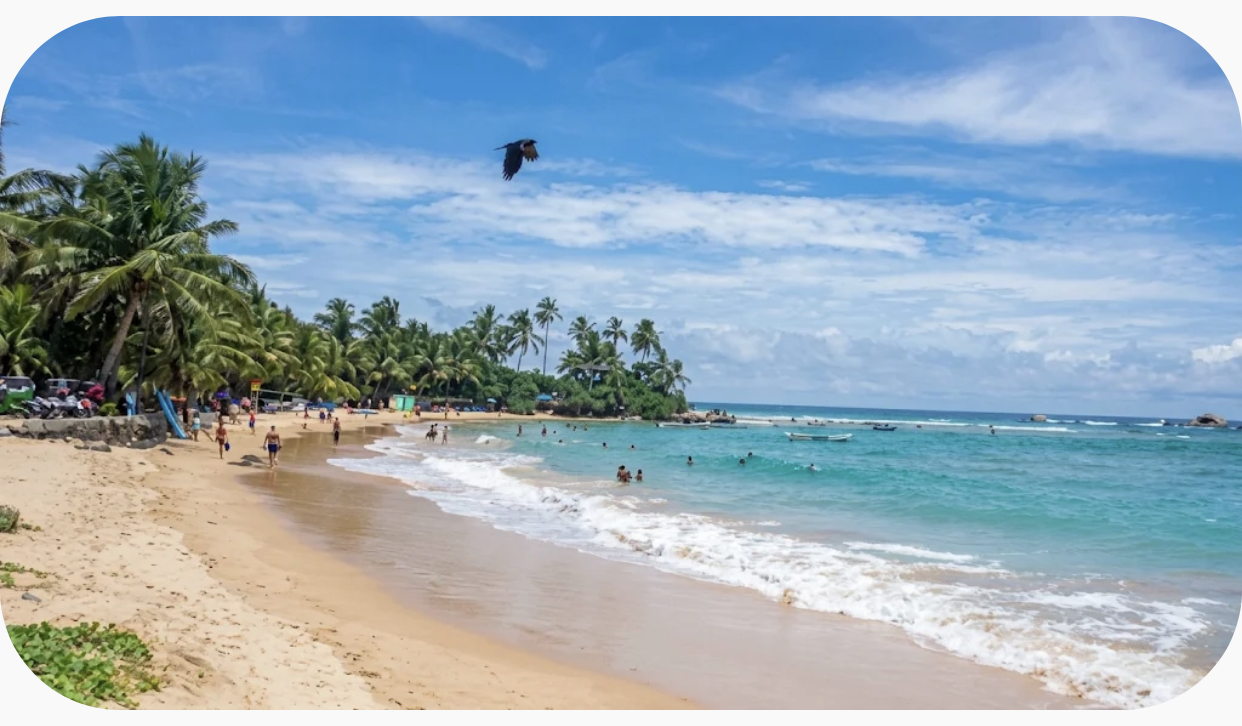
November marks the start of the southern coast’s peak tourist season, when thousands of international visitors arrive expecting turquoise bays and gentle surf. On Sunday evening, November 15, that postcard illusion turned fatal at NarigamaBeach in Hikkaduwa.
A 71-year-old German national entered the sea along the popular Narigama stretch for an evening swim when a powerful rip current seized him and dragged him offshore. Alert local residents spotted the swimmer in distress, pulled him back to the sand, and rushed him to the Balapitiya Base Hospital. Despite emergency medical treatment, he succumbed shortly after admission. His body remains at the Balapitiya Hospital mortuary pending a post-mortem examination as Hikkaduwa Police continue their inquiry.
Anyone familiar with Sri Lanka’s southwestern shoreline knows that Hikkaduwa, alongside neighbouring Balapitiya, Bentota, and Mirissa, sits squarely on the Sri Lanka Coast Guard’s list of highest-risk coastal zones. Even more sobering is the timing. Coast Guard operational data explicitly identifies November through May as the peak window for coastal rescues, largely because visitors assume that the arrival of the dry season makes the Indian Ocean tame.
Submit Your Press Release
Get your company news, announcements, launches, appointments and events in front of a wider audience.


The numbers tell a very different story. Police records logged 388 water-related fatalities across Sri Lanka in 2025 alone, while police lifeguards had to pull 96 foreign tourists from dangerous waters that same year. Over the longer term, the Sri Lanka Coast Guard has rescued 2,662 people since 2009, nearly half of them, 1,244, foreign nationals. At Hikkaduwa itself, a 54-year-old visitor perished in a strong current last December, following the death of a young tourist swept away there in January 2025. Across the island this year, rip currents and rough surf have already claimed visitors at Bentota, Weligama, and Nilaveli.
Part of the problem lies in patchy beach coverage. While Police maintain 71 lifeguard units with 308 officers across 31 divisions and the Coast Guard operates 16 dedicated coastal lifesaving posts, long stretches of popular tourist beaches, including sections of Narigama, remain unpatrolled, particularly around dusk when swimmers head in for sunset dips.
For anyone heading to the coast this season, understanding how a rip current works is far more useful than relying on a calendar. A rip current does not pull you underwater; it is a narrow, fast-moving channel of water rushing away from the beach through gaps in sandbars. Ironically, the water inside a rip often looks deceptively calm and dark between lines of breaking white waves.
Swimmers get into fatal trouble when panic sets in and they try to swim straight back toward the sand against a current moving faster than an Olympic freestyler. Exhaustion does the rest. If you ever feel the sand vanish beneath your feet and the shore receding rapidly, fight the instinct to battle the pull. Keep your head above water, float to conserve energy, and swim parallel to the shoreline until you escape the narrow channel before angling back toward the beach.
Always swim near staffed lifeguard posts, respect red warning flags even when the surface looks glassy, and never enter the sea alone at dusk. In Hikkaduwa, the ocean rarely gives a second warning.



