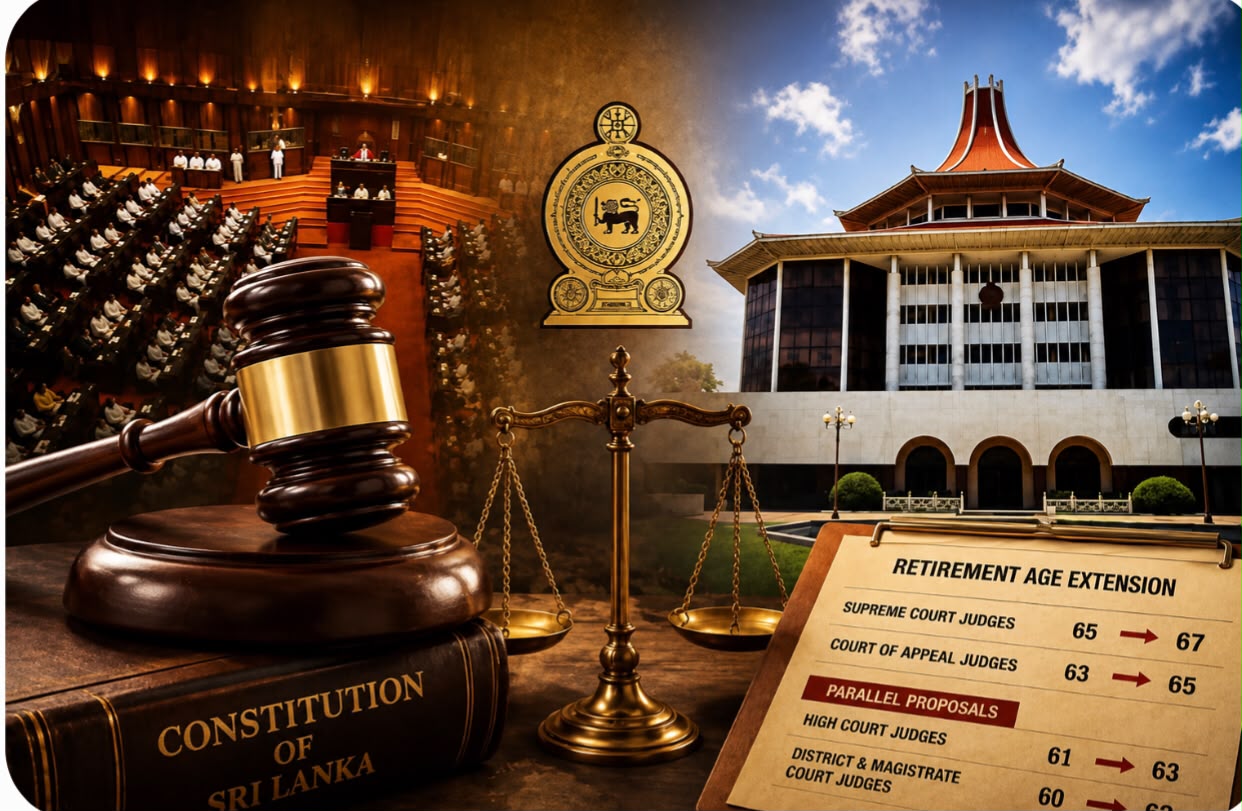
The publication of the Government’s Bill to extend the retirement age of judges of the Supreme Court and Court of Appeal has immediately revived one of the most important constitutional questions likely to arise before Parliament this year.
The issue is not whether judges should retire at whichever age. Many countries have reviewed judicial retirement ages in response to increasing life expectancy and the growing value of retaining experienced judges on the Bench.
The real question is whether Sri Lanka’s Constitution permits the retirement age of judges already appointed under the existing constitutional framework to be altered without first obtaining the approval of the People.
The Constitution presently specifies the retirement ages of judges of the Supreme Court and Court of Appeal. Critics of the Government’s proposal, including the Bar Association of Sri Lanka, have argued that changing those constitutional provisions in a manner that affects incumbent judges may have implications for judicial independence and, by extension, the sovereignty of the People protected under Article 3 of the Constitution.
Their argument is that security of judicial tenure is a fundamental component of judicial independence.
If Parliament is able to alter the terms of office of serving judges after their appointment, questions arise as to whether such a change affects entrenched constitutional principles which, under certain circumstances, require approval not only by a two-thirds majority in Parliament but also by the People at a Referendum.
The Government takes a different view. It maintains that the proposal is a general constitutional reform designed to strengthen the administration of justice by retaining experienced judges for a longer period. Ministers have rejected suggestions that the Bill is intended to benefit any individual judge and argue that Parliament possesses the constitutional authority to amend these provisions in accordance with the amendment procedure laid down in the Constitution.
Ultimately, it will not be politicians who answer this question. Once the Bill is placed on the Order Paper of Parliament, it may be challenged before the Supreme Court. The Court will then determine whether any provision of the Bill is inconsistent with the Constitution and, if so, the manner in which Parliament may lawfully enact it.
The Supreme Court’s determination will therefore be watched closely not merely because of its effect on judicial retirement ages, but because it will clarify the constitutional limits of Parliament’s power to alter the tenure of judges and the circumstances in which the People themselves must be consulted through a Referendum.
Whatever the Court ultimately decides, its ruling is likely to become an important constitutional precedent extending well beyond the immediate question of judicial retirement ages.