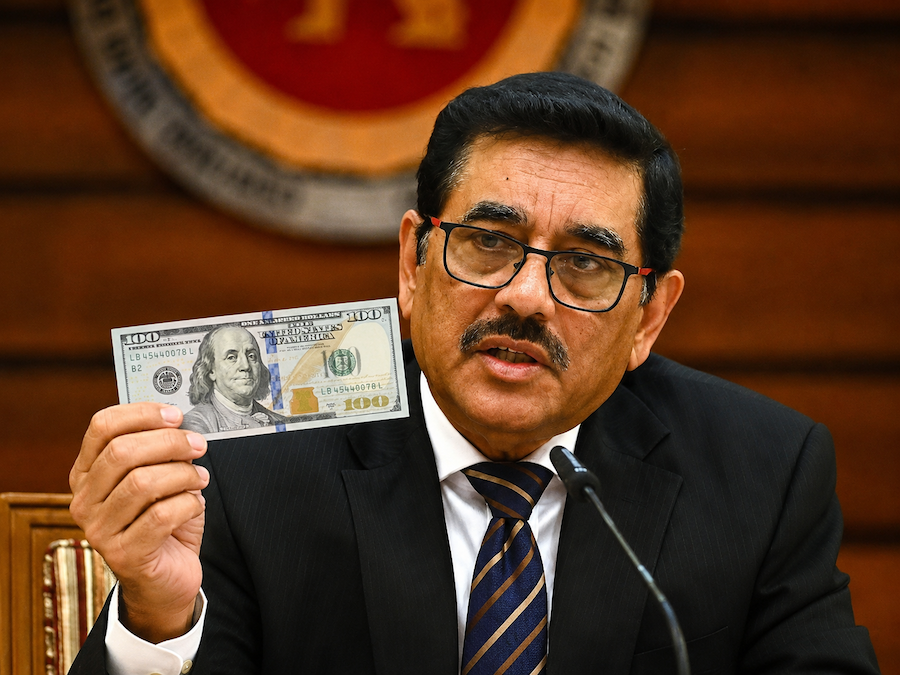
Sri Lanka’s economic crisis may no longer be making global headlines, but for ordinary citizens the pain is far from over. A rapidly depreciating rupee, rising living costs, weakened purchasing power, and growing dependence on foreign monetary dictates have once again raised a difficult question: did Sri Lanka’s economic managers choose the wrong path under the IMF programme?
Critics argue that one of the biggest policy failures of the current recovery strategy was the decision to maintain an overwhelming dependence on the U.S. dollar while ignoring the possibility of a diversified currency framework better suited to Sri Lanka’s regional economic realities.
At the center of this criticism are the International Monetary Fund and Central Bank Governor Dr. Nandalal Weerasinghe, who championed aggressive monetary tightening, a market-driven exchange regime, and IMF-backed stabilization policies that many now say came at an enormous social and economic cost.
While the IMF programme succeeded in restoring a degree of macroeconomic order and rebuilding foreign reserves, opponents argue that it did so by sacrificing domestic economic stability and exposing Sri Lanka to the full force of global dollar volatility.
As the U.S. Federal Reserve maintained high interest rates and the dollar strengthened globally, Sri Lanka’s rupee remained under constant pressure. The result was predictable: imported inflation surged, businesses struggled with higher input costs, and consumers absorbed the burden through rising prices on everything from medicine to food.
Economists questioning the current strategy point out that Sri Lanka’s trade and financial relationships are no longer dominated solely by the West. India and China are among Sri Lanka’s largest trading partners, lenders, and investors. Yet policymakers failed to seriously explore a managed currency basket involving the Chinese yuan and Indian rupee alongside the U.S. dollar.
Such a system, they argue, could have reduced pressure on dollar reserves, stabilized trade settlements, and protected the rupee from excessive exposure to U.S. monetary shocks.
Ironically, the IMF itself permits and even recognizes basket-based exchange systems in several countries. Kuwait operates on a basket peg. Morocco maintains a euro-dollar basket. China references a basket arrangement in managing the yuan. Yet Sri Lanka, despite facing one of the worst balance-of-payments crises in modern history, was effectively pushed toward a dollar-centric stabilization model.
Critics say this reflects a deeper structural bias within IMF programmes — one that prioritizes financial orthodoxy and creditor confidence over long-term monetary sovereignty and regional integration.
Questions are now also being raised about whether the Central Bank under Nandalal Weerasinghe became excessively aligned with IMF prescriptions while failing to develop a uniquely Sri Lankan strategy suited to the island’s geopolitical and economic realities.
For many businesses, the consequences have been devastating. Companies dependent on imports continue to face volatile pricing. Small and medium enterprises remain trapped between high borrowing costs and weakened consumer demand. Families that survived the 2022 collapse are once again seeing their savings eroded by currency weakness and inflation.
Supporters of the IMF programme insist there was no alternative and argue that Sri Lanka had to restore international credibility after defaulting on its debt. But critics counter that stabilization without economic sovereignty merely postpones future crises.
The central accusation is becoming louder: Sri Lanka was rescued financially, but at the cost of becoming more vulnerable monetarily.
As global trade increasingly shifts toward multipolar currency arrangements and regional settlements, Sri Lanka may ultimately regret failing to build a more balanced monetary framework when it had the opportunity.
For a nation still recovering from economic collapse, the fear now is that dependence on a single foreign currency — and blind faith in externally designed policy frameworks — may continue to keep the country trapped in cycles of instability for years to come.