
COPF Summons Treasury Secretary Over Missing USD 2.5 Million As Constitutional Questions Begin To Surface
Be that as it may, Sri Lanka tonight finds itself confronting a constitutional reality that governments, ministries and public officials occasionally appear to forget until Parliament reminds them.
When Parliament summons you over public money, it is not an invitation to tea.
It is a summons.
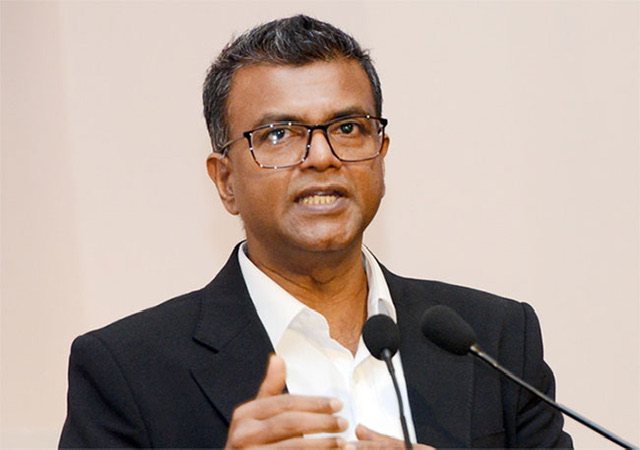
And that distinction now sits at the centre of a growing institutional confrontation involving Treasury Secretary Harshana Suriyapperuma, the alleged diversion of USD 2.5 million intended for an Australian state entity and
the authority of Parliament itself over public finance.
The Secretary to the Treasury has been summoned before the Committee on Public Finance to answer questions surrounding the now notorious transfer that allegedly ended up in the hands of hackers rather than reaching its intended destination.
The matter has already generated considerable concern within financial and political circles because it touches directly upon sovereign payments, Treasury controls and the credibility of state financial systems.
However, NewsLine understands that Suriyapperuma has formally informed Parliament that he will not be attending the Committee sitting scheduled for 30 April 2026.
That development has immediately intensified discussion within parliamentary and legal circles because the order issued by the Committee is not merely a routine request. In parliamentary practice, a summons carries legal and constitutional weight. Certainly, appearance dates can sometimes be adjusted on acceptable grounds with the concurrence of the Committee. Illness, official travel or unavoidable state duties may justify postponement where Parliament itself accepts the explanation.
But the larger constitutional principle remains clear.
Once summoned by Parliament in relation to public finance, attendance is not optional.
After all, Parliament remains the final constitutional authority over the raising, allocation, appropriation and scrutiny of public funds. That principle lies at the very foundation of parliamentary democracy itself. Governments may administer money. Ministries may spend it. Treasury officials may manage it. But ultimately, public finance belongs constitutionally to Parliament and through Parliament to the people.
Which is why this issue now extends far beyond a missing USD 2.5 million.
The deeper question becoming visible is whether Sri Lanka’s institutional culture fully appreciates that parliamentary oversight is not a ceremonial exercise conducted for headlines and committee-room theatrics. It exists precisely so that public officials entrusted with state finances can be questioned directly when serious concerns arise involving public money, controls and accountability.
Separately, the Governor of the Central Bank of Sri Lanka has also reportedly been summoned before the Committee. However, he is understood to presently be overseas. It remains unclear whether the Governor himself will subsequently appear before Parliament or whether a Deputy Governor may instead be delegated to represent the Central Bank at the proceedings.
That issue too may become politically sensitive.
Because while deputies and officials may explain technical processes, Parliament may ultimately insist on hearing directly from the individuals occupying the apex of institutional responsibility itself.


