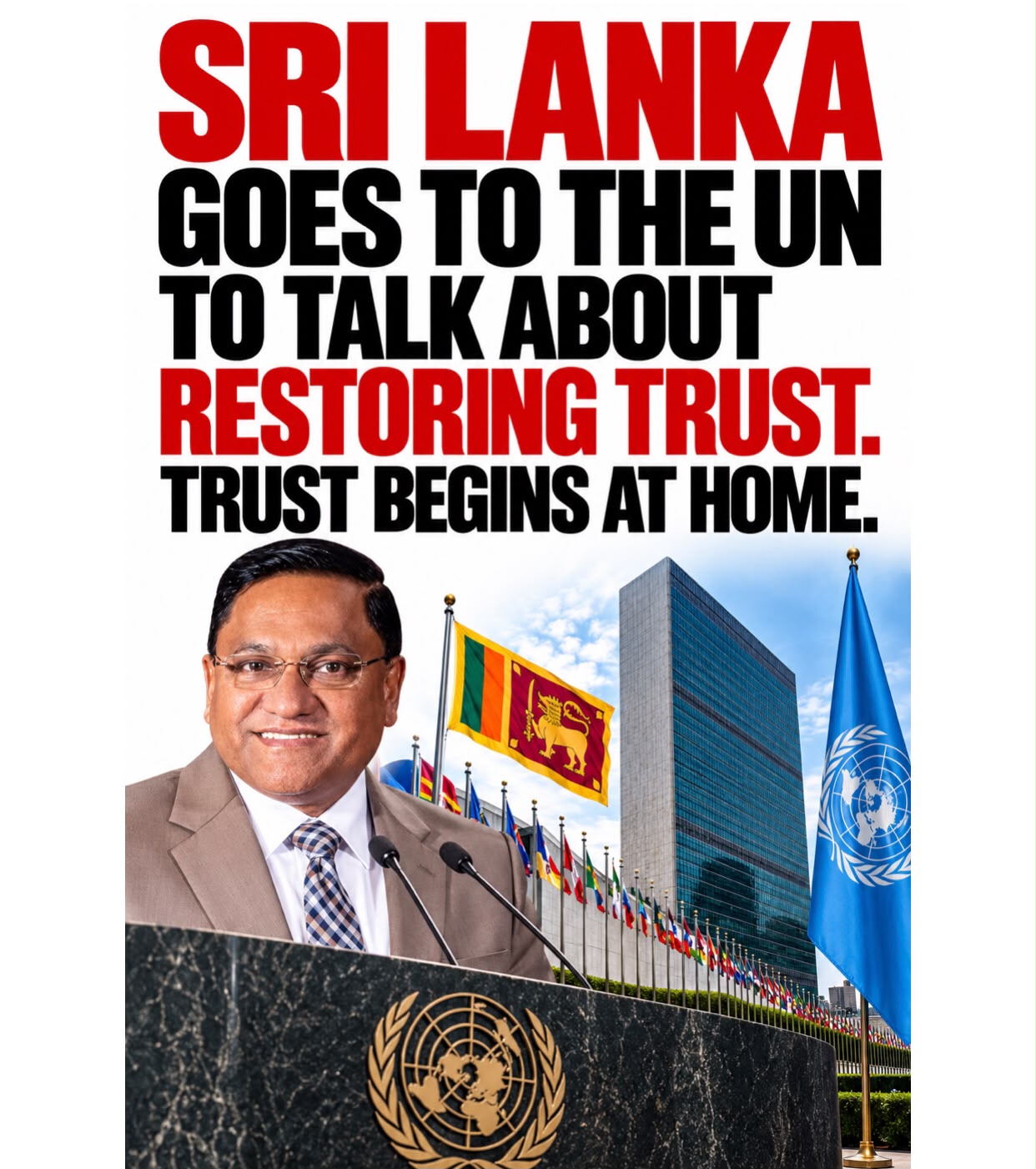
Foreign Minister Vijitha Herath has taken Sri Lanka’s message to the United Nations under a General Assembly theme built around restoring trust. For a country still rebuilding its economy, institutions and international relationships, those two words carry rather more weight than diplomatic rhetoric might suggest.
Foreign Minister Vijitha Herath was scheduled to deliver Sri Lanka’s national statement to the 81st Session of the United Nations General Assembly in New York on Monday, leading the country’s delegation during one of the most important weeks in international diplomacy.
This year’s theme is unusually appropriate: “Restoring Trust, Managing Transformation: A United Nations That Delivers for All.”
Submit Your Press Release
Get your company news, announcements, launches, appointments and events in front of a wider audience.


Herath is also scheduled to meet UN Secretary-General António Guterres, senior United Nations officials and foreign ministers from several countries during the visit.
For Sri Lanka, however, “restoring trust” is not merely a convenient phrase appearing on the UN programme.
It describes much of the country’s unfinished business.
Sri Lanka has spent the years since the economic collapse trying to restore trust among creditors, international financial institutions, investors and its own citizens. Debt restructuring required creditors to believe the country would honour a new arrangement. The IMF programme requires confidence that agreed reforms and fiscal targets will be maintained. Investors need to believe that rules will not change unpredictably after capital has been committed.
Citizens require something more basic: confidence that institutions work fairly.
Sri Lanka’s international diplomacy therefore operates against a domestic backdrop that cannot conveniently be separated from it.
Governments naturally use the General Assembly to present their countries in the strongest possible light. That is hardly peculiar to Sri Lanka. New York during UN week may be the world’s largest annual gathering of governments explaining their achievements to one another.
But international credibility ultimately rests upon what happens after the speeches.
The present Government came to office promising a significant change in political culture, governance and accountability. It has an unusually large parliamentary majority with which to pursue that programme. That gives it power, but it also removes one of the traditional excuses governments employ when reform becomes uncomfortable.
The international community will watch the economic programme. It will also watch reconciliation, human rights, institutional independence, corruption enforcement and the durability of democratic safeguards.
None of this means Sri Lanka should travel to New York to perform an exercise in national self-criticism. Foreign policy exists to advance national interests, and the Foreign Minister’s responsibility is to represent Sri Lanka rather than apologise for it.
Sri Lanka also has legitimate interests that deserve forceful advocacy.
As an Indian Ocean state, it is exposed to geopolitical competition it did not create. As an importer of energy, it is acutely vulnerable to conflict in the Middle East. As a developing economy emerging from default, it has an obvious interest in reform of international financial structures. Climate change poses risks disproportionate to the country’s contribution to the problem.
These are issues on which Sri Lanka should have a voice. But a country’s voice abroad becomes stronger when its institutions command confidence at home.
That is why the UN’s language about restoring trust deserves attention beyond the conference hall.
Trust is an unusual national asset. It cannot be imported, borrowed from the IMF or manufactured by a communications department. It accumulates when governments say what they intend to do, do it, explain when they cannot, and apply rules consistently even when doing so becomes politically inconvenient.
Sri Lanka has learned, at enormous cost, what happens when confidence disappears.
Be that as it may, Vijitha Herath’s audience in New York is important.