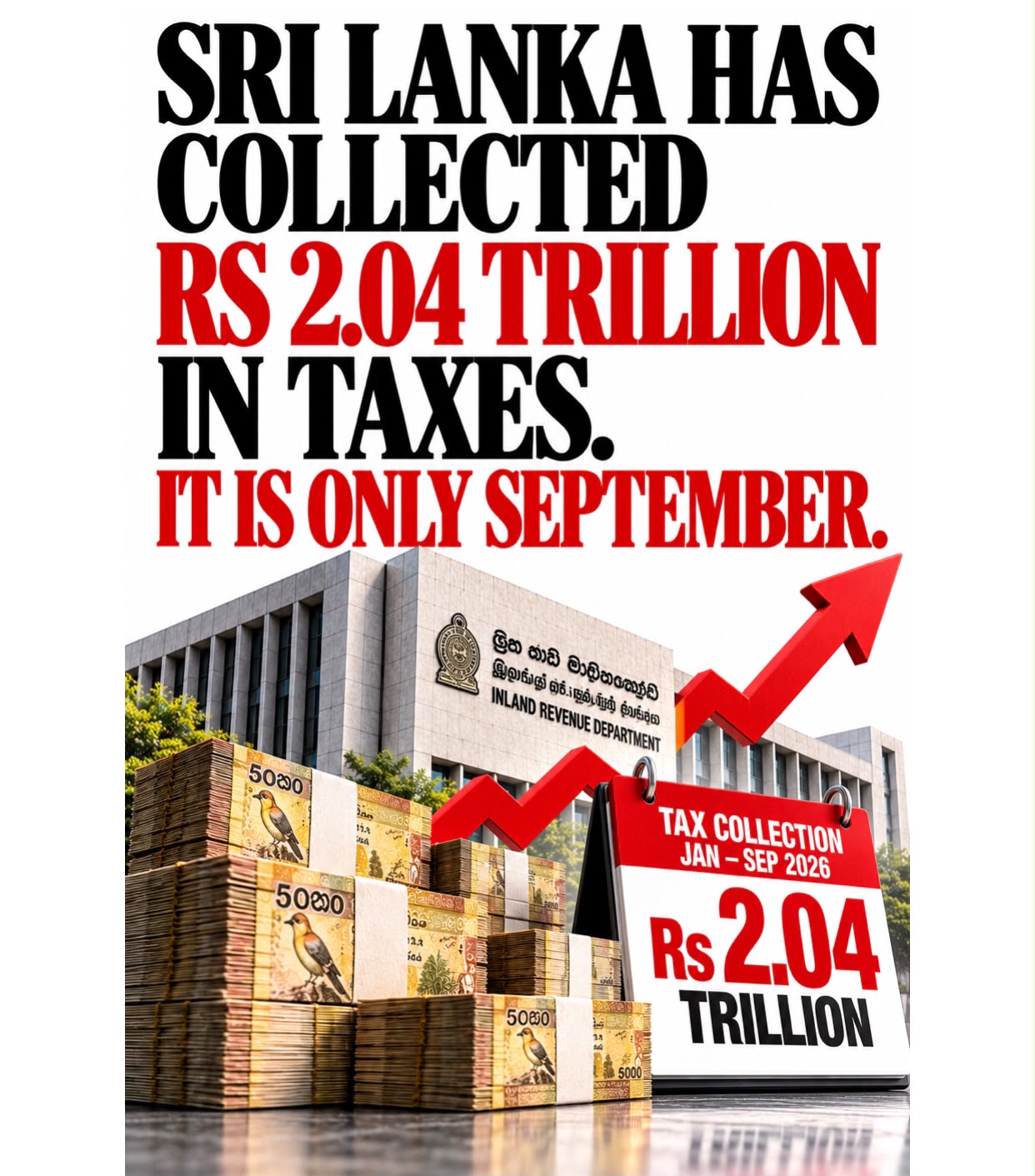
Sri Lanka’s Inland Revenue Department has collected Rs 2.04 trillion in the first nine months of 2026, already reaching 85 percent of its target for the entire year. That is an impressive achievement for the tax collector. It also raises a rather more interesting question for the taxpayer: where exactly did the additional Rs 398 billion come from?
Something significant has happened to Sri Lanka’s ability to collect taxes. Between January and September last year, the Inland Revenue Department collected Rs 1.642 trillion. During the same nine months this year it collected Rs 2.040 trillion, an increase of Rs 398 billion or approximately 24 percent.
The annual target is Rs 2.401 trillion. That means the IRD had already collected around 85 percent of what it was expected to raise during the whole of 2026 before the final quarter had even begun. September alone produced Rs 288 billion, compared with Rs 216 billion during September last year.
Submit Your Press Release
Get your company news, announcements, launches, appointments and events in front of a wider audience.


For a country that spent decades complaining about an inadequate tax base, poor compliance and a government unable to collect what it was owed, that deserves recognition. Sri Lanka’s fiscal problem was never simply that governments spent too much. The State also became remarkably bad at collecting sufficient revenue from the economy it governed.
That changed dramatically after the economic collapse.
Taxes increased, exemptions were reduced, income-tax thresholds changed and PAYE returned in the form of Advanced Personal Income Tax. VAT increased and its coverage widened, withholding taxes changed, corporate taxation was strengthened and tax administration became considerably more aggressive. The number of people and businesses brought within the tax system expanded.
The results are now visible in the Government’s bank account.
But a 24 percent increase in tax revenue does not necessarily mean Sri Lankan incomes or corporate profits increased by 24 percent. Several different things can produce higher nominal tax collections at the same time, and separating them matters if we want to understand what is actually happening in the economy.
Part of the increase reflects stronger enforcement and compliance. Part reflects changes in tax rates and coverage introduced during the post-crisis fiscal reforms. Inflation also matters because higher nominal prices and incomes can increase nominal tax collections even where the underlying increase in real economic activity is considerably smaller.
There is genuine economic growth as well. Sri Lanka’s economy expanded 4.2 percent in the second quarter of 2026 and has continued recovering from the extraordinary contraction experienced during the crisis. More economic activity should naturally produce more government revenue.
The interesting exercise now would be to disaggregate that Rs 398 billion increase.
How much came from corporate income tax? How much came from individuals? How much from APIT? How much from withholding taxes and VAT administered through Inland Revenue? How much represents additional taxpayers entering the system rather than existing taxpayers paying more?
Those distinctions tell us whether Sri Lanka is broadening its tax base or simply extracting substantially more from the people and businesses already inside it.
That matters because the Government faces two objectives that can eventually conflict. It needs enough revenue to maintain fiscal stability and service the obligations of the State, but it also needs private businesses and households to retain enough money to invest, consume and expand the economy.
Taxation is therefore not simply a contest to see how high government revenue can go. The objective should be collecting sufficient revenue efficiently, fairly and predictably while leaving the productive economy capable of producing tomorrow’s tax base.
There is another question that will become increasingly difficult to avoid if revenue continues outperforming expectations. When does the taxpayer begin receiving a visible dividend from improved government finances?
That need not mean immediate tax cuts. Sri Lanka still has substantial debt obligations, public services require investment and the country’s fiscal recovery remains incomplete. Reducing taxes prematurely and recreating the revenue weakness that contributed to the crisis would achieve very little.
But taxpayers are entitled to ask what improved collection produces.
If the State becomes dramatically better at collecting money, hospitals should work better. Schools should improve. Public transport should become more reliable. Government departments should become more efficient and infrastructure should be maintained rather than allowed to deteriorate until another enormous capital expenditure programme becomes necessary.
Fiscal reform cannot ultimately be measured only by how efficiently the Government reaches into the taxpayer’s pocket. It must eventually be measured by what comes back out.
Rs 2.04 trillion says Sri Lanka has become much better at collecting taxes.
The next numbers should tell us what it is doing with them.