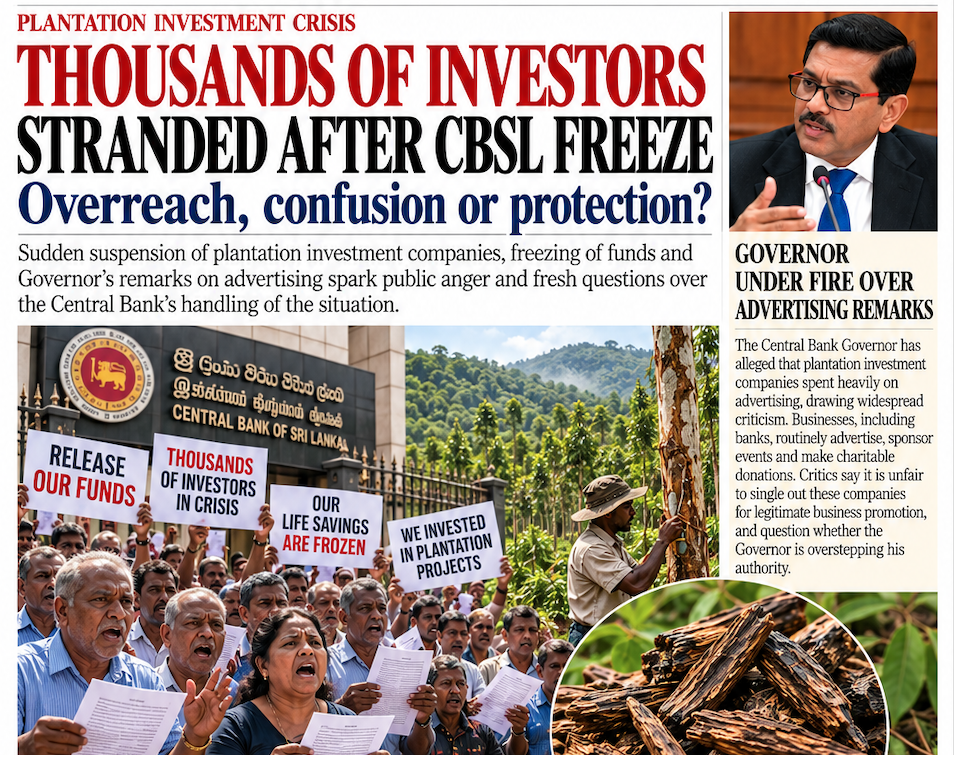
An examination of regulatory overreach, low bank deposit returns, frozen investor funds and the urgent need for a more transparent, proportionate approach to financial supervision.
The Central Bank of Sri Lanka (CBSL) has a legitimate and essential responsibility to protect the public from financial fraud, illegal deposit-taking and pyramid schemes. But even when a regulator has a valid legal objective, the manner in which it exercises its powers matters enormously. When regulatory action affects hundreds of ordinary investors, freezes access to their savings and threatens to disrupt legitimate commercial activity, the public has every right to demand answers about proportionality, transparency and the availability of remedies.
The controversy surrounding plantation and forestry investment companies raises precisely these questions. In late September 2026, the Central Bank announced enforcement action against six institutions accused of accepting unauthorised deposits under the guise of cultivation projects. The action followed complaints from investors who said they could no longer access their money. Governor Nandalal Weerasinghe defended the crackdown, arguing that promises of substantial annual returns and repayment of capital could not be sustained without continuously attracting new funds.
Submit Your Press Release
Get your company news, announcements, launches, appointments and events in front of a wider audience.


Yet the central issue is not whether Sri Lanka should tolerate fraudulent investment schemes. It should not. The more important question is whether the Central Bank has handled the situation in a way that distinguishes proven wrongdoing from legitimate commercial activity, protects investors without unnecessarily deepening their losses, and addresses the economic conditions that make people vulnerable to promises of unusually high returns.
A regulatory intervention can be legally justified and still be poorly managed. The test of effective regulation is not simply how quickly a regulator can stop a business, but whether it can stop unlawful conduct while preserving evidence, safeguarding recoverable assets, treating investors fairly and ensuring that innocent parties are not needlessly harmed.
The legal distinction between a deposit and an investment cannot be ignored
One of the most contentious aspects of this dispute is the distinction between accepting deposits and raising capital for an investment project.
A deposit-taking business ordinarily receives money with an obligation to repay it under agreed terms. A genuine investment, by contrast, generally involves capital committed to a business activity, with returns dependent on the project’s performance and the contractual rights of the investor. The precise legal classification depends on the arrangement’s substance, not simply the name used in a contract or advertisement.
This distinction is critical. A plantation company selling an ownership interest in trees, agricultural land, future produce or another identifiable commercial asset should not automatically be treated as a deposit-taking institution merely because it receives money from investors. Equally, a company cannot evade financial regulation by labelling a fixed-return, capital-repayment arrangement an “investment” if the underlying transaction falls within the legal definition of deposit-taking.
The Central Bank’s own public guidance says that unauthorised deposit-taking is unlawful and that a scheme’s features must be examined to identify prohibited conduct.
The appropriate response, therefore, is not to accept either side’s description at face value. It is to examine the contracts, ownership rights, use of funds, underlying plantation assets, cash flows, repayment obligations and source of investor returns.
The regulator must demonstrate how the relevant legal provisions apply to the actual business model. If a company has engaged in unlawful deposit-taking, the law should be enforced. If it operates a genuine investment business that falls outside the prohibition, it should not be forced into a regulatory category simply because its commercial model is unfamiliar or its returns are higher than those offered by banks.
That is the case for clear legal definitions, transparent reasoning and a fair opportunity for affected companies to challenge regulatory decisions.
The banking sector’s profits raise legitimate questions about savings and competition
The wider economic context cannot be overlooked. Sri Lanka’s banks are highly profitable, and the gap between what banks earn on lending and what they pay depositors remains an important issue for savers.
According to the Central Bank’s Annual Economic Review 2025, the banking sector recorded provisional profit after tax of Rs. 368.8 billion in 2025, compared with Rs. 324.2 billion in 2024. Net interest income rose from Rs. 909.6 billion to Rs. 1,022.5 billion. The sector’s return on equity, however, moderated from 17.4% to 16.6%.
These figures do not establish that banks are acting improperly. Banks must cover operating expenses, credit losses, capital requirements, taxes and the cost of funding. Their profitability also reflects the risks they assume and the services they provide.
Nevertheless, the numbers reinforce a legitimate public-policy question: are ordinary savers receiving sufficiently attractive returns for leaving their money in regulated financial institutions?
When bank deposits offer returns that savers consider inadequate, some will search for alternatives promising substantially higher income. Plantation projects, property ventures, private lending and other non-bank investments can become attractive, particularly to retirees and households seeking supplementary income.
That does not mean low deposit rates are the sole cause of the current crisis, nor does it make a risky scheme safe. The pursuit of extraordinary returns can expose investors to substantial losses regardless of prevailing bank rates. But the relationship between deposit returns, financial literacy and the demand for alternative investments deserves serious investigation.
The Central Bank should examine this demand rather than treat investor behaviour solely as a failure of individual judgement.
Investors’ hardship must be part of the regulatory equation
The immediate human consequence of freezing funds is that investors may lose access to money they had expected to use for household expenses, medical costs, education, retirement or other commitments.
Some investors may have believed they were financing genuine plantation activity. Others may have been attracted by promised monthly payments or a contractual return of capital. Their circumstances and legal claims may differ considerably.
The fact that a company previously made payments to investors is not proof that its business model was sustainable. A scheme may make payments from genuine operating revenue, asset sales, borrowed funds or new investor contributions. Only a forensic examination of its accounts can establish the actual source.
The opposite is also true: the fact that a company is under investigation does not, by itself, establish that every transaction was fraudulent or that every investor knowingly participated in an unlawful scheme.
In late September 2026, the Governor stated that the Central Bank had frozen accounts associated with six institutions and was seeking to preserve assets for eventual court-supervised distribution. He also alleged that funds had been diverted to other commercial ventures and used to sustain payments to participants. These are serious claims that warrant a thorough investigation and evidence-based findings.
If the allegations are substantiated, enforcement is necessary. But the regulatory response should also recognise that freezing funds can create severe hardship for people who may themselves be victims.
A freeze may be necessary to prevent asset transfers, dissipation or concealment. Yet a freeze is not the same as recovering the money, establishing liability or compensating investors. Without a transparent process, affected people can be left in prolonged uncertainty while legal proceedings continue.
The Central Bank and the relevant courts should therefore communicate clearly about what has been frozen, which assets are subject to court orders, the status of investigations and the process through which verified claims will be considered.
Investors deserve more than warnings that they may have been deceived. They deserve a credible process for determining what remains, who has legitimate claims and how recoverable assets will be distributed lawfully.
Freezing orders: necessary protection or unnecessarily broad intervention?
The Central Bank’s own announcement of 22 September 2026 provides important detail. It identifies Kasagala Green Plantation (Private) Limited and Ceylon Green Life Plantation (Private) Limited among the companies under investigation, alongside four other institutions subject to freezing orders. The Bank says the High Court of Colombo has confirmed and extended the relevant orders. It distinguishes the two plantation companies under investigation from the other four companies it says have already been determined to have carried on finance business or accepted deposits in contravention of the Finance Business Act.
That distinction matters. An investigation, a regulatory determination and a final finding of criminal liability are not interchangeable.
The existence of a court-confirmed freezing order also means the issue cannot fairly be described as a unilateral administrative decision in every respect. The Central Bank has statutory powers, and the courts have a role in reviewing or confirming certain orders. Criticism should therefore focus on the evidence, proportionality, implementation and consequences of the measures, rather than suggesting that every freeze was imposed without judicial involvement.
Nevertheless, the public deserves answers to several questions:
- Were the restrictions limited to assets reasonably suspected of being connected with the alleged unlawful activity?
- Were legitimate plantation operations and productive assets unnecessarily disrupted?
- Could independent supervision have allowed essential agricultural operations to continue while preserving assets?
- How quickly will the authorities verify investor claims and establish a transparent recovery process?
- What safeguards prevent the investigation from becoming an indefinite freeze that leaves investors without either their money or a clear route to recovery?
These are not arguments for allowing suspected wrongdoing to continue. They are questions about whether enforcement is achieving its stated purpose with the least avoidable harm.
A blanket freeze may be justified where there is a demonstrable risk that assets will be dissipated. But it should not become a substitute for a recovery strategy. The objective must be to preserve value, investigate misconduct and maximise lawful recovery—not simply to immobilise assets indefinitely.
Advertising is not proof of fraud
The Governor’s public comments about advertising raise another important issue.
In July 2026, the Governor warned media organisations against carrying advertisements that could mislead citizens into unlawful deposit-taking arrangements. He reportedly raised concerns about advertisements promoting cultivation projects that allegedly served as a route for soliciting money from the public.
There is a legitimate concern here: advertising can be used to attract participants into fraudulent schemes. Media organisations should not knowingly promote unlawful financial products or publish misleading claims about guaranteed returns.
But the principle must be applied consistently.
Advertising is a normal and lawful business activity. The existence of an advertisement is not, by itself, evidence of fraud.Banks, finance companies, insurers, investment firms and ordinary commercial enterprises advertise their products, promote their services, sponsor events and participate in charitable initiatives.
A company should not be treated as fraudulent merely because it spends money on marketing. The relevant questions are what it advertised, whether its claims were truthful, whether the advertised product was lawful and how the money raised was actually used.
If an advertisement promises an unrealistic guaranteed return, conceals material risks or solicits deposits without the required authorisation, the authorities should act on that evidence. If the advertisement accurately describes a lawful commercial investment, the mere fact that it promotes the business should not become a basis for regulatory suspicion.
The same standard must apply to all market participants, regardless of their size, political connections or standing in the financial system.
The Central Bank should publish clear guidance for advertisers and media houses that distinguishes lawful investment promotion from misleading or unlawful solicitation. Such guidance would be far more constructive than allowing uncertainty to develop around whether entire categories of commercial advertising might attract regulatory action.
There is also no sound basis for concluding, from the public record reviewed here, that the Governor has a personal vendetta against the companies concerned. Such an allegation would require evidence. The appropriate criticism is that regulatory decisions and public statements must be evidence-based, proportionate and free from any appearance of personal or selective enforcement.
How the Central Bank should have handled the crisis
The Central Bank had a range of tools available to it. The most effective response would have combined firm enforcement with a structured process to protect investors and minimise avoidable economic damage.
1. Investigate the business model before making broad public conclusions
Examine each company’s contracts, bank statements, audited accounts, plantation ownership, crop yields, land valuations, liabilities and investor-payment records. Establish whether returns come from genuine operating revenue, asset sales, borrowing or new investor contributions. Publish the legal basis and factual grounds for each enforcement decision to the extent permitted by law.
2. Use targeted asset-preservation measures
Freeze assets where there is a substantiated risk of concealment, transfer or dissipation. Where legally permissible, consider independent administrators, court-approved expenditure for maintaining plantations, and controls on related-party transactions. Protecting the underlying agricultural assets may preserve more value for creditors and investors than allowing productive operations to deteriorate.
3. Separate legitimate investment activity from unauthorised deposit-taking
Assess each scheme against the Finance Business Act, Banking Act and any other applicable legislation. Distinguish genuine equity or asset-backed investment arrangements from arrangements that function as repayable public deposits. Give affected businesses a fair opportunity to present evidence and seek judicial review, without allowing that process to become a means of continuing unlawful fundraising.
4. Establish a dedicated investor-claims and recovery mechanism
Create a verified register of investors, disclose the claims-submission process and provide regular updates on investigations and court proceedings. Work with the courts to determine the lawful priority of claims and distribute recoverable assets transparently. Do not promise full repayment unless the available assets and legal position support it.
5. Regulate misleading advertisements consistently
Publish objective rules governing claims about returns, risk disclosures, licensing and the solicitation of funds. Investigate specific misleading advertisements and take action against proven violations. Do not confuse ordinary advertising, sponsorship or charitable contributions with evidence of an unlawful financial arrangement.
6. Address the wider savings and investment problem
Review deposit-rate competition, the transmission of policy rates to savers, consumer financial education and access to regulated investment products. Coordinate with relevant authorities to make lawful investment alternatives more accessible. Better returns cannot be guaranteed, but informed savers should have a range of transparent, fairly priced options.
Low deposit rates may contribute to the problem but cannot excuse unlawful schemes
The relationship between bank deposit rates and alternative investments deserves particular attention.
If households believe that their savings earn too little in banks, they may be more willing to accept risks they do not fully understand. That is a reason to improve financial education, competition and access to regulated investment products.
It is not proof that every person who invested in a plantation scheme was driven there by low deposit rates, nor that every such scheme was legitimate.
Likewise, higher deposit rates alone would not eliminate fraudulent schemes. Some investors will continue to pursue exceptional returns even when bank deposits become more attractive.
The Central Bank should therefore avoid treating monetary policy as a substitute for supervision, just as it should avoid treating enforcement as a substitute for broader financial-sector reform.
The banking sector’s 2025 profitability figures provide a legitimate basis for examining the distribution of returns between banks and depositors. But any proposal to increase policy rates or mandate higher deposit returns must also consider inflation expectations, credit conditions, bank funding costs, financial stability and the effect on borrowers and productive investment. A rate increase is not a guaranteed solution to this crisis.
The Central Bank must be firm on fraud and fair to investors
Sri Lanka cannot allow unlawful deposit-taking or pyramid schemes to flourish. Such arrangements can cause substantial losses, undermine confidence in the financial system and leave large numbers of people without realistic prospects of recovery. The Central Bank is right to investigate suspicious arrangements, preserve assets where justified and warn the public about material risks.
But a regulator’s responsibility does not end with stopping the collection of money.
It must also explain its decisions, distinguish allegations from established findings, use proportionate measures, support a fair judicial process and help maximise the recovery of assets for those who have suffered losses.
The plantation investment controversy is an opportunity to demonstrate that these principles can operate together. The authorities should disclose the status of the investigations, explain the legal basis of the restrictions, establish a clear claims process and provide regular public updates. They should also ensure that legitimate commercial activities are not unnecessarily destroyed while suspected unlawful conduct is being examined.
Ultimately, the question is not whether the Central Bank should protect the public. It must. The question is whether it can do so without creating unnecessary hardship for the very people it is meant to protect.
The credibility of financial regulation depends on more than the power to freeze assets. It depends on evidence, consistency, proportionality, transparency and a credible path towards justice and recovery.