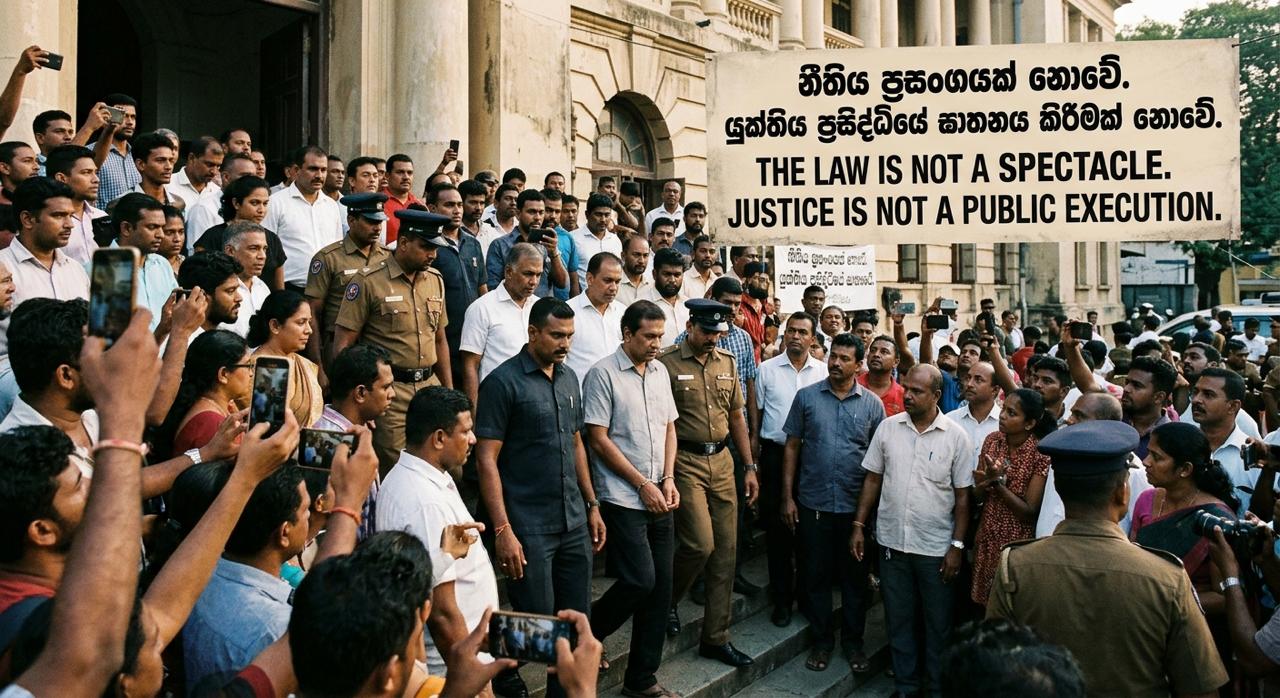
Sri Lanka is witnessing an extraordinary period in which individuals once regarded as politically untouchable are being investigated, arrested and brought before the courts. For a country that has endured decades of allegations of impunity, this is a significant development. But accountability must never become a substitute for justice, and the presumption of innocence must not become another casualty of political change.
There is something profoundly encouraging about a country beginning to question the conduct of those who once exercised enormous political and institutional power. Sri Lanka has spent far too many years confronting allegations of corruption, abuse of authority, financial misconduct and failures of public responsibility without consistently delivering the accountability its citizens deserve.
The election of President Anura Kumara Dissanayake and the subsequent parliamentary mandate secured by the National People’s Power reflected, among other things, a public demand for a different approach to governance. The expectation was not simply that different politicians would occupy the seats of power, but that the institutions of the Republic would begin functioning according to principles of transparency, fairness and equality before the law.
Submit Your Press Release
Get your company news, announcements, launches, appointments and events in front of a wider audience.


That expectation remains entirely legitimate.
But the manner in which accountability is pursued matters just as much as the determination to pursue it.
Recent months have seen former presidents, a former First Lady, senior police officers, political figures and other influential individuals become subjects of investigations and judicial proceedings. Their appearances before courts, encounters with investigators and periods in custody have attracted considerable public attention.
For some, these developments represent long-awaited evidence that political influence no longer guarantees protection from the law. For others, they raise concerns about the possibility of selective investigations and the political consequences of highly publicised arrests.
Neither public satisfaction nor political suspicion should determine the outcome of a criminal investigation.
The law must.
An arrest is not a conviction. Remand is not a sentence. An allegation is not evidence of guilt, and the decision to initiate proceedings does not establish that an offence has been committed.
These distinctions are not technicalities invented to protect powerful individuals. They are fundamental safeguards intended to protect every citizen from the arbitrary exercise of State power.
A person accused of stealing a modest sum is entitled to the same presumption of innocence as a former president accused of misconduct involving millions. A politically unpopular defendant possesses the same constitutional protections as a citizen whose innocence commands widespread public sympathy.
The principle is uncomplicated, even if its application is frequently uncomfortable.
Sri Lanka cannot claim to have established equality before the law while allowing the rights of an accused person to depend on public approval.
This is particularly important in a country where criminal investigations have historically been vulnerable to political influence, institutional weakness and selective enforcement.
The danger is not confined to the possibility that innocent people may be prosecuted. It also includes the risk that poorly prepared investigations, premature publicity and procedural failures will undermine otherwise legitimate cases.
When investigators make allegations that cannot subsequently be established through admissible evidence, the resulting acquittals can damage public confidence and provide opportunities for those accused to portray the entire accountability process as politically motivated.
The State must therefore approach investigations with professional discipline rather than public enthusiasm.
Evidence must be collected lawfully, witnesses must be protected, financial records must be examined competently and prosecutors must be satisfied that the available material supports the charges brought before a court.
The purpose of criminal justice is not to produce headlines. It is to establish responsibility according to law.
There is also a distinction between the legitimate reporting of judicial proceedings and the public humiliation of those accused.
The media has an important responsibility to scrutinise the conduct of powerful individuals, expose wrongdoing and inform citizens about matters of public interest. But that responsibility does not confer the right to present allegations as established facts or treat an accused person’s appearance in custody as proof of criminal responsibility.
The spectacle of arrest can be politically satisfying. It can also be dangerously misleading.
A person may be arrested and subsequently released without charge. Another may be remanded while investigations continue and eventually acquitted. A third may be convicted after a lengthy trial and sentenced according to law.
These outcomes are fundamentally different, and responsible public discussion must recognise those differences.
The presumption of innocence is not suspended when a defendant becomes unpopular.
Nor should the principle of equal treatment be abandoned when questions arise concerning religious identity, social standing or previous political office.
Recent controversy surrounding the treatment of convicted religious figures has demonstrated how quickly the debate can move from constitutional equality to demands for special accommodation.
Religious dignity deserves respect, but the State must distinguish between reasonable accommodation and preferential treatment that cannot be justified under the law.
The same principle applies to the wealthy, the politically connected and those who once exercised authority over the institutions now investigating them.
No individual should receive preferential treatment because of former office, family connections or public influence. Equally, no individual should be subjected to harsher treatment merely because of political history or public hostility.
Justice must be indifferent to status.
That is a demanding standard, particularly for a society emerging from years of frustration with political privilege.
There is an understandable desire to see those suspected of abusing public power held accountable. Citizens who have endured economic hardship, declining public services and repeated allegations of corruption are entitled to expect meaningful action.
But public anger, however justified, cannot replace the discipline of the law.
Indeed, the strongest demonstration of institutional reform would be a justice system capable of investigating the most powerful individuals while protecting their constitutional rights with exactly the same determination extended to every other citizen.
Such a system would be neither weak nor indulgent.
It would be credible.
The Government also has a responsibility to ensure that accountability extends beyond the prosecution of individuals associated with previous administrations.
A genuine commitment to clean government requires effective scrutiny of current officeholders, public procurement, appointments, State enterprises and the expenditure of public funds.
The standards applied to yesterday’s rulers must apply with equal force to those governing today.
Otherwise, accountability risks becoming a political cycle in which each incoming administration investigates its predecessors while expecting its own conduct to escape equivalent examination.
Sri Lanka has experienced enough of that pattern.
The country needs institutions capable of operating independently of political transitions, supported by competent investigators, properly resourced prosecutors and courts able to determine cases without interference or intimidation.
It also needs a public willing to accept judicial outcomes even when those outcomes do not satisfy political expectations.
An acquittal is not automatically evidence of corruption. A conviction is not automatically evidence of political persecution. Both must be assessed according to the evidence, procedures and legal reasoning involved.
The judiciary must be permitted to perform its constitutional responsibilities without being required to satisfy the demands of politicians, commentators or public opinion.
This does not place judicial decisions beyond criticism. Courts, like every public institution, are properly subject to informed scrutiny. But criticism must be distinguished from attempts to intimidate judges or prejudge proceedings.
The ultimate objective should be a Republic in which no citizen fears arbitrary prosecution and no public official assumes immunity from lawful investigation.
That would represent genuine change.
Be that as it may, Sri Lanka will not establish justice by turning the humiliation of yesterday’s powerful into today’s political entertainment. The handcuffs are not the revolution, the prison cell is not proof of guilt, and public applause is not a judicial verdict. A government committed to ending impunity must be equally committed to preventing injustice. Otherwise, the faces may change, the slogans may change and the occupants of political office may change, but the abuse of power will remain. The true measure of this Republic will not be how many prominent people it arrests, but whether it can finally deliver justice without fear, favour or exception.