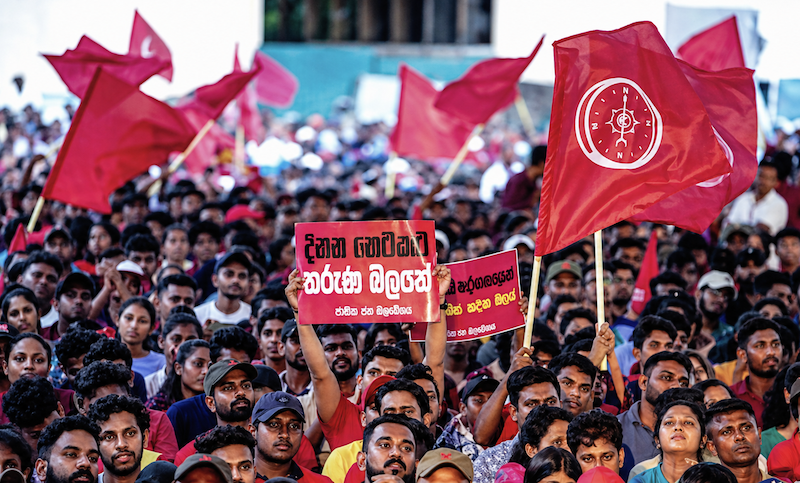
Every revolutionary government eventually reaches the same dangerous moment.
The slogans begin colliding with systems.
The promises encounter bureaucracy.
And moral outrage must finally become measurable competence.
FROM REVOLUTION TO RESPONSIBILITY: THE NPP NOW FACES ITS REAL TEST CYBER FAILURES, COAL CONTROVERSIES AND PUBLIC EXPECTATION COLLIDE WITH GOVERNMENT REALITY
For Sri Lanka’s ruling National People’s Power government, that moment appears to have arrived.
For months after the dramatic political upheaval that brought President Anura Kumara Dissanayake and the NPP to power, the administration benefited from something rare in Sri Lankan politics: public patience. After years of economic collapse, corruption allegations, political excess and institutional breakdown, many Sri Lankans were willing to give the new administration time, space and goodwill.
But the national mood now appears to be changing. Not necessarily toward hostility.
But unmistakably toward scrutiny.
The Treasury cyber theft involving the diversion of USD 2.5 million linked to payments associated with Australia may ultimately prove to be more than a financial scandal. It has become symbolic of a deeper anxiety now emerging around governance, oversight and administrative competence itself.
The Government insists hackers manipulated email communications through a Business Email Compromise operation. Investigations continue. Officials have been suspended. Yet the public questions now being asked extend far beyond cybersecurity.
How could such a breach occur inside the Treasury itself ? Why were warning signs allegedly missed?
Why was Parliament not informed earlier?
And perhaps most damagingly of all:
why did the Government appear reluctant to disclose the matter publicly until external pressure forced acknowledgment?
Those questions strike directly at the core brand upon which the NPP built its rise:
transparency, accountability and institutional discipline. The problem for reformist governments is brutal but simple. They are not judged merely against ordinary standards. They are judged against the standards they themselves demanded from others.
And that is where the pressure now intensifies.
The cyber theft controversy has arrived almost immediately after the damaging coal procurement dispute, where the Government initially defended procedures before an audit report cast doubt over aspects of the process. Add to this the political noise surrounding container releases, institutional appointments and growing concerns around operational capacity within key state sectors, and a pattern begins emerging that the opposition is now aggressively trying to frame:
that the NPP may possess moral legitimacy, but not yet administrative mastery.
To be fair, governing Sri Lanka in 2026 is no simple exercise. The country remains economically fragile. IMF- linked reforms continue imposing painful pressures on ordinary citizens.
Global instability in the Middle East threatens fuel prices, shipping routes and inflation. Bureaucratic systems inherited over decades remain deeply complex and resistant to rapid reform.
Yet that reality may matter less politically than perception. Because what Sri Lankans increasingly appear to want now is not simply honesty.
They want competence.
The NPP’s original political power came from presenting itself as fundamentally different from the old political order. Cleaner. Smarter. More disciplined. Less compromised. But every government eventually learns the same lesson:
public trust is not sustained by comparison with the past forever.
Eventually, performance itself becomes the benchmark.
That does not mean the Government is collapsing politically. Far from it. The opposition remains fragmented. President Dissanayake still retains significant personal credibility among large sections of the electorate. Many Sri Lankans continue believing the administration is more sincere than previous governments.
But sincerity alone no longer satisfies populations that have already experienced national collapse firsthand.
Sri Lanka today is not merely recovering economically. It is psychologically traumatised by failure.
And populations that have survived collapse become extraordinarily sensitive to warning signs suggesting systems may still be weaker than advertised.
Which is why the current phase of this Government may prove its most dangerous and most defining.
Not the revolution. Not the election. Not the slogans.
But the transition from promise to performance. Because once a government promises to end a “76-year curse,” the public eventually asks one unavoidable question:
What happens if the new system begins looking uncomfortably familiar to the old one?
Revolutions win elections. Competence keeps power.