
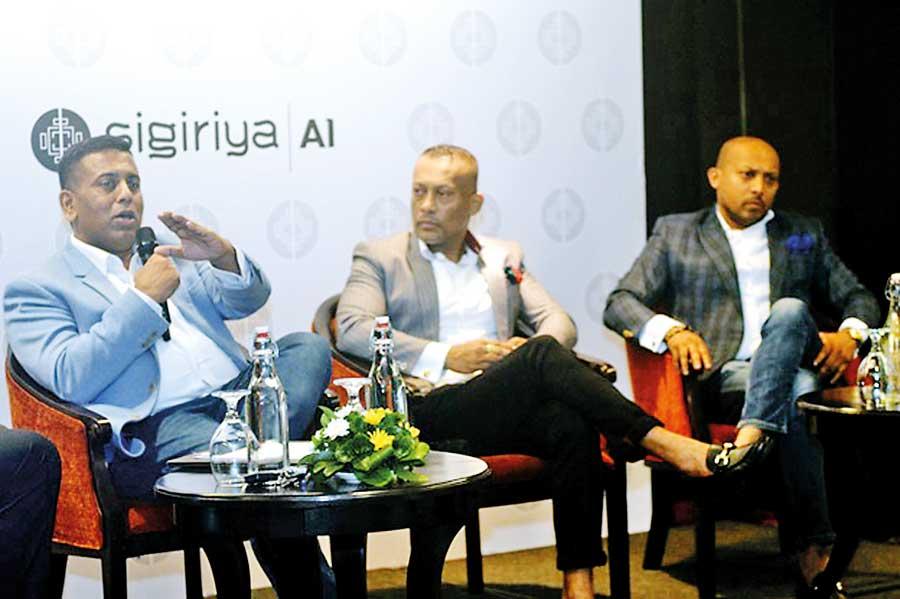
In May and June 2024, an unknown startup captured headlines across Sri Lanka’s mainstream media. Newspapers, television stations and online publications reported the imminent launch of “Sigiriya AI”, a platform described as Sri Lanka’s first Sinhala and Tamil Generative AI system. The project was promoted as a technological breakthrough that would place Sri Lanka on the global artificial intelligence map.
The founders Lakshitha Karunaratne, Lasitha Gunasinghe and Kasun Gunasinghe made a series of ambitious claims. According to media reports, Sigiriya AI would launch in July 2024, support Sinhala and Tamil dialects, achieve accuracy levels of 90-95 percent, and was built using proprietary datasets consisting of billions of Sinhala and Tamil records. The company also stated that the system was developed by a team spread across Sri Lanka, the United States, Dubai, India and the United Kingdom.
The publicity campaign was remarkably successful.
Daily Mirror, Daily News, The Island, Sunday Times and several other publications carried extensive coverage of the project. Newspapers and social media channels amplified the announcement, presenting Sigiriya AI as a major milestone for Sri Lanka’s technology sector.
Yet two years later, a simple question remains:
Where is Sigiriya AI?
A review of publicly available information reveals numerous launch announcements and promotional articles. What is less visible is evidence of large-scale public adoption, independently verified benchmark performance, published technical papers, open-source releases, enterprise deployments, developer ecosystems, or significant commercial traction. While the absence of public information does not prove failure, it does raise legitimate questions about whether the project ultimately delivered on the expectations created during its media campaign.
One of the most striking claims reported by multiple media outlets was that the platform had been trained using “10 billion Sinhala datasets” and “10 billion Tamil datasets.” Such figures would represent one of the largest language resources ever assembled for Sri Lankan languages. Yet no publicly available technical documentation appears to have been released explaining the composition, source, validation or licensing of these datasets.
Similarly, public claims regarding 90-95 percent accuracy were widely reported. However, there appears to be no publicly available benchmark methodology, independent evaluation, peer-reviewed study or technical report explaining how those figures were calculated or compared against competing AI models.
__________________________________
Vaporware is a tech industry term used to describe a product – typically hardware, software, or digital assets – that is announced, marketed, and hyped, but is ultimately never released or delayed for so long that it becomes irrelevant.
- All Hype, No Substance: Companies often market the product aggressively to generate buzz, secure pre-orders, or inflate their stock prices, despite the actual technology being in its infancy or entirely hypothetical.
- The Name: The term implies that the promised product vanishes into thin air like vapor.
- Why It Happens: It is often a result of overambitious development, “development hell” (constant setbacks), or intentional deception to hold consumer attention away from competitors.

____________________________________________________
The Sigiriya AI story also exposes a broader issue within Sri Lanka’s media landscape. Much of the coverage reproduced company statements with limited independent verification. While this is not unusual for technology reporting, it highlights the need for greater scrutiny when startups make extraordinary claims regarding artificial intelligence, datasets, model performance and technological breakthroughs.
Around the world, the AI boom has produced countless announcements, prototypes and launch events. Some evolved into successful products. Others never moved beyond the publicity stage. The challenge for journalists, investors and the public is distinguishing between technological achievement and technological aspiration.
The unanswered questions surrounding Sigiriya AI do not establish wrongdoing. However, they do illustrate why transparency matters. When companies make ambitious public claims, the public is entitled to ask what was delivered, how it was measured, how many users adopted it, and whether the promised technology ultimately reached the market.
Until those questions are answered, Sigiriya AI remains one of the most intriguing and least understood AI projects ever launched in Sri Lanka.
