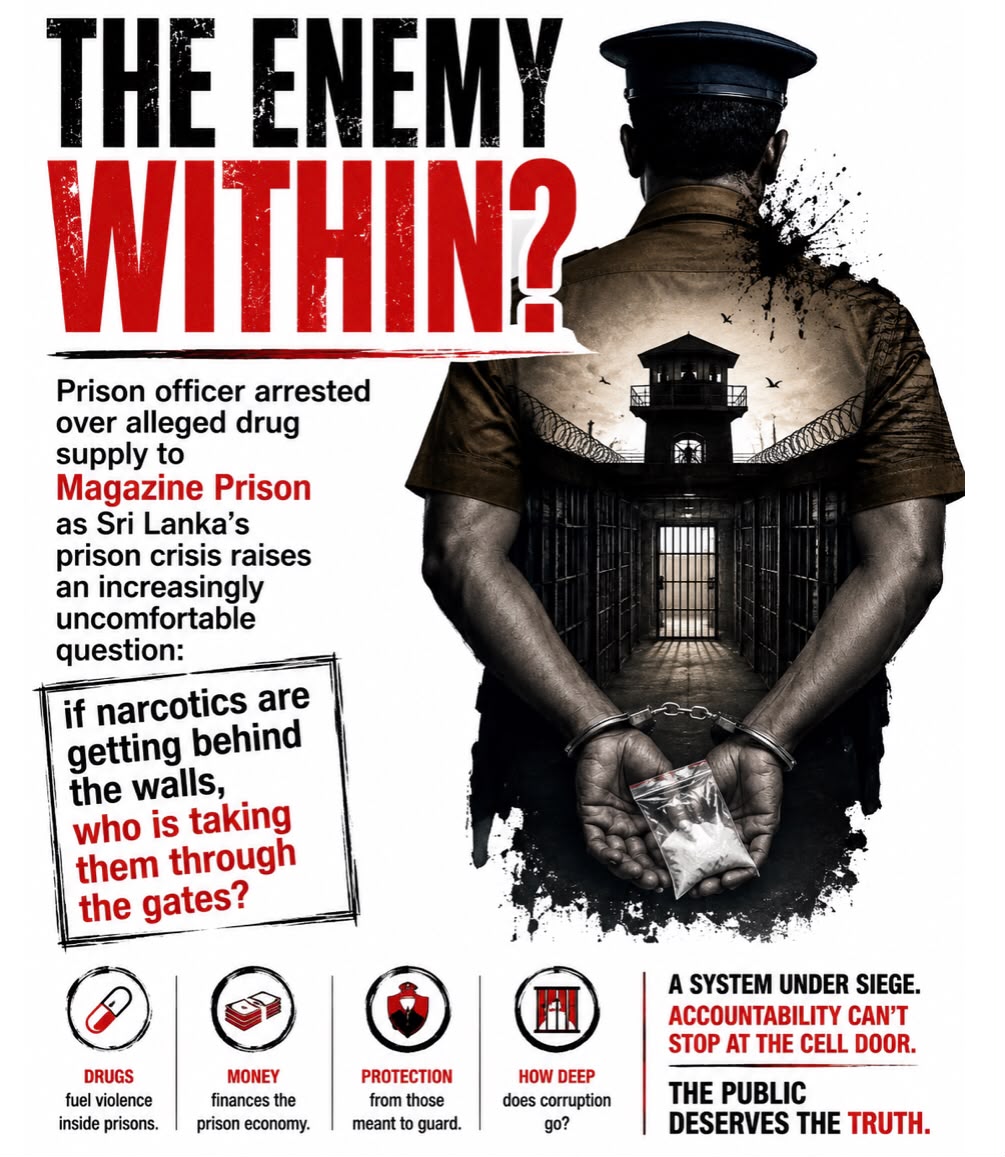
Prison officer arrested over alleged drug supply to Magazine Prison as Sri Lanka’s prison crisis raises an increasingly uncomfortable question: if narcotics are getting behind the walls, who is taking them through the gates?
COLOMBO, Wednesday – A prison officer has been arrested over allegations that he supplied narcotics to an inmate at Colombo’s Magazine Prison, adding a potentially disturbing new dimension to the crisis confronting Sri Lanka’s prison system and raising questions over whether corruption from within is helping sustain the illicit economy behind prison walls.
The 53-year-old officer was arrested following an investigation by the Colombo Crime Division into the alleged delivery of narcotics to a prisoner. Police said narcotics valued at more than Rs. 700,000 were recovered in connection with the arrest, while investigations are continuing into the circumstances surrounding the alleged operation.
Submit Your Press Release
Get your company news, announcements, launches, appointments and events in front of a wider audience.


The arrest comes at a particularly sensitive moment for the Department of Prisons. A succession of violentincidents at Negombo, Mahara, Magazine and other institutions has focused national attention on overcrowding, organised criminal networks, drugs, intelligence failures and the ability of prison authorities to maintain effective control inside facilities supposedly secured by the State.
The latest allegation therefore raises a question considerably wider than the culpability of one officer. If narcotics and other prohibited items are circulating within heavily guarded prisons, investigators will need to establish not merely who possesses them inside, but how they enter, whether established supply chains exist and whether prison personnel or outsiders with privileged access are facilitating those networks.
That question becomes still more pressing against the enormous cost of the recent disorder. The Prisons Department has now estimated that damage caused during the July unrest at Negombo Prison alone exceeds Rs. 100 million, adding a substantial financial burden to the loss of life, injuries and disruption already caused by the violence.
Authorities have repeatedly pointed towards narcotics and rival criminal groups as significant factors behind instability within prisons. But an effective response cannot rest solely upon tighter control of inmates if investigations establish that people entrusted with guarding the institutions are themselves capable of becoming links in the contraband chain.
The arrest should therefore provide investigators with an opportunity to work backwards. The critical questions include where the drugs allegedly originated, how frequently deliveries may have occurred, who was intended to receive them, whether money changed hands and whether other officers, prisoners or outside criminal networks were involved.
Sri Lanka’s prison problem is increasingly revealing itself as something larger than overcrowded cells or occasional eruptions of violence. It is becoming a test of whether the State exercises effective control over institutions in which the State possesses almost absolute authority.
If the allegations against the officer are established, the significance will lie not simply in another drug arrest. It will lie in the possibility that part of the threat to prison security may be entering through the same gates that are supposed to keep it out.