
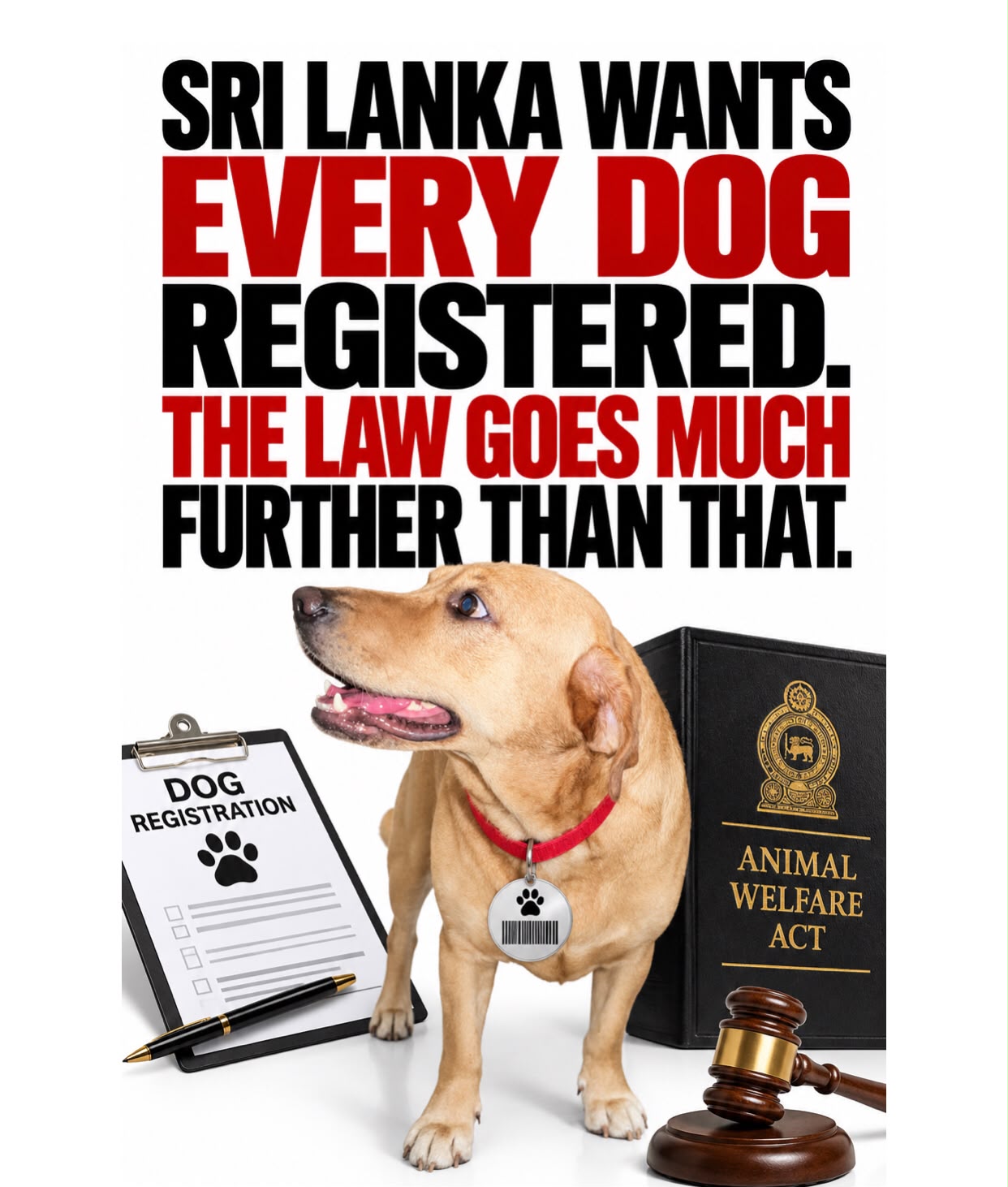
Annual vaccination and registration. Controls on breeding. A census every five years. Powers to enter premises and seize animals. Sri Lanka’s proposed new rabies law is not simply about registering the family dog. It would create an entirely new system for managing the country’s dog population.
A piece of legislation presented to Parliament on Thursday could eventually affect almost every household in Sri Lanka that owns a dog.
The Elimination of Rabies and Registration of Dogs Bill seeks to replace two longstanding laws with a new national framework covering rabies vaccination, dog registration, stray-dog management and commercial breeding. Parliament’s official record confirms that the Bill was presented on September 24.
Submit Your Press Release
Get your company news, announcements, launches, appointments and events in front of a wider audience.


At first glance, it sounds straightforward.
Vaccinate dogs. Register them. Control rabies.
Look more closely at the Bill, however, and the scale of what is proposed becomes apparent.
Owners or those responsible for dogs more than six weeks old would be required to ensure that they are vaccinated against rabies and registered. Local authorities would carry significant responsibility for administering the system, while commercial dog-breeding operations would also be brought under a licensing regime.
The legislation also proposes national and regional rabies-elimination advisory committees and a mechanism for managing the dog population. The Government says its objective is ultimately the elimination of rabies.
Few could quarrel with that objective.
Rabies is preventable, yet once clinical symptoms develop it is overwhelmingly fatal. A country capable of systematically vaccinating its dog population should therefore be capable of preventing deaths that should never occur.
But legislation is the easy part.
Implementation will depend heavily upon Sri Lanka’s local authorities.
That raises some very practical questions.
Can every Municipal Council, Urban Council and Pradeshiya Sabha maintain an accurate register of dogs within its area? Are there sufficient veterinary personnel? How will registration work in rural communities? What happens when ownership cannot readily be established? And who carries the continuing cost of dealing with a large free-roaming dog population?
The Bill also contains enforcement powers that deserve public attention.
Authorised officers may, subject to the conditions set out in the legislation, enter premises where they reasonably believe a rabid, unregistered or unvaccinated dog is being kept. They may examine animals, inspect relevant material and in specified circumstances seize and detain dogs.
Those powers may be necessary for effective disease control. But powers of entry and seizure should always be understood by the public before a law begins operating, rather than discovered after an enforcement officer arrives at the gate.
There are significant animal-welfare provisions as well.
The proposed framework moves away from simply destroying an animal because rabies is suspected. Dogs suspected of infection can instead be captured and observed under veterinary supervision, with euthanasia contemplated where infection is confirmed and the animal presents the relevant danger.
Stray dogs present perhaps the hardest challenge.
The Bill envisages sterilisation or castration as part of population management, with animals subsequently returned to the place from which they were captured after recovery in applicable circumstances. It also proposes a nationwide dog census every five years.
That is ambitious.
Sri Lanka has tried for decades to reconcile three competing obligations: protecting human beings from rabies, treating animals humanely and controlling a large roaming-dog population.
A modern law can establish the rules.
It cannot vaccinate a single dog by itself.
That requires veterinary capacity, functioning local authorities, reliable records, sustained funding and cooperation from millions of people.
The real measure of this legislation will therefore not be whether Parliament can pass it.
It will be whether Sri Lanka can make it work outside Parliament.



