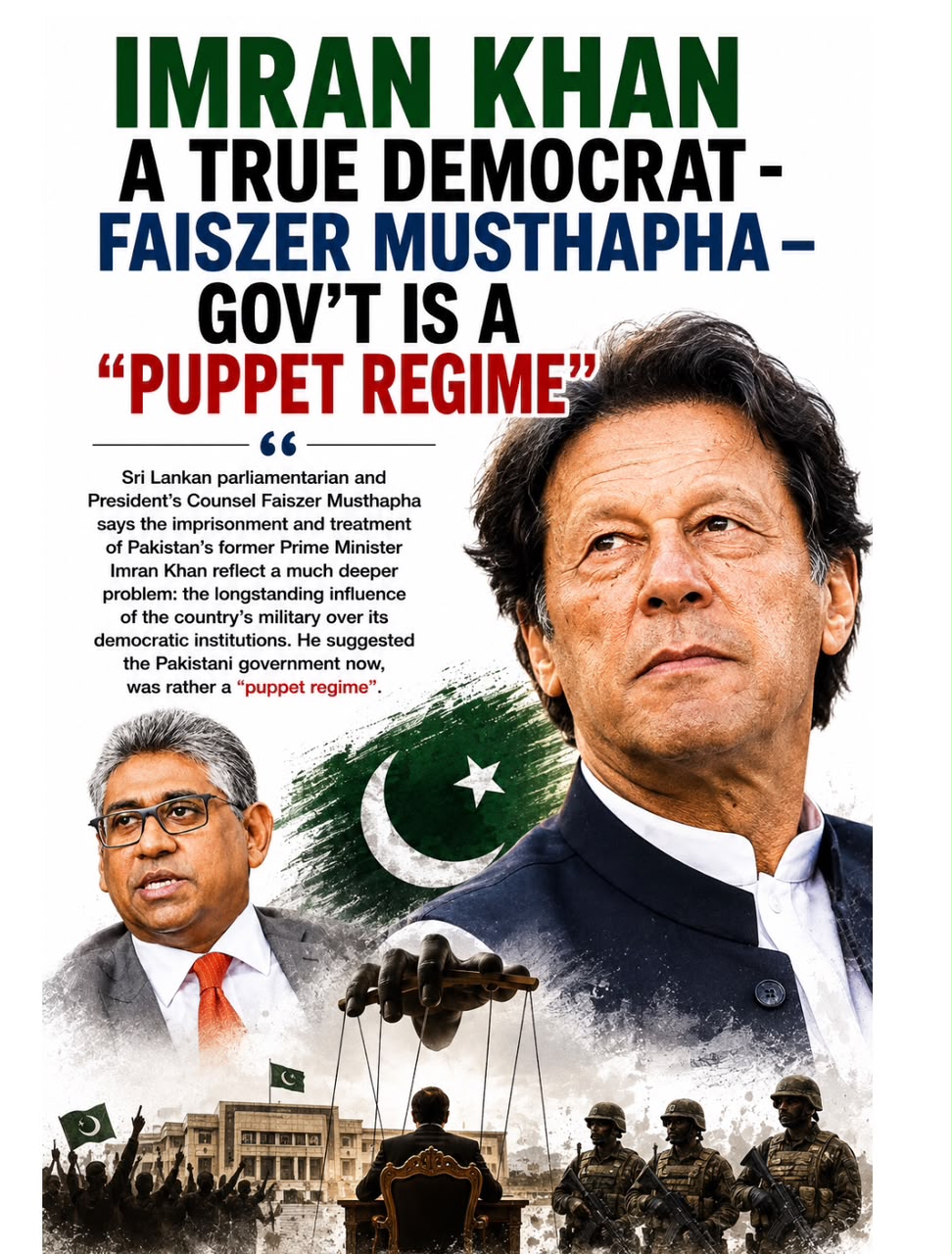
Sri Lankan parliamentarian and President’s Counsel Faiszer Musthapha says the imprisonment and treatment of Pakistan’s former Prime Minister Imran Khan reflect a much deeper problem: the longstanding influence of the country’s military over its democratic institutions. He suggested the Pakistani government now, was rather a “puppet regime”.
Former Pakistani Prime Minister and cricket legend Imran Khan is a “man of conscience” and a “true democrat” who has suffered because of his unwillingness to submit to the country’s powerful military establishment, Sri Lankan MP and President’s Counsel Faiszer Musthapha has said.
Speaking to NewsLine about the plight of the imprisoned former Prime Minister, Musthapha said Khan’s present circumstances could not be considered in isolation from Pakistan’s troubled history of relations between civilian governments and the military.

“You have to go back to history and the structure of governance in Pakistan. The military plays a great role,” Musthapha said, arguing that repeated military intervention had weakened democratic government and created an environment in which civilian leaders were expected to remain supportive of the military establishment.
Musthapha described Khan as a politician who understood the mood of ordinary Pakistanis and had been prepared to challenge powerful interests.
“I would say that Imran Khan is a man of conscience who understands the pulse of the people and who fought for justice,” he said. “He was disliked by the military because he is a true democrat.”
Khan, who captained Pakistan to its historic Cricket World Cup victory in 1992 before entering politics and eventually becoming Prime Minister, remains one of the country’s most recognisable figures. His removal from office in a parliamentary no-confidence vote in April 2022 was followed by an extraordinary period of political confrontation, criminal prosecutions and imprisonment.
Musthapha was particularly critical of Khan’s treatment in custody and welcomed judicial intervention requiring that he receive appropriate medical care.
He went considerably further in his criticism of Pakistan’s present political establishment, alleging that those responsible for Khan’s incarceration wanted him to suffer in prison and describing the civilian administration as a “puppet regime”.
Musthapha’s assertions concerning the motives of Pakistan’s Government and military are his own and remain politically contested. Pakistani authorities and the military have rejected accusations that prosecutions involving Khan represent a politically directed campaign against him.
The Sri Lankan MP nevertheless argued that Khan’s predicament demonstrated the fundamental difficulty confronting Pakistani democracy: the extent of military influence over civilian political institutions.
Musthapha said it was particularly contradictory that Pakistan continued to participate in international diplomacy and efforts to resolve global disputes while, in his view, failing to protect democratic government at home.
“Pakistan has intervened in solving global issues, but in their backyard they are a dictatorship,” he said, contending that meaningful democratic development would remain difficult while the military possessed sufficient influence to determine the political fortunes of civilian leaders.
For Pakistan to break that cycle, Musthapha argued, its citizens would ultimately have to defend the authority of democratic institutions irrespective of which political party happened to hold office.
“Until all Pakistanis unite and strengthen democracy and keep the military in their place, democracy will never grow in Pakistan,” he said.
For Musthapha, therefore, the continuing controversy surrounding Imran Khan is about considerably more than the fate of one former Prime Minister — even one who remains a national sporting icon.
It is a test of whether elected civilian government or the military establishment ultimately determines Pakistan’s political future.