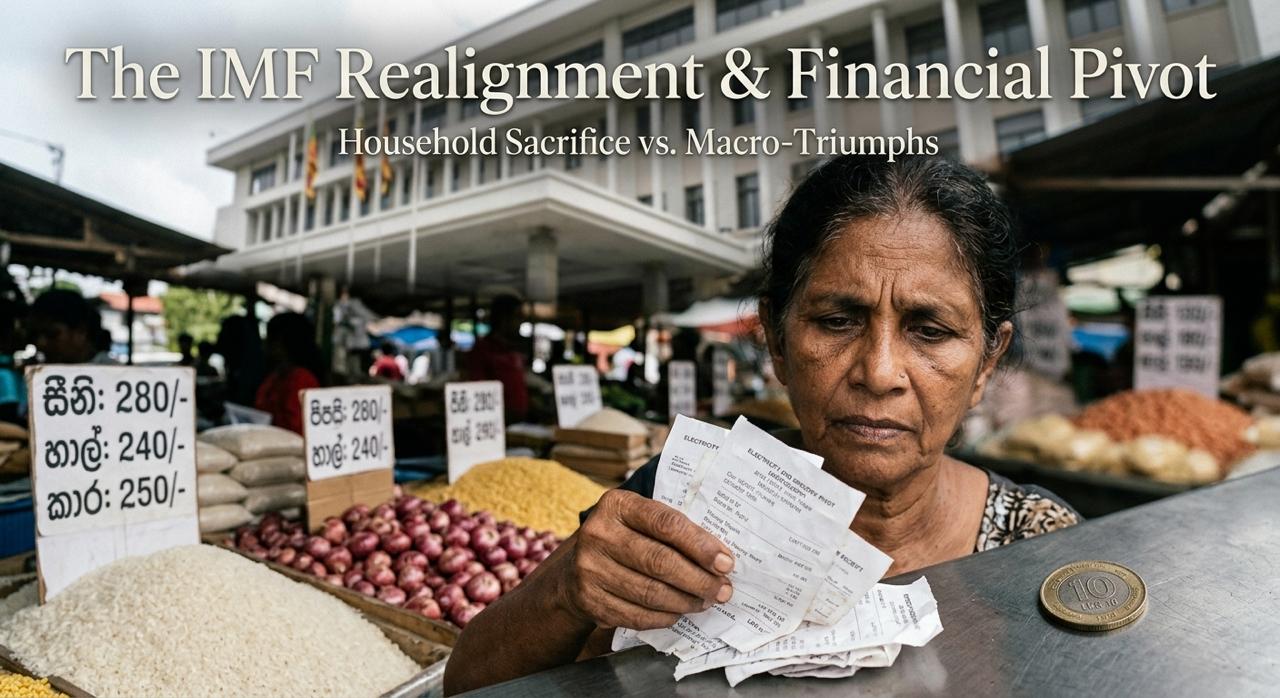
Financial stability is important. But should protecting financial institutions come at the expense of economic opportunity for ordinary citizens?
The Central Bank Governor’s recent defence of the 70% loan-to-value (LTV) ceiling on gold-backed lending raises a much wider question about the role of the Central Bank in Sri Lanka’s economy.
According to the report published on 23 November 2026, Governor Dr. Nandalal Weerasinghe explained that the 70% ceiling helps protect both financial institutions and borrowers against the risk of declining gold prices. His argument is understandable from a financial stability perspective. When the value of collateral declines, lenders face increased exposure, while borrowers may find themselves with loans exceeding the recoverable value of their pledged assets.
However, there is another side to this argument that deserves equal consideration.
Submit Your Press Release
Get your company news, announcements, launches, appointments and events in front of a wider audience.


Who actually suffers when the Central Bank restricts the amount a citizen can borrow against his or her own assets?
The Central Bank’s responsibility is not simply to protect the balance sheets of banks and finance companies. Its regulatory decisions also influence the availability of credit, investment, entrepreneurship, employment and economic participation.
The question is whether the current regulatory approach achieves an appropriate balance between financial stability and economic freedom.
1. The 70% gold-loan ceiling: Who bears the cost?
Consider a farmer who owns gold jewellery worth Rs. 1 million and requires Rs. 800,000 to finance cultivation, purchase fertiliser, pay workers or meet an urgent financial obligation.
Under a 70% LTV restriction, the maximum borrowing is Rs. 700,000.
Where does the remaining Rs. 100,000 come from?
The borrower may have to approach an informal lender, sell part of the jewellery, find alternative financing or abandon the intended economic activity.
For many Sri Lankan households, gold jewellery represents accumulated savings and a source of emergency liquidity. Pawning is often the most accessible form of secured borrowing, particularly for individuals who cannot satisfy conventional bank lending requirements.
There is no question that fluctuations in international gold prices create collateral risks. Nevertheless, should every borrower be subjected to the same regulatory ceiling regardless of repayment capacity, loan duration, collateral quality and individual circumstances?
Could the same objective be achieved through more sophisticated collateral valuation, risk-based lending, appropriate margins and stronger disclosure requirements?
The Central Bank should explain why a uniform 70% ceiling is more effective than a differentiated risk-based approach.
Reducing the exposure of a lender is not automatically equivalent to improving the financial position of a borrower.
2. Vehicle financing: A progressive tightening of credit
The Central Bank’s vehicle-financing restrictions provide another example of how regulatory decisions can directly influence economic activity.
The vehicle LTV framework has undergone several revisions.
Under Directions No. 02 of 2025, issued in July 2025, the maximum LTV ratios for new and recently registered vehicles were as follows:
| Vehicle category | Maximum LTV |
|---|---|
| Commercial vehicles | 80% |
| Motor cars, SUVs and vans | 60% |
| Three-wheelers | 50% |
| Other vehicles | 70% |
These limits were subsequently tightened.
In November 2025, the commercial vehicle ceiling was reduced to 70%, while other vehicle categories were generally restricted to 50%.
In May 2026, the Central Bank tightened the framework further. The maximum LTV for new commercial vehicles was reduced to 60%, while other new vehicles were restricted to 40%. The maximum LTV for used vehicles operating in Sri Lanka for more than one year was reduced from 70% to 60%.
This represents a substantial tightening of financing conditions within a relatively short period.
Consider a commercial vehicle valued at Rs. 10 million.
Under the July 2025 framework, the borrower could obtain financing of up to Rs. 8 million. Under the May 2026 framework, that amount fell to Rs. 6 million.
The entrepreneur must now find an additional Rs. 2 million to acquire the same productive asset.
Who bears this additional financing burden?
A small transport operator, an agricultural entrepreneur, a construction contractor or a business owner may need a vehicle to generate revenue. Restricting financing does not necessarily eliminate the demand for that vehicle. It may simply prevent the borrower from accessing it.
There are also wider consequences for vehicle dealers, leasing companies, insurance providers, repair businesses and employment across the automotive sector.
The Central Bank must therefore assess whether reducing credit risk within financial institutions is worth the economic activity potentially lost elsewhere.
3. Plantation investment companies: Regulatory intervention and due process
Another important issue concerns the Central Bank’s regulatory interventions involving plantation investment companies.
In September 2026, the Central Bank announced freezing orders against six companies and their directors under Section 44 of the Finance Business Act, No. 42 of 2011. The Colombo High Court subsequently confirmed and extended those orders.
The Central Bank identified two companies against which investigations were ongoing and four companies where it had already determined that finance business had been conducted and/or deposits accepted contrary to the Act.
It is important to distinguish between these situations. An investigation is not a conviction, and an interim asset-freezing order is not a final judicial determination of criminal liability.
The Central Bank must have the authority to intervene where there is credible evidence of unlawful deposit-taking or potential financial misconduct. Protecting the public against fraudulent investment schemes is a legitimate regulatory objective.
However, regulatory intervention can have consequences beyond the immediate companies concerned.
Employees, agricultural workers, suppliers, investors and other stakeholders may be affected when assets are frozen or business operations are disrupted.
The important questions are whether the evidence supports the scope of the intervention, whether affected parties receive appropriate procedural safeguards, whether the measures are proportionate and whether there is an effective opportunity to challenge the regulatory action.
Regulatory authority should not become a substitute for judicial determination.
At the same time, the absence of a final judicial determination should not prevent lawful interim protective measures where legislation expressly permits them.
The distinction between investigation, interim protection, administrative determination and final judicial liability must remain clear.
4. A recurring question: Is restricting credit always the best solution?
Sri Lanka’s experience with vehicle-financing restrictions also demonstrates how the Central Bank has used LTV ratios as a macroprudential instrument for different economic objectives.
The Central Bank’s Financial Stability Review records that vehicle LTV restrictions were first introduced in September 2015, partly to curtail excessive credit growth and vehicle imports that placed pressure on the balance of payments.
The framework was subsequently revised several times, including in 2017, 2018, 2019, 2020 and 2025.
This history demonstrates that credit restrictions have repeatedly been used to respond to changing macroeconomic conditions.
There is a legitimate argument for such intervention during periods of excessive credit expansion or external-sector pressure. However, a restriction introduced to address one economic problem can create another.
For example, limiting vehicle financing may reduce demand for imported vehicles, but it can also restrict access to productive transport assets. Similarly, restricting gold-backed lending may reduce collateral exposure while limiting access to short-term liquidity for households and small businesses.
The Central Bank should therefore evaluate the broader economic consequences of its interventions, rather than concentrating exclusively on the immediate financial-sector risk.
5. Who regulates the regulator?
The Central Bank enjoys institutional independence and has significant macroprudential powers under the Central Bank of Sri Lanka Act, No. 16 of 2023.
That independence is essential for maintaining monetary and financial stability.
However, independence should never be confused with infallibility.
Major regulatory decisions should be supported by transparent evidence, published impact assessments and clearly articulated policy objectives.
The public should be able to understand why a particular restriction is necessary, how its effectiveness will be measured, what alternatives were considered and when the restriction will be reviewed.
There should also be meaningful mechanisms through which affected parties can question decisions that appear disproportionate or inconsistent with the law.
The following principles deserve particular attention:
- Proportionality: Is the restriction necessary, or could the same objective be achieved through a less restrictive measure?
- Economic impact: Have the consequences for households, SMEs, employment and investment been adequately assessed?
- Transparency: Are the underlying data, assumptions and risk assessments publicly available?
- Consistency: Are regulatory changes supported by clear evidence rather than repeated policy adjustments?
- Accountability: Can affected individuals and businesses effectively challenge decisions that adversely affect their legitimate interests?
An independent regulator must also be an accountable regulator.
6. Regulation must protect the economy, not merely financial institutions
Sri Lanka needs a strong financial regulatory framework. No one should advocate irresponsible lending, excessive leverage or the exploitation of vulnerable borrowers.
However, credit is not merely a liability on a financial institution’s balance sheet. It is also an instrument of economic participation.
For a farmer, it can finance cultivation. For a small business, it can support expansion. For a transport operator, it can generate income. For a household, it can provide emergency financial security.
The Central Bank should distinguish between speculative borrowing and productive borrowing, between irresponsible credit expansion and legitimate demand for finance.
A more differentiated regulatory framework could consider the purpose of borrowing, the borrower’s repayment capacity, collateral quality, loan duration and the financial institution’s risk exposure.
The objective should be to manage financial risk intelligently rather than suppress legitimate economic activity through blanket restrictions.
Conclusion: Financial stability must not come at the expense of economic opportunity
The Governor may be correct that a 70% gold-loan ceiling reduces risks to financial institutions and borrowers. But the question remains whether the policy creates a disproportionate burden on individuals who depend on secured lending.
When a farmer cannot obtain sufficient cultivation finance, who accounts for the lost economic opportunity?
When a small entrepreneur cannot finance a commercial vehicle, who accounts for the business expansion that never happens?
When regulatory intervention affects a plantation company before the conclusion of legal proceedings, who ensures that innocent stakeholders are protected?
These are not arguments against the Central Bank. They are questions about the quality, proportionality and accountability of its regulatory decisions.
The success of a Central Bank should not be measured solely by how effectively it protects financial institutions against risk. It should also be measured by how effectively its policies support a stable, competitive and inclusive economy.
An independent Central Bank is essential. But an independent Central Bank must also recognise that its decisions have real consequences for the economic lives of ordinary citizens.
Financial stability is a means to achieve economic prosperity. It should never become an end in itself at the expense of the very economy it is intended to protect.
The ultimate question is not simply who protects the banks. It is who protects the borrower, the entrepreneur, the investor and the ordinary citizen from the unintended consequences of regulatory power.
Opinion and commentary. This article does not question the Central Bank’s statutory authority to regulate financial institutions. It calls for evidence-based, proportionate, transparent and accountable use of that authority.