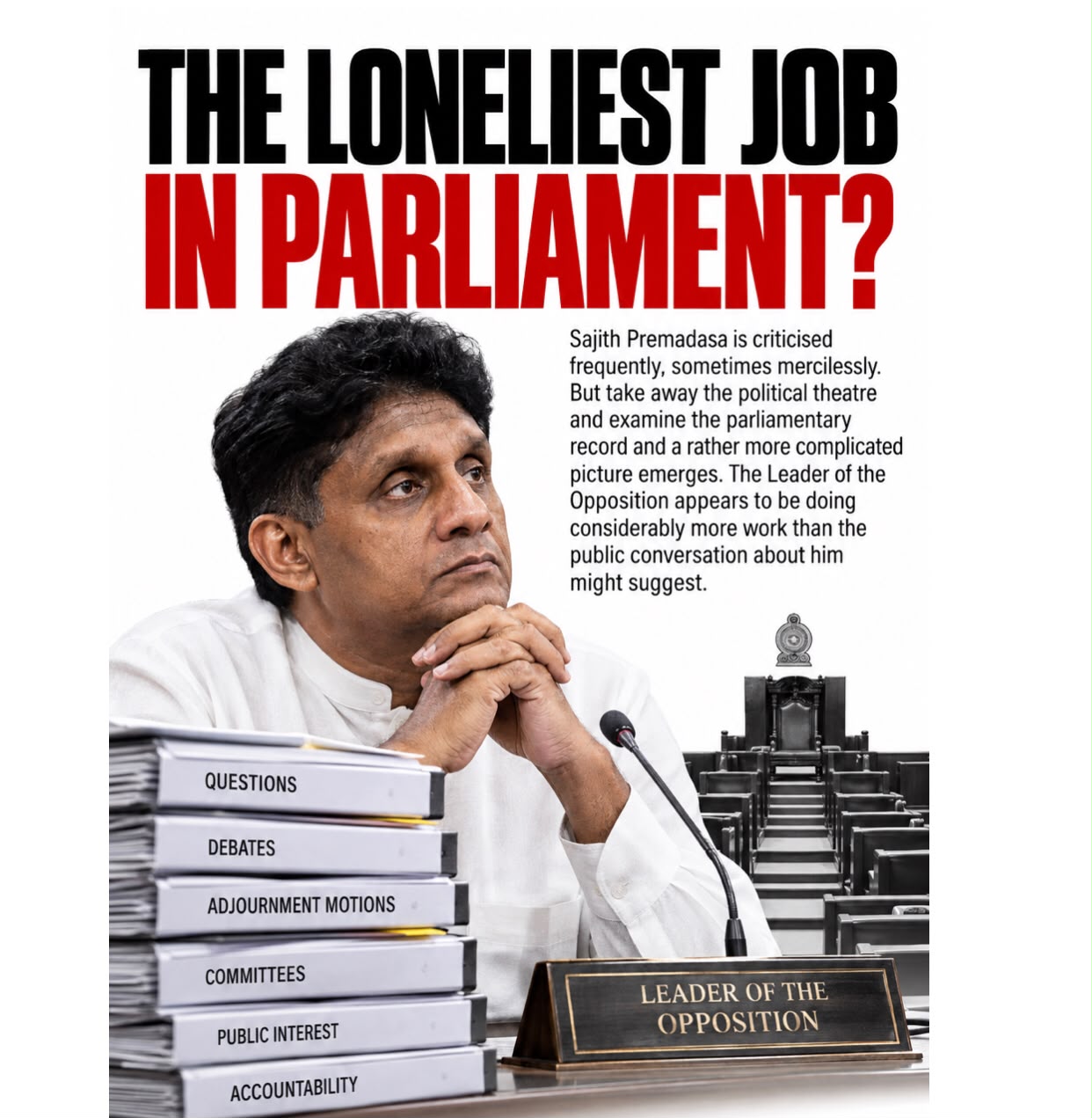
Sajith Premadasa is criticised frequently, sometimes mercilessly. But take away the political theatre and examine the parliamentary record and a rather more complicated picture emerges. The Leader of the Opposition appears to be doing considerably more work than the public conversation about him might suggest.
There may be few more frustrating jobs in Sri Lankan politics today than being Leader of the Opposition.
Sajith Premadasa leads the principal Opposition party in a Parliament in which the National People’s Power holds 159 of the 225 seats. His Samagi Jana Balawegaya has 40. The entire parliamentary Opposition elected in 2024 amounted to just 66 MPs spread across a collection of parties.
Submit Your Press Release
Get your company news, announcements, launches, appointments and events in front of a wider audience.


Those numbers matter.
A government with 159 MPs does not merely possess a working majority. It possesses enough parliamentary strength to make conventional Opposition politics extraordinarily difficult. An Opposition can question. It can investigate. It can expose. It can argue. It can attempt to shape public opinion. But, unless members of the Government itself break ranks, it cannot normally defeat the Government through numbers in the House.
That is the political arithmetic against which Premadasa’s performance ought to be examined.
And when NEWSLINE looked beyond speeches, press conferences and the inevitable social-media attacks and examined the parliamentary activity recorded by Manthri.lk, something interesting emerged.
As of May 2026, Manthri.lk ranked Premadasa third among MPs overall for parliamentary participation and first within his own party. It recorded 337 instances of participation across 14 different subject areas. His strongest rankings included natural resources and environment, education, economy and finance, health, governance and parliamentary affairs, technology and energy, rights and representation, and justice, defence and public order.
That does not establish that every intervention was correct, effective or politically astute. Parliamentary activity is not the same thing as political effectiveness.
But it does challenge the easier caricature of an Opposition Leader simply occupying the chair and waiting for the Government to make mistakes.
The parliamentary record shows Premadasa repeatedly using one of the Opposition Leader’s most important weapons: questions under Standing Order 27(2).
And the subjects have hardly been trivial.
During 2026 he has raised questions concerning the economic difficulties confronting the public, national fiscal and monetary policy, fuel supply and procurement, the rights of children, the EPF and ETF, an alleged US$2.5 million fraud relating to Sri Lanka’s foreign-debt payment, compensation arising from the X-Press Pearl disaster, the proposed extension of the retirement age of Supreme Court judges and, most recently, Sri Lanka’s preparations for the developing El Niño conditions.
There is is another important detail.another important detail.
These have not simply disappeared into the parliamentary ether. The official parliamentary record shows ministers answering a number of these questions, sometimes immediately and sometimes subsequently. In April, for example, the Government responded to an earlier Premadasa question concerning difficulties faced by SMEs. In May, a ministerial response was recorded to his earlier question on poverty. Questions concerning fuel, the economy, the alleged foreign-debt-payment fraud and judicial retirement have likewise produced government responses.
That is worth understanding because it goes to the constitutional purpose of an Opposition.
An Opposition does not have to win a parliamentary vote to perform a useful function. Sometimes its job is simply to force a question onto the official record and require the executive to provide an answer that can subsequently be tested against events.
Premadasa has also gone beyond questions. On 9 April, for example, the parliamentary record shows him moving an adjournment motion concerning the Easter Sunday attacks, while Manthri.lk records a mixture of oral contributions, procedural interventions, questions, debates and adjournment motions.
His attendance record is also difficult to dismiss. Parliament’s own profile currently records Premadasa as present on 167 sitting days and absent on 13 during the Tenth Parliament.
None of this settles the political argument about Sajith Premadasa.
His critics are entitled to ask whether parliamentary industriousness has translated into a sufficiently compelling political message outside Parliament. They can question the SJB’s organisation, its communications, its ability to broaden its constituency and whether Premadasa has successfully defined an alternative programme of government rather than merely opposing the Government’s programme.
Those are legitimate political questions.
But there is a distinction between saying an Opposition Leader should be politically more effective and saying that he is not doing the parliamentary work.
The available evidence makes the second proposition considerably harder to sustain.
There is also an unusual psychological dimension to the present Parliament. The NPP did not scrape into government. It arrived with an extraordinary electoral mandate and 159 seats. The Opposition therefore operates in an environment where almost every parliamentary confrontation begins with everyone knowing what the numerical outcome will be.
Consider the no-confidence motion against Justice Minister Harshana Nanayakkara in July. Whatever one thought of the merits of that motion, the arithmetic was brutal: 36 MPs voted for it and 152 against.
That illustrates the structural problem facing Premadasa better than almost anything else.
How does an Opposition oppose when it cannot realistically defeat the Government on the floor of Parliament?
The answer may be that it has to play a longer game. Premadasa appears to be trying to construct part of that game around the parliamentary record: ask the question, obtain the answer, put both on record and allow subsequent events to determine which side was right.
There is a political calculation behind that approach, too.
Premadasa and the SJB plainly hope that the extraordinary majority enjoyed by the NPP will not remain politically impregnable forever. Governments are ultimately judged not by the size of the mandate with which they entered office but by what they do with it.
That does not mean the SJB automatically becomes the beneficiary if public sentiment changes. Sri Lankan politics has repeatedly demonstrated that voters are capable of abandoning both governments and established opposition parties. The SJB therefore still has to persuade voters that it represents a credible alternative rather than merely the largest available alternative.
That distinction could determine Premadasa’s political future.
There are also concerns voiced within the wider Opposition about the climate in which politics is now being conducted, including litigation, investigations and the conduct of state institutions. Such claims require evidence and should be examined individually rather than converted into a sweeping conclusion that institutions such as the Police, Customs, military or judiciary are acting politically.
But an Opposition that believes government decisions will eventually face greater public scrutiny has an obvious incentive to document those decisions now.
That may explain something about Premadasa’s parliamentary strategy.
He does not possess the numbers to stop the Government.
What he possesses is the ability to make it answer.
And sometimes an answer given in Parliament becomes more important six months or two years later than it appeared on the afternoon on which it was given.
There remains a larger question that no parliamentary statistic can answer.
Can Sajith Premadasa convert diligence into leadership?
Being one of Parliament’s most active MPs is evidence of work. It is not evidence that the electorate will ultimately choose him. Asking hundreds of questions demonstrates scrutiny; it does not by itself constitute an alternative economic or political programme. And leading the largest Opposition party does not give anyone a permanent claim to being the next government.
Those tests remain ahead of him.
But if the charge is simply that Sri Lanka’s Leader of the Opposition is sitting back and doing very little while an overwhelmingly powerful Government governs unchecked, the parliamentary record tells a different story.
Premadasa is asking questions. He is putting ministers on record. He is intervening across a remarkably broad range of subjects. He is turning up.
Whether the country is listening is another matter entirely.
And whether those questions one day become the documentary trail by which this Government is judged may prove to be the more interesting question.
Be that as it may.