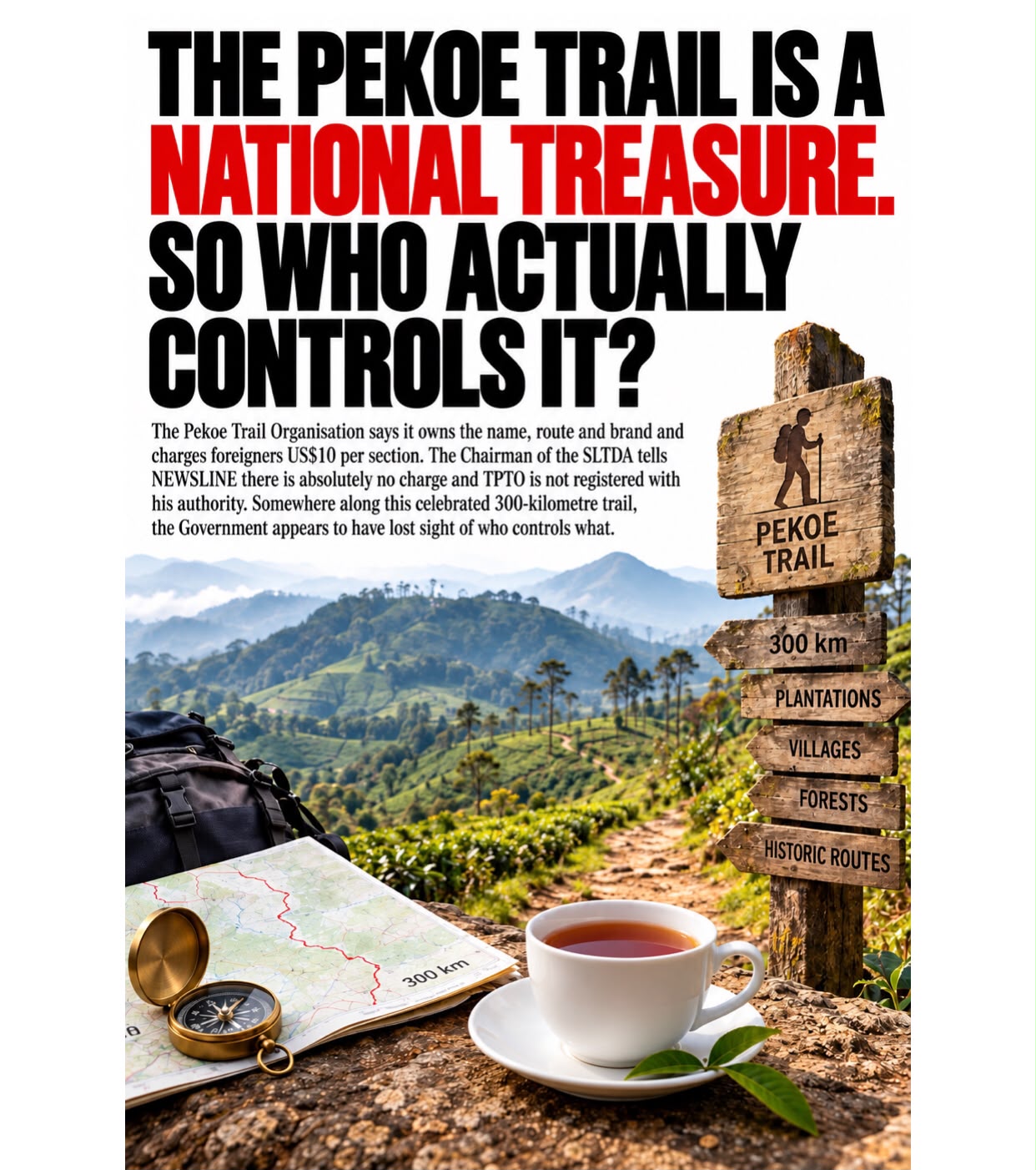
The Pekoe Trail Organisation says it owns the name, route and brand and charges foreigners US$10 per section. The Chairman of the SLTDA tells NEWSLINE there is absolutely no charge and TPTO is not registered with his authority. Somewhere along this celebrated 300-kilometre trail, the Government appears to have lost sight of who controls what.
Sri Lanka is presently pursuing alleged corruption and misuse of public assets with an enthusiasm rarely witnessed in recent years. Former presidents, political families, senior officials and others once considered almost untouchable have faced investigation, arrest or proceedings before the courts. The message is unmistakable: public assets belong to the public and those entrusted with them must account for what they do.
Why, then, does government oversight appear so remarkably relaxed when it comes to the Pekoe Trail?
Submit Your Press Release
Get your company news, announcements, launches, appointments and events in front of a wider audience.


The approximately 300-kilometre trail through Sri Lanka’s Central Highlands connects plantation roads, village paths, forest tracks, public roads and historic routes. International donor funding involving the European Union and USAID helped transform those existing pathways into an internationally marketed tourism product. The land beneath the trail belongs variously to the State, plantation companies and other landholders.
The Pekoe Trail Organisation, TPTO, meanwhile says it owns the name, route and brand. It operates through a company limited by guarantee and is chaired by businessman Malik J. Fernando, associated with Dilmah and Resplendent Ceylon. TPTO also makes another important admission: it does not own the land.
That distinction goes directly to the heart of the matter.
On September 14, it was publicly reported, following discussions with Sri Lanka Tourism Development Authority Chairman Suranjith Wevita, that the SLTDA would take ownership of the Pekoe Trail during September. Under the proposed arrangement, the SLTDA and other State institutions were expected to hold the larger share of directorships alongside private-sector nominees.
September came and went. October is here. Malik Fernando remains identified as Chairman of the organisation managing the trail and there has been no publicly demonstrated completion of the transfer announced for September.
NEWSLINE telephoned Mr Wevita.
He was emphatic that the Pekoe Trail is a national asset and a national treasure. Indeed, he questioned why NEWSLINE was interested in a private company when, in his view, the essential point was that the Pekoe Trail belonged in the national realm. Any company could claim anything, he maintained, but this remained a national treasure.
That ought to be reassuring. Instead, it makes the question even more obvious.
If this is a national asset, what precisely does a private company own when it says it owns the name, route and brand? Who transferred those rights, under what agreement, and what exactly does the State own today?
When NEWSLINE pressed Mr Wevita about the transfer announced for September, he maintained that it would happen. There were, he said, several works in progress.
There may be a perfectly reasonable explanation for the delay. Intellectual property, corporate restructuring, plantation agreements and State participation cannot necessarily be reorganised overnight. But surely the public can be told what is being transferred, from whom, to whom and when.
Then the trail became considerably more interesting.
TPTO advertises Trail Passes. Foreign visitors are charged US$10 per section while Sri Lankan residents have been asked to pay Rs. 600. NEWSLINE therefore asked Mr Wevita whether we would have to pay Rs. 600 if we turned up tomorrow and walked a section of the Pekoe Trail.
His answer was unequivocal. There is absolutely no charge.
What happens, NEWSLINE asked, if somebody insists that we pay? Mr Wevita said the matter could be reported to the Police.
There is an obvious problem here. An organisation is advertising passes costing US$10 and Rs. 600 while the Chairman of Sri Lanka’s statutory tourism authority says there is absolutely no charge.
Both propositions cannot govern the same access in the same circumstances.
NEWSLINE resisted pointing out that somebody challenged for Rs. 600 somewhere deep in the Central Highlands might then have to embark upon an entirely different trail: finding the nearest police station.
There is, however, a considerably more serious question.
Mr Wevita also told NEWSLINE that TPTO is not registered with the SLTDA.
Anyone familiar with Sri Lanka’s tourism industry knows that registration and regulation are not optional concepts for businesses falling within prescribed tourism categories. Hotels, travel operators, guides and other tourism service providers operate within a regulatory framework.
So where does TPTO sit?
If an organisation markets an internationally recognised Sri Lankan tourism experience and charges a foreign visitor US$10 per section to use it, does that constitute a tourism service requiring registration with the SLTDA? If it does not, what is the exemption or legal distinction?
Perhaps TPTO’s status as a nonprofit destination management organisation places it outside the relevant category. Perhaps the US$10 is legally a contribution rather than an admission fee. Perhaps it purchases services surrounding the walk rather than access to the trail itself.
There may be a perfectly satisfactory explanation. NEWSLINE would like to hear it.
Because if the Chairman of the SLTDA says there is absolutely no charge to walk the Pekoe Trail, there is a very simple follow-up question.
What exactly does the US$10 buy?
Consider another national treasure. Sigiriya operates within a clearly identifiable State framework. Private companies can bring tourists there, sell packages, provide transport and offer authorised tourism services, but the distinction between the national asset and the businesses earning money around it is readily understood.
The Pekoe Trail is admittedly more complicated. It crosses different categories of land, including plantation property, and private landowners may legitimately impose access conditions on their property.
That makes transparency more important, not less.
If Rs. 600 buys permission to cross private property, say so. If US$10 pays for maintenance, mapping, insurance, signage or another service, say so. If a section follows an unrestricted public road or State track which anybody may walk without payment, say that too.
A tourist should not have to determine the legal status of the ground beneath his shoes while standing on it.
There is another important dimension. International assistance helped create the tourism product now being marketed as the Pekoe Trail. Money was spent identifying the route, mapping it, developing infrastructure, creating digital assets, promoting it and turning hundreds of kilometres of existing pathways into something capable of attracting international visitors.
What happened to those assets when the donor project ended?
Who owns the intellectual property? Who owns the maps and digital infrastructure? Who receives the Trail Pass revenue? Who audits it? How much is spent maintaining the trail and how much reaches the communities through which it passes?
Most importantly, who ultimately answers to whom?
These are questions, not accusations. There is no evidence before NEWSLINE that Malik Fernando personally owns the physical Pekoe Trail or improperly acquired State property. His chairmanship of TPTO establishes nothing of the sort.
The issue is institutional and considerably simpler.
Who owns what? Who authorised it? Who regulates it? Who collects the money?
There is an uncomfortable irony in having to ask.
The State is presently demonstrating that it can investigate alleged misuse of public assets years after transactions occurred, involving some of the most powerful people in Sri Lanka. Investigators search for documents, prosecutors reconstruct decisions and courts are eventually asked to determine whether public resources were properly handled.
Why wait until then?
Good governance cannot simply mean investigating what happened to a national asset after something has gone wrong. It must also mean establishing ownership, regulation, revenue flows and accountability while the asset is being created.
Prevention is considerably cheaper than prosecution.
The Government says the Pekoe Trail is moving into State ownership. The Chairman of the SLTDA says it is a national treasure. He tells NEWSLINE there is absolutely no charge to walk it and that TPTO is not registered with his authority.
TPTO meanwhile advertises paid Trail Passes and says it owns the Pekoe Trail’s name, route and brand.
There appear to be several slips between several cups of tea and the lips or, in this particular case, before one’s feet even begin moving along the Pekoe Trail.
Sri Lanka should be proud of what has been created across those 300 kilometres. The Pekoe Trail has the potential to become one of the country’s great tourism success stories and to take visitors, employment and money into communities far beyond the traditional tourism circuit.
That is precisely why the questions should be answered now.
Be that as it may, NEWSLINE will continue following this particular trail: the trail of how Sri Lanka protects its national assets, including the ones it has only just created.