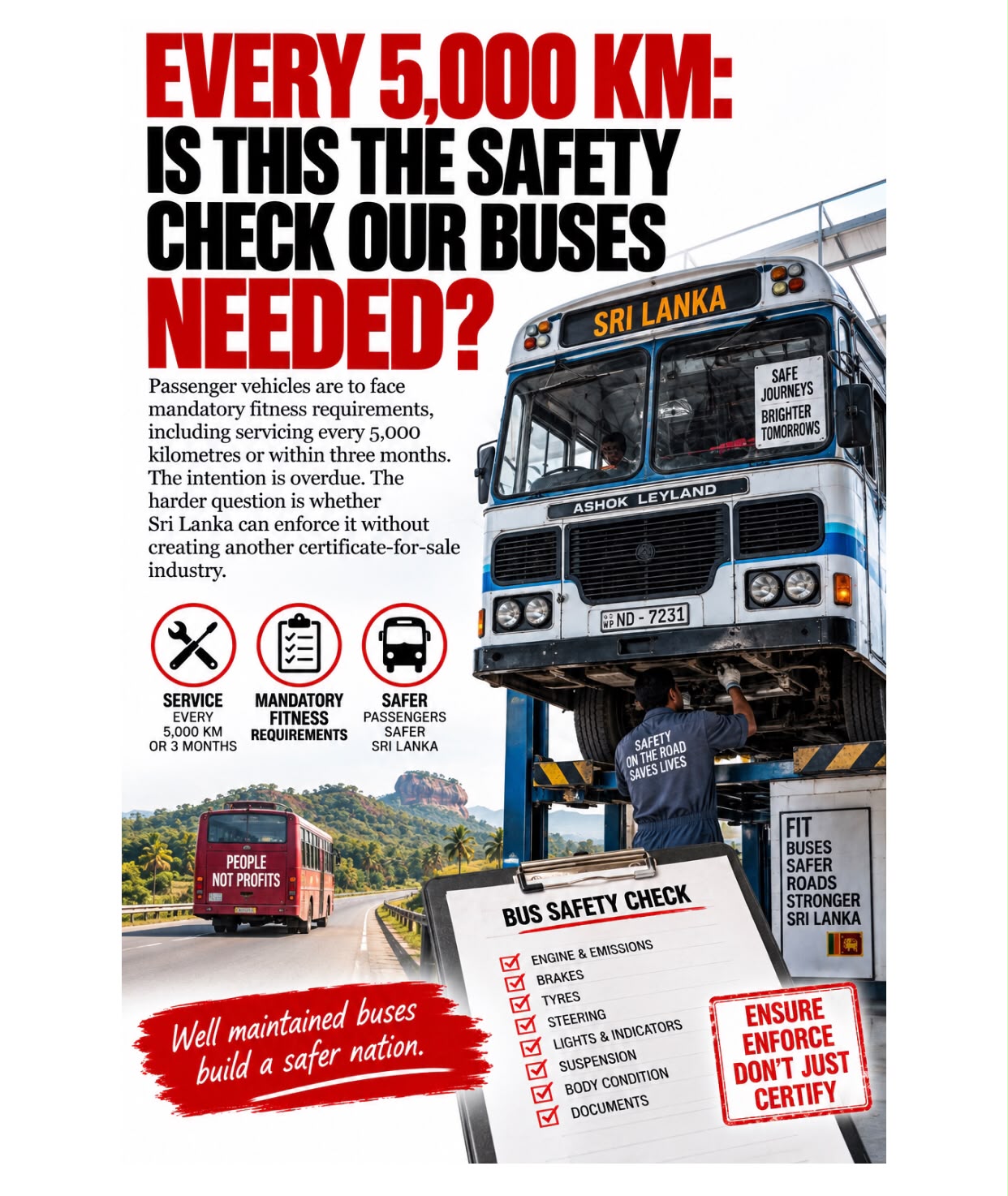
Passenger vehicles are to face mandatory fitness requirements, including servicing every 5,000 kilometres or within three months. The intention is overdue. The harder question is whether Sri Lanka can enforce it without creating another certificate-for-sale industry.
Sri Lanka is preparing to make fitness testing mandatory for vehicles engaged in passenger transport as part of a wider attempt to improve roadworthiness and passenger safety.
Commissioner General of Motor Traffic Vice Marshal (Retd.) Thushara Idunil Fernando says passenger transport vehicles will be required to undergo a full service every 5,000 kilometres or within three months, with legal provisions to support the new regime.

The proposal comes ahead of a broader reform planned for 2028, when the existing emissions-test regime is expected to evolve into a more comprehensive roadworthiness system covering brakes, lights, tyres and other safety-critical components.
Few passengers who regularly travel in Sri Lankan buses will argue against tougher vehicle standards.
The more interesting question is whether the system will test vehicles or merely paperwork.
Sri Lanka has no shortage of regulations. Its recurring problem is enforcement.
A genuinely independent fitness regime could identify dangerously worn tyres, defective brakes, steering problems and poorly maintained suspension before they become the subject of a police report after an accident.
But if certificates become obtainable without meaningful inspection, the entire exercise risks becoming one more cost imposed on operators while doing little for passengers.
There is another practical question.
A service every 5,000 kilometres may sound generous to the private motorist. A bus operating continuously between major towns can cover that distance remarkably quickly. For high-mileage commercial vehicles, enforcement will therefore require reliable mileage records and a system capable of preventing manipulation.
The Department of Motor Traffic has already indicated that hundreds of qualified personnel and technicians are being recruited as the broader roadworthiness programme is developed.
That is encouraging.
But road safety will not improve because Sri Lanka introduces another certificate.
It will improve only when a dangerously unroadworthy bus cannot obtain one.
Be that as it may.