
Higher education in Sri Lanka has suffered a sobering reality check. In the latest QS Asia University Rankings 2027 released by higher education analysts Quacquarelli Symonds, eight of Sri Lanka’s twelve featured public universities registered notable drops in their regional standings. The University of Colombo slipped forty-six places to rank 364th in Asia, while the University of Peradeniya and the University of Sri Jayewardenepura dropped to 389th and 398th respectively. Even with its decline, the University of Colombo maintained its streak as the island’s premier institution for the fifth consecutive year, standing as the only local university inside Asia’s top 200 for Employer Reputation at 192nd. Elsewhere, the University of Moratuwa climbed thirty-seven spots to 517th, and the University of Kelaniya surged forty-four places to secure 687th position.
Yet, the overarching trend raises a critical question: is local academic quality deteriorating, or are broader regional mechanics driving the slide?
To understand these shifts, it helps to examine the specific mechanics of the QS Asia evaluation methodology. Unlike global league tables, the Asian regional framework measures eleven specific indicators across academic performance, graduate employability, research production, faculty capacity, and internationalization. Academic reputation accounts for thirty percent of an institution’s total score, while employer reputation contributes twenty percent. Faculty-to-student ratios, international research networks, and citations per paper each carry a ten percent weight, with smaller percentages allocated to staff holding doctorates, papers per faculty, and international student or faculty exchanges.
Submit Your Press Release
Get your company news, announcements, launches, appointments and events in front of a wider audience.


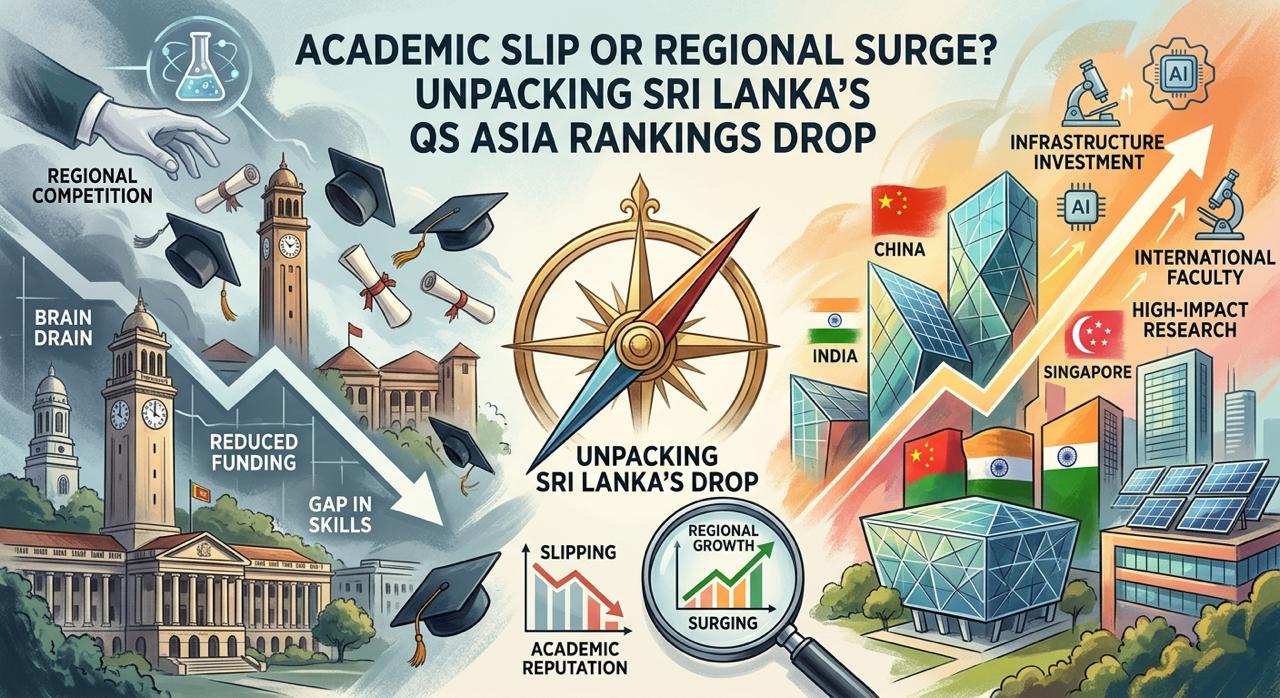
A primary catalyst for the widespread slide is simple regional dilution. Nearly two hundred new institutions entered this year’s rankings evaluation pool across East and South Asia. Rapidly funded universities in China, India, and Southeast Asia are pouring billions into state-of-the-art laboratory infrastructure, lucrative research grants, and aggressive international faculty recruitment. In comparison, Sri Lankan state universities operate under severe fiscal constraints, making relative movement downward almost inevitable when regional peers scale up at exponential speed.
Beyond regional competition, systemic domestic pressures continue to exact a heavy toll. Years of currency devaluation and economic adjustments triggered a notable brain drain across higher education faculties, with senior professors and doctorate holders pursuing overseas appointments. This loss directly damages metrics like staff with doctorates and faculty-student ratios. Furthermore, severe cuts to state research budgets restrict local scholars from publishing in high-impact international journals, directly dampening citation counts and global academic visibility.
Employer perception also took a hit, with drops in the Employer Reputation indicator affecting both Colombo and Sri Jayewardenepura. As global industries adapt to rapid technological shifts, gaps between public university curricula and modern private sector demands have grown more visible to hiring managers.
As QS analysts emphasize, a drop in ranking numbers does not automatically signal a decline in actual teaching quality. However, it serves as an unmistakable warning light: without strategic investments in academic retention, research funding, and industry alignment, Sri Lanka risks being steadily outpaced by a fast-moving regional higher education landscape.



