
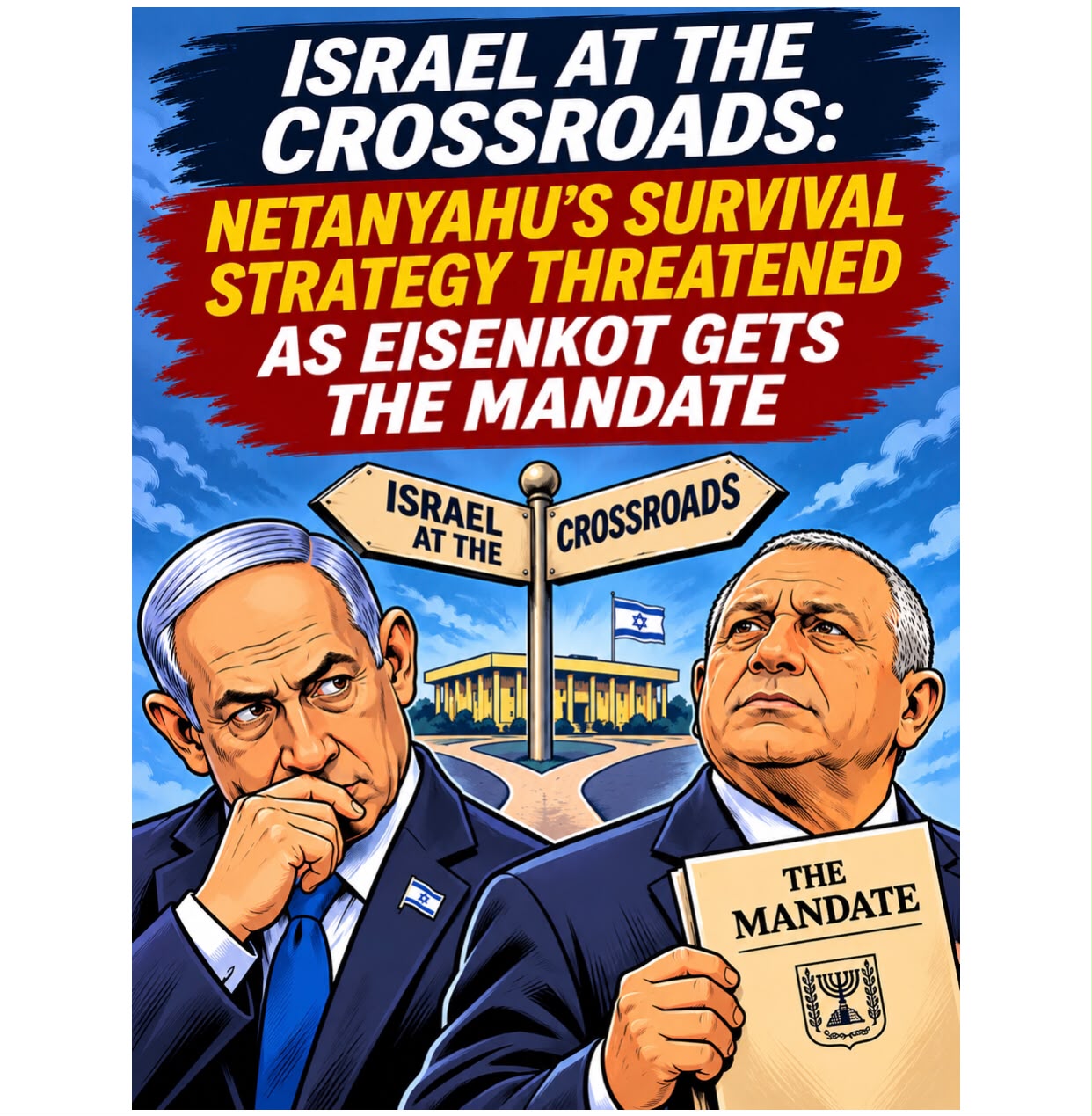
Israeli President Isaac Herzog has officially handed former military chief Gadi Eisenkot the first crack at piecing together a governing coalition following the rather messy October 27 general election. The decision came after 67 lawmakers in the 120-seat Knesset threw their weight behind Eisenkot during presidential chats, leaving incumbent Prime Minister Benjamin Netanyahu trailing behind with just 46 backers.
Still, the brutal arithmetic of Israeli parliamentary politics means Eisenkot is in for a proper uphill struggle. His core four-party alliance commands a modest 48 seats, while Netanyahu’s right-wing and religious bloc sits on 53. Arab-led parties scored a record 19 seats and backed Eisenkot simply to freeze out Netanyahu, but the former general has already ruled out inviting them into formal cabinet chairs. Eisenkot now has 28 days to charm rivals, settle feuds, and land a 61-seat majority, or face another deadlock that sends voters straight back to the polling booths.
Handing over the mandate is a massive bump in the road for Benjamin Netanyahu, but it also lays bare the absolute fracture running through Israeli public life. For millions of citizens, this vote was never about dry policy papers or standard fiscal debates. It was a straight-up national referendum on Netanyahu himself, a man whose stubborn hold on the top job has left the country split right down the middle.
Submit Your Press Release
Get your company news, announcements, launches, appointments and events in front of a wider audience.


Public opinion across the nation is a proper battlefield. Die-hard supporters still view Bibi as the ultimate political chess master and an indispensable guard dog for national security. On the flip side, a fed-up and increasingly loud majority sees a leader who has spent years putting his own political survival ahead of basic state stability. Constant street protests, public burnout, and genuine outrage over government antics have turned daily politics into a non-stop soap opera of mistrust.
At the heart of Netanyahu’s desperate scramble to hang onto the keys of official office lies a very personal headache: his looming court dates. Facing serious trial charges including bribery, fraud, and breach of trust, the Prime Minister’s chair isn’t just a position of authority for him, it is his primary get-out-of-jail card. Staying at the top gives him the muscle needed to push through judicial tweaks, spar with prosecutors, and drag his heels through the legal system. For Bibi, losing power isn’t just an awkward career setback, it carries very real, very unappealing legal consequences.
This existential fight to dodge the dock explains why Netanyahu clung so tightly to his hardline partners in the first place. His coalition with far-right and ultra-Orthodox outfits was stitched together precisely because those groups were happy to offer him legal cover in exchange for policy wins and state cash.
It is worth noting however, that while political commentators in West Jerusalem endlessly obsess over Knesset mathematics and Netanyahu’s personal legal troubles, the true weight of his decades-long tenure has been borne by Palestinians in Gaza and the West Bank. For millions, Netanyahu’s time in power represents far more than clever political maneuverings or domestic soap operas. It stands as an era of calculated territorial fragmentation, systematic displacement, and unprecedented humanitarian disaster.
For years, Netanyahu’s strategy toward Palestine relied on a divide-and-rule playbook, keeping the Palestinian Authority weak in the West Bank while propping up Hamas in Gaza specifically to ensure Palestinians remained politically split and unable to press for an independent state. What followed under his war cabinet was a military onslaught of staggering proportions, leaving more than seventy percent of Gaza’s residential infrastructure in ruins, wiping entire extended families off the civil registry, and reducing historic urban centers to sprawling fields of gray dust.
The physical destruction of Gaza was accompanied by engineered humanitarian horror. Hospitals were flattened or stripped of power, water sanitation networks were systematically dismantled, and basic food shipments were restricted to the point where international agencies warned of human-made famine. In the occupied West Bank, Netanyahu’s reliance on extreme right-wing coalition partners opened the floodgates for state-sanctioned land grabs and aggressive settlement expansions, while armed settler violence and arbitrary raids turned daily life into an exhausting exercise in survival.
The political tragedy facing Palestinians is that even as Netanyahu’s hold on power wavers, the political alternative offers little comfort. Gadi Eisenkot, the former military chief now tasked with forming a new Israeli government, brings his own heavy footprint to the Palestinian context. As creator of the infamous Dahiya Doctrine, which calls for using disproportionate force and razing civilian infrastructure in enemy territory, Eisenkot’s military career is defined by aggressive campaigns against Palestinian populations. Furthermore, Eisenkot has explicitly rejected a two-state solution and supports continued settlement presence in the West Bank.
Now, with Eisenkot holding the official pen to draft the next administration, the cracks in Netanyahu’s defensive wall look wider than ever. Over the next four weeks, Israel finds itself at a massive crossroad. The country must decide whether to gamble on a fragile new coalition guided by a quiet former general, or watch its longest-serving political survivor pull out every trick in the book for one last, chaotic stand.



