Germany could be the first European country to get their outbreak under control, if their social distancing measures succeed.
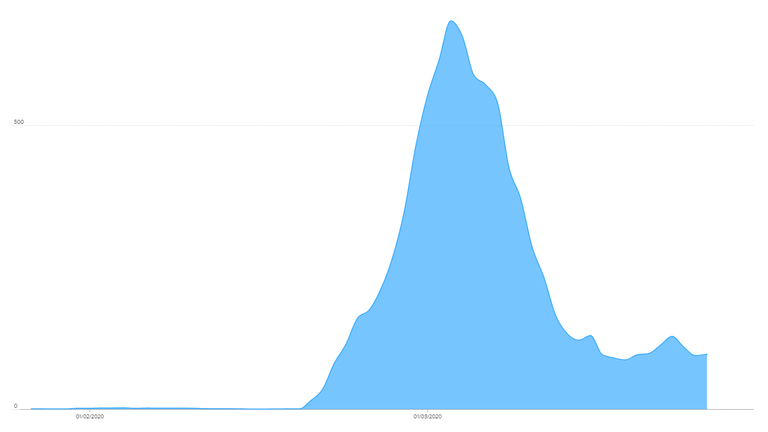
After more than 80,000 cases and more than 3,200 deaths, China has successfully reduced the number of new coronavirus cases it is recording each day.
In other words, the country where the disease originated has “flattened the curve” of the outbreak.
It is not the only country starting to get the outbreak under control.
In South Korea more than 9,000 people have been infected with the virus and at least 130 people have died.
What is ‘flattening the curve’?
The “curve” in an epidemic outbreak is the projected number of people who will get sick over a given period of time.
China and South Korea’s curves – so far – are shown on the charts above.
A sharp increase in the curve means the disease is spreading quickly, which can lead to many people being infected at the same time and the health system becoming overloaded.
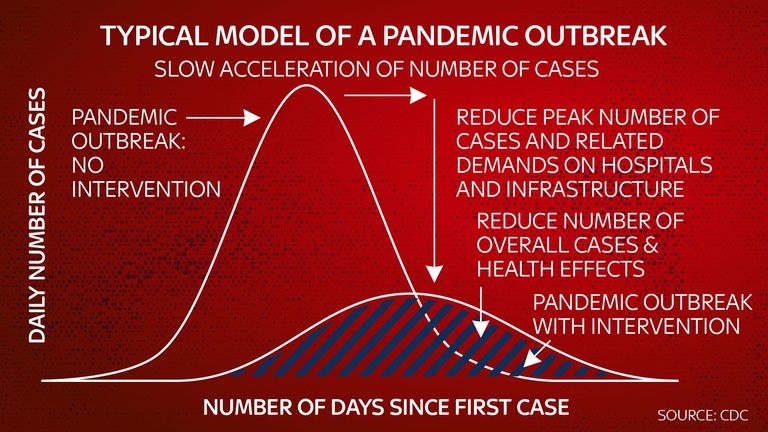
A flatter curve means there is a slower infection rate and while the same number of people could be infected overall, this will take place over a longer period of time.
This means the number of cases at the peak of the disease – the highest point on the chart – will be smaller, allowing the health service to cope better with the situation and provide the appropriate care.
Containing measures – such as social distancing – aim to lower the infection rate and, consequently, to “flatten the curve”.

The outbreak started in China in December last year and quickly spread to several other countries in Asia from the epicentre of the outbreak in Wuhan.
Despite their proximity to China, Singapore, Hong Kong and Taiwan have managed to keep their numbers of new cases low.
However, these countries have a relatively small population compared with other countries of the region and although their case numbers are small, their curves have not yet decreased significantly.
The curve can also increase following a period in which it decreases, as is currently happening in Japan.
There, the daily number of people infected started to slow in the middle of March, but has since started to rise again.
In February, Europe became the new centre of the COVID-19outbreak.
Italy has now had more confirmed cases of the disease than China and both Spain and Italy have reported more deaths than China.
Large parts of the continent are now under lockdown or using social distancing measures to stop the spread of the disease.
In some places the measures are starting to take effect and Germany could be the first European country to flatten the curve.
On Wednesday, the head of the German hospital federation, Gerald Gass, said that the infection rate will likely slow down in the country by the beginning of April due to social distancing.
The epidemic has also effected countries in the Middle East, with Iran being particularly badly hit.
It is now moving towards North and South America, where the number of cases is increasing in most countries.
In the United States, lockdowns are in place in cities including New York, San Francisco and LA.
How fast the cases are growing?
Almost every country in the world has reported at least one case of the coronavirus, according to the World Health Organisation (WHO).
Although China has the largest number of cases recorded in absolute terms, the case rate is higher in around a third of the countries affected, with European countries at the top of the list.
A fast growth rate can lead to a large number of cases very rapidly so the goal is to slow down the rate of growth using measures such as social distancing.
If we compare countries with the highest number of cases since they reported their 100th case, the UK appears to be following a similar trend to other European countries, like Italy or Spain, and the US. At the moment the number of cases in the UK is doubling every two or three days.