
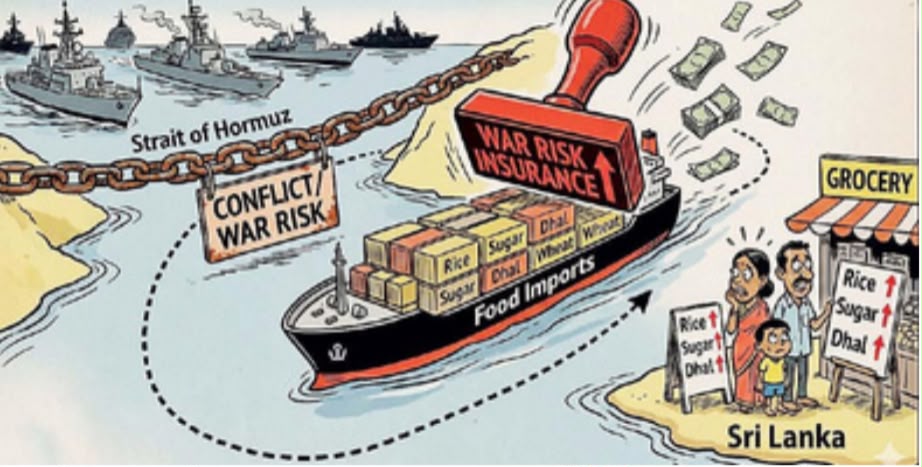
The next economic shock may not begin in Colombo. It may begin 5,000 kilometres away.
There is a tendency in Sri Lanka to regard wars in distant parts of the world as somebody else’s problem. The missiles fly over unfamiliar deserts, naval vessels patrol waters most Sri Lankans will never see, and the evening news moves on to the next crisis. Until, that is, the petrol station displays a new price, the supermarket quietly adjusts its shelves and families once again discover that events far beyond their control have somehow reached their monthly budget.
That is precisely why the Strait of Hormuz matters.
Barely twenty-one nautical miles wide at its narrowest point, this narrow stretch of water carries roughly one-fifth of the world’s traded oil. When ships hesitate to enter it, insurers increase premiums, shipping companies recalculate their risks and oil traders immediately begin pricing uncertainty into every barrel.
This week uncertainty returned with considerable force.
The latest escalation between the United States and Iran has seen Washington resume military operations against Iranian targets while President Donald Trump announced plans to reinstate a blockade of Iranian shipping and proposed a 20 per cent charge on cargo transiting the Strait of Hormuz under American protection.
Brent crude climbed above USD 86 per barrel, its highest level in around a month, as financial markets rapidly priced in the growing geopolitical risk.
For Sri Lanka, this is not merely another foreign affairs story.
Every increase in global oil prices eventually filters through to the Sri Lankan economy. Fuel imports become more expensive. Electricity generation costs increase. Freight charges rise. Imported food becomes dearer. Airlines face higher operating costs. Manufacturers pay more to transport raw materials. Inflation, which policymakers have worked so hard to tame, suddenly discovers a new source of energy.
The country’s economic recovery remains encouraging but undeniably fragile. Foreign reserves have improved. Inflation has moderated. Tourism has recovered. Confidence has cautiously returned.
None of those achievements, however, immunise Sri Lanka against external shocks.
Indeed, one could argue that the greatest threat to the recovery today may not come from Parliament, the Central Bank or even the Treasury. It may arrive aboard an oil tanker waiting for permission to transit one of the world’s busiest waterways.
There is another lesson here.
For decades, Sri Lanka has debated economic resilience almost entirely through the lens of domestic politics. We argue over taxes, government spending, IMF programmes and exchange rates.
Those debates matter enormously. Yet a small trading nation can run exemplary fiscal policy and still suffer because somebody thousands of kilometres away decides to launch a missile or close a shipping lane.
That is the uncomfortable reality of globalisation. Prosperity increasingly depends not only on what governments do at home, but also on what happens abroad.
Fortunately, Sri Lanka is far better positioned than it was during the fuel queues of 2022. Fuel stocks are healthier, foreign exchange reserves are stronger and institutions are considerably more stable. That should provide some cushion against temporary volatility.
Whether it provides enough cushion if tensions continue to escalate is another matter entirely.
The Strait of Hormuz may appear distant on a map. Economically, it is remarkably close to Colombo.
Be that as it may, Sri Lanka has no vote in what happens in the Gulf. It will almost certainly receive the invoice nevertheless.


