
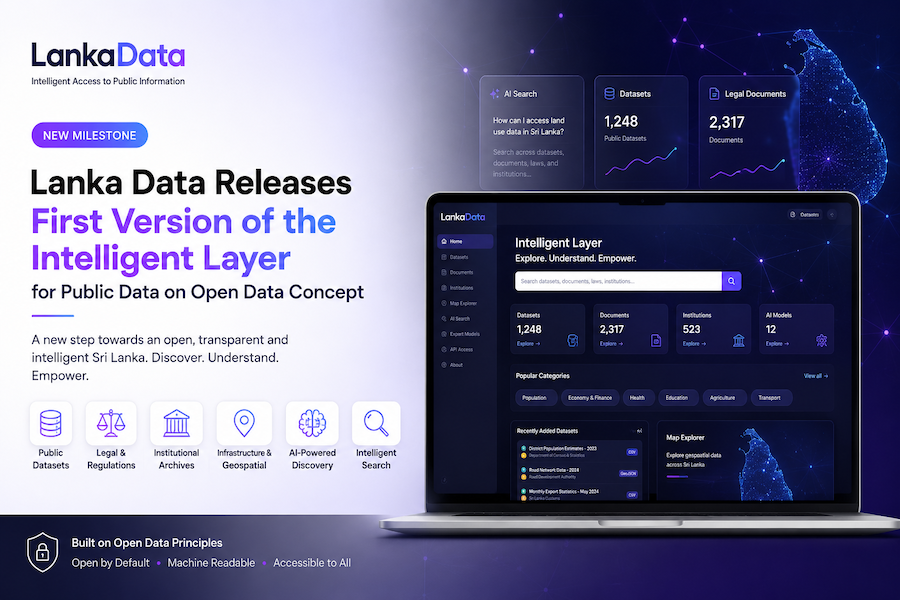
Sri Lanka’s emerging public data ecosystem took a significant step forward this week with the release of the first version of the Lanka Data Intelligent Layer, a platform designed to make public information more searchable, accessible, and useful through open data principles and artificial intelligence.
The platform introduces a new approach to navigating Sri Lankan public information by combining structured datasets, legal archives, institutional records, and contextual AI search into a unified digital layer. The initiative aims to improve how researchers, developers, policymakers, journalists, businesses, and citizens interact with government and institutional information.
The release builds upon the broader global movement toward open government data, where public sector information is made digitally accessible in machine-readable formats for innovation, transparency, and public benefit. Sri Lanka has maintained an official open data framework for several years through its national data portal, which encourages agencies to make datasets available to the public.
According to Lanka Data, the Intelligent Layer is designed not merely as a repository of files, but as a semantic discovery infrastructure capable of understanding relationships between documents, laws, datasets, institutions, and geographic information. The platform uses contextual indexing and multilingual search capabilities to improve discovery across fragmented public records.
The first version of the system includes access pathways for:
- Public datasets
- Legal and regulatory documents
- Institutional archives
- Infrastructure and geospatial references
- AI-assisted document discovery
- Cross-referenced knowledge search
The platform also reflects growing international interest in open data ecosystems as foundations for digital governance, research, and AI-driven public services. Sri Lanka’s existing open data initiatives already include datasets related to demography, infrastructure, economics, transport, agriculture, and information technology.
Developers behind the initiative say the long-term goal is to create an interoperable intelligence layer capable of connecting public knowledge systems across institutions while supporting open innovation. Future versions are expected to expand into API access, advanced retrieval systems, multilingual reasoning models, and institutional AI tools.
The launch comes at a time when governments and technology organizations worldwide are increasingly recognizing data infrastructure as a strategic national asset. Sri Lanka’s own data-sharing frameworks have emphasized accessibility, machine processability, and public usability as core principles of digital governance.
Observers note that one of the biggest challenges facing Sri Lanka’s digital information landscape has been fragmentation — with public records spread across disconnected portals, PDFs, databases, and institutional silos. Platforms such as Lanka Data may help bridge these gaps by creating a more intelligent interface between users and public information.
The release of the first Intelligent Layer marks an early but notable milestone in Sri Lanka’s evolving open data and AI ecosystem, potentially laying the groundwork for more transparent, searchable, and interoperable public knowledge systems in the years ahead.


