
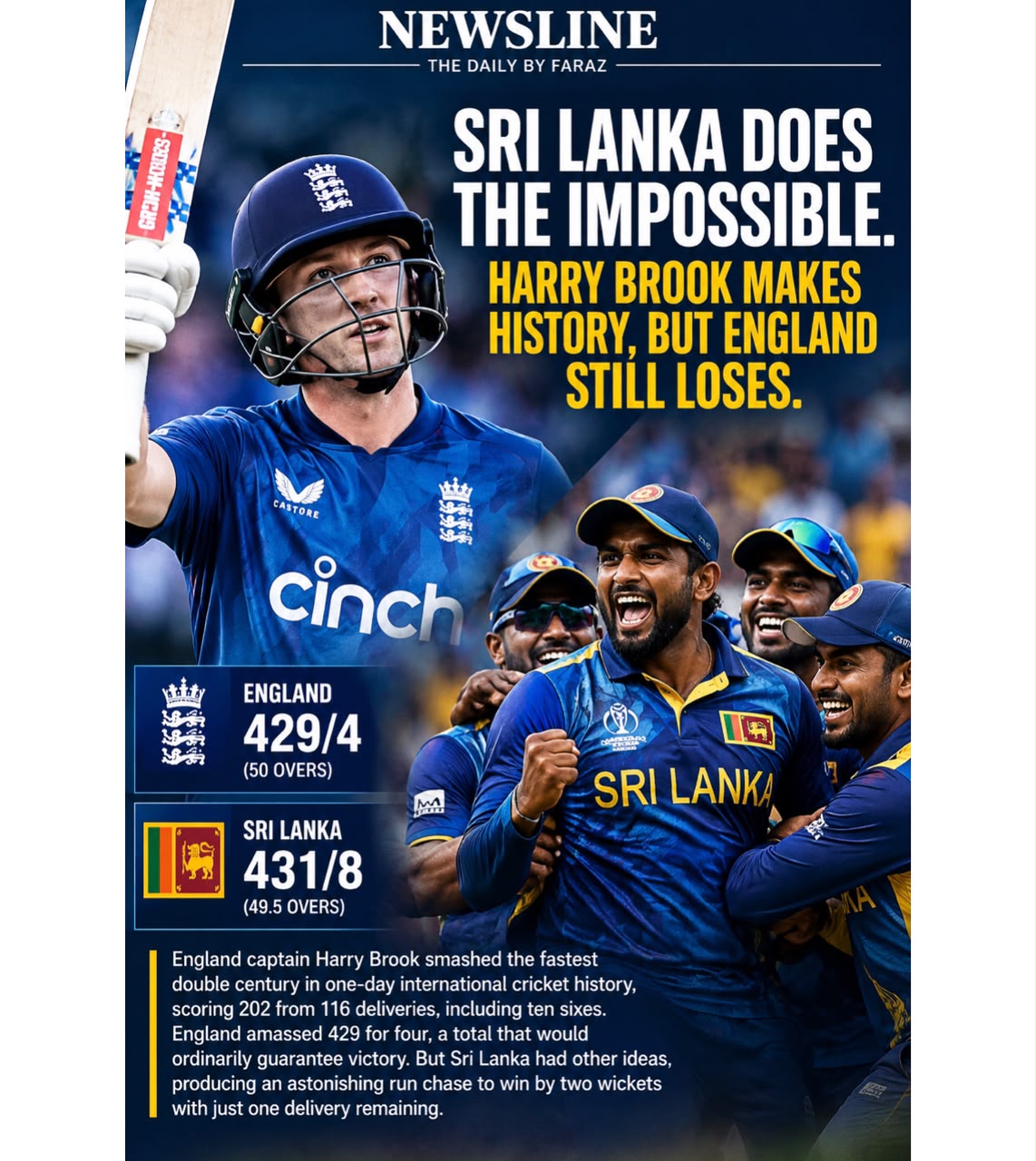
England captain Harry Brook smashed the fastest double century in one-day international cricket history, scoring 202 from 116 deliveries, including ten sixes. England amassed 429 for four, a total that would ordinarily guarantee victory. But Sri Lanka had other ideas, producing an astonishing run chase to win by two wickets with just one delivery remaining.
There are cricket matches that are remembered for an individual performance, others for a remarkable team effort, and occasionally one that manages to deliver both. Thursday’s encounter between Sri Lanka and England in Rawalpindi belonged to that rare category. Harry Brook produced an innings of extraordinary power and precision, rewriting the record books with the fastest double century in men’s one-day international cricket. Yet when the final ball was struck and the celebrations began, it was Sri Lanka that had achieved something even more remarkable.
England’s 429 for four appeared an almost insurmountable target. Brook reached his double century in just 114 deliveries before eventually departing for 202 from 116 balls, having struck 21 fours and ten sixes. His performance was supported by Joe Root’s 69, Tom Banton’s 50 and Will Jacks’ unbeaten 66. England had not merely posted a competitive total. They had delivered the kind of batting performance that generally leaves the opposition playing for respectability rather than victory.
Submit Your Press Release
Get your company news, announcements, launches, appointments and events in front of a wider audience.


Sri Lanka’s reply began disastrously. At 24 for two, the prospect of chasing another 406 runs appeared remote, even allowing for the increasingly extravagant possibilities of modern limited-overs cricket. England had the runs, the momentum and every reason to believe the contest was effectively settled. What followed was an extraordinary demonstration of attacking cricket, calculated risk and an unwillingness to accept defeat.
Avishka Fernando began the recovery with an accomplished 97 from 83 deliveries, striking eleven boundaries and two sixes. Pavan Rathnayake then produced the innings around which Sri Lanka’s response was constructed, scoring a magnificent 130 from 106 balls. His contribution combined sustained aggression with the discipline necessary to prevent the required scoring rate from becoming unmanageable.
The decisive acceleration came from Dasun Shanaka. Returning to one-day international cricket after more than two years, he struck 97 from just 50 deliveries, including eight sixes. His innings transformed a formidable challenge into a genuine possibility. England’s bowlers, who had begun with the comfort of an enormous total, suddenly found themselves defending boundaries rather than dictating terms.
But there was still work to be done. Janith Liyanage delivered the finishing performance, remaining unbeaten on 61 from just 27 balls. With Sri Lanka needing seven runs from the final over, the contest remained balanced between an extraordinary victory and an agonising failure. Two wickets fell in successive deliveries, leaving Sri Lanka eight down and the pressure almost unbearable. Liyanage responded by striking the penultimate delivery for six, taking Sri Lanka to 430 for eight and completing one of the most astonishing successful chases in the history of one-day international cricket.
The achievement was the second-highest successful run chase in men’s ODI history. It also provided a remarkable contrast between individual brilliance and collective determination. Brook’s innings deserved every accolade, and England’s total would have been sufficient to win almost any ordinary contest. Sri Lanka, however, demonstrated that even a world-record individual performance cannot guarantee the result.
For Sri Lankan cricket, which has endured years of criticism over inconsistency, administration and declining international standards, the victory offers something beyond the immediate result. It demonstrates the quality that remains within the national side and the possibilities available when talent is matched by confidence and determination. It does not erase the problems confronting the sport, nor should one extraordinary afternoon become an excuse to ignore them.
Be that as it may, Thursday belonged to Sri Lanka. Harry Brook made history with his bat, but Sri Lanka made history with the scoreboard. England scored 429 runs and still lost. For once, the mathematics of cricket seemed almost as extraordinary as the cricket itself.



