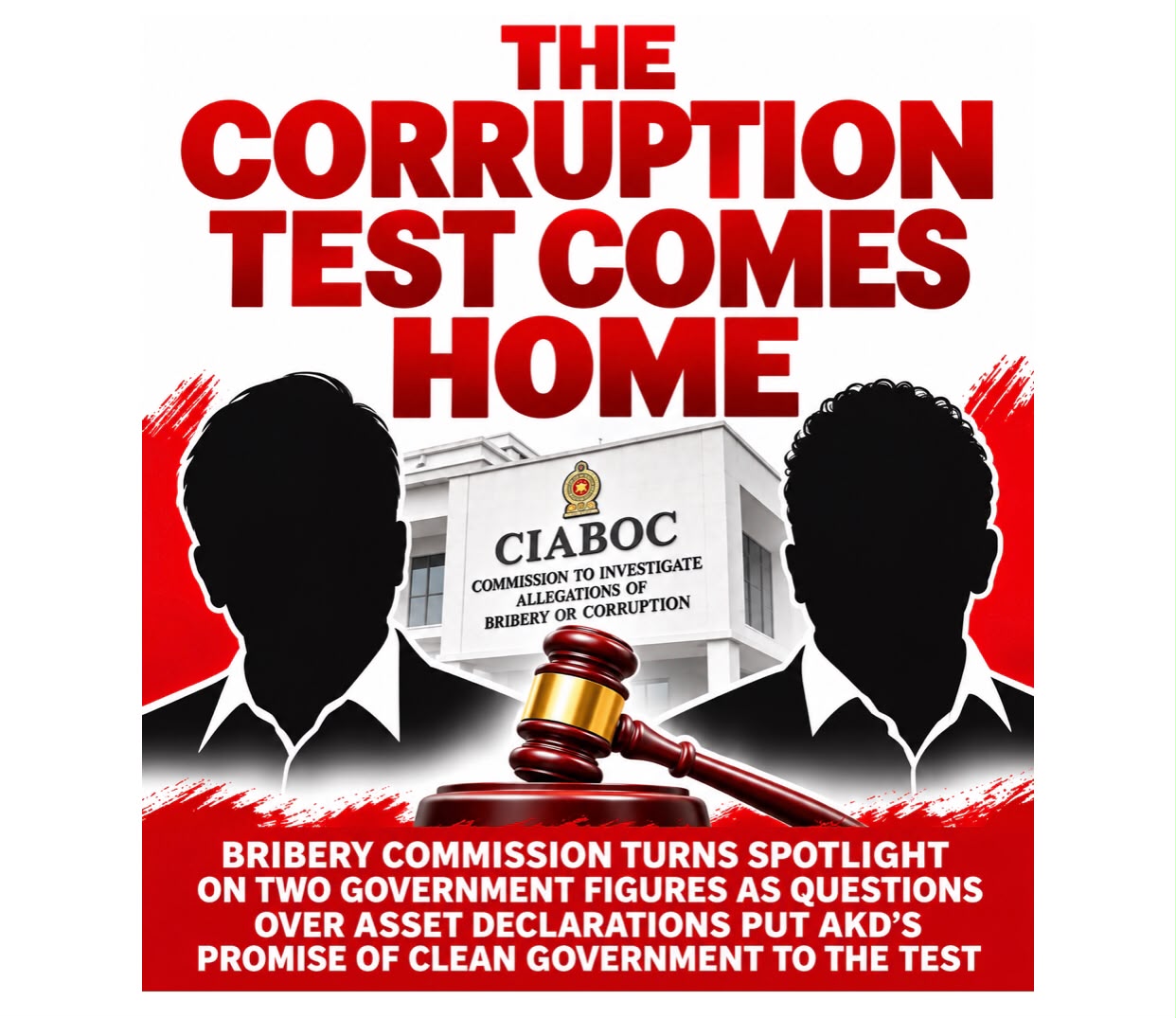
Bribery Commission Turns Spotlight on Two Government Figures as Questions Over Asset Declarations Put AKD’s Promise of Clean Government to the Test
The promise of a new political culture is facing a significant test. Sri Lanka’s Commission to Investigate Allegations of Bribery or Corruption (CIABOC) has reportedly decided to conduct full investigations into the assets of Deputy Minister of Public Security Sunil Watagala and former Energy Minister Kumara Jayakody, following preliminary inquiries that identified matters requiring further examination.
The investigations arise from a complaint lodged in September 2025 by civil rights activist Jamuni Kamantha Thushara de Silva concerning the assets of five Cabinet ministers and a deputy minister. The complaint also named Bimal Rathnayake, Wasantha Samarasinghe, Sunil Handunnetti and Nalinda Jayatissa. The latest development, however, concerns the decision to pursue more detailed inquiries into Watagala and Jayakody.
Submit Your Press Release
Get your company news, announcements, launches, appointments and events in front of a wider audience.


At the centre of the investigation are reported discrepancies between earlier and subsequent asset declarations. Preliminary inquiries reportedly established that increases in property values could explain some changes in declared wealth. Questions concerning additional assets subsequently declared have nevertheless prompted further examination.
None of this establishes wrongdoing. Both men are entitled to the presumption of innocence, and discrepancies in asset declarations do not automatically constitute evidence of corruption. The responsibility of investigators is to establish whether the assets were lawfully acquired and properly declared, not to satisfy political expectations.
But the political implications are considerable. President Anura Kumara Dissanayake came to office promising to dismantle a culture in which political connections appeared to offer protection from scrutiny. His administration has repeatedly emphasised accountability for the conduct of previous governments. The more demanding test is whether the same standards will apply without hesitation to those associated with his own administration.
Be that as it may, an investigation into government figures should not automatically become an embarrassment for the President. On the contrary, the willingness of independent institutions to examine those holding political office could become evidence that the system is changing, provided the process is genuinely independent and reaches conclusions supported by evidence.
There must be no political interference, no premature exoneration and certainly no trial by publicity. The Commission must be free to investigate, while those under scrutiny must have every opportunity to explain their declarations.
Sri Lanka has endured decades of allegations, investigations and prosecutions that have too often left the public questioning whether justice depends upon political circumstances.
The question confronting this government is therefore straightforward. Will accountability remain a principle when those being investigated belong to its own ranks?