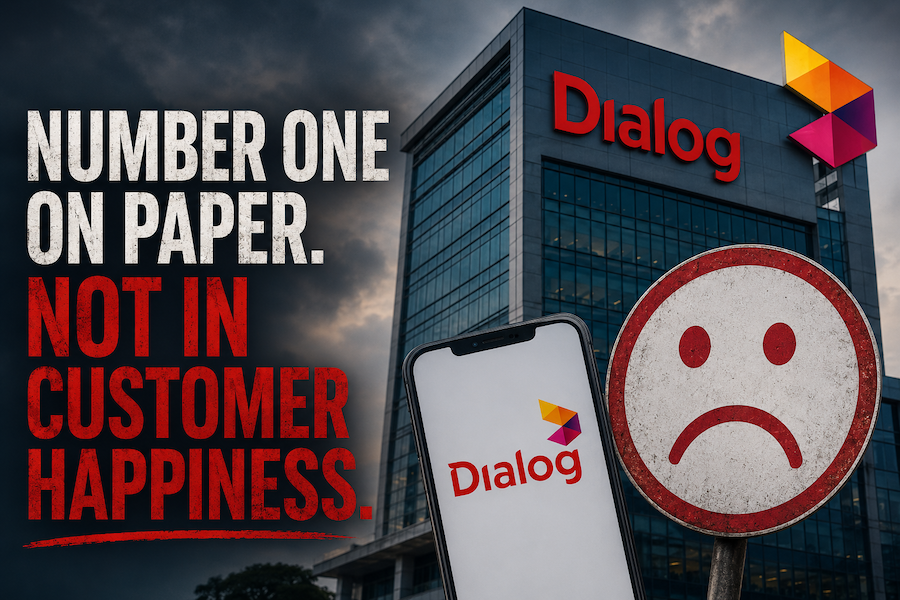
Dialog Axiata PLC has now emerged as one of the most valuable listed company in Sri Lanka by market capitalisation with over Rs 382 billion cementing its dominance over the country’s telecommunications and digital infrastructure landscape. Market data and investor reports show the telecom giant’s valuation climbing sharply during 2025 and 2026, pushing it ahead of several long-established corporate giants on the Colombo Stock Exchange.
For investors, the numbers tell a story of growth. For ordinary Sri Lankans, however, the story on the ground often sounds very different.
Across social media, customer forums, and everyday conversations, frustration with the company’s service quality continues to grow. Consumers increasingly complain about poor customer support, confusing data packages, unexplained deductions, inconsistent internet speeds, dropped connections, and the feeling that there is little real competition left in the market. While the company celebrates its financial milestones, many users argue that the average customer experience has deteriorated.
Dialog’s rise reflects the extraordinary scale of its telecom empire. The company serves millions of mobile and broadband users across Sri Lanka and controls a massive portion of the country’s digital communications infrastructure. Yet critics argue that scale without accountability creates a dangerous imbalance between corporate power and consumer rights.
The biggest concern is not merely that customers are unhappy. It is that many feel they have no meaningful alternative.
Sri Lanka’s telecom market has increasingly consolidated over the years. Smaller competitors have struggled to match the infrastructure and financial muscle of dominant operators. The acquisition and merger activity within the sector has further strengthened the grip of large telecom players. Consumers and industry observers warn that this trend risks creating a telecom environment where companies become too powerful to be pressured by customer dissatisfaction.
A monopoly — or even a near-monopoly — in a country’s digital infrastructure sector can have serious consequences. Telecommunications today are not a luxury service. They are essential for education, business, banking, media, healthcare, and government access. When one company becomes overwhelmingly dominant, customer choice weakens, innovation slows, and service standards can decline without meaningful consequences.
Many Sri Lankan users complain that promotional data packages often fail to match real-world performance. Customers regularly say they are sold “unlimited” or “high-speed” experiences only to encounter throttling, hidden restrictions, reduced speeds, or rapidly expiring allocations. Others describe spending hours trying to resolve billing disputes or technical failures through customer support channels that feel automated, slow, or disconnected from real problem-solving.
The frustration extends beyond technology itself. Critics say the company has become excessively corporate and bureaucratic, with frontline staff often unable to make decisions or solve issues effectively. Customers frequently describe experiences involving endless transfers between departments, scripted responses, and unresolved complaints. In a sector that directly impacts daily life, such inefficiency damages public trust.
The uncomfortable question for Sri Lanka is whether market capitalisation has become disconnected from customer satisfaction.
Being the most valuable company on the stock market should represent excellence in service, innovation, reliability, and public confidence. Instead, many consumers argue that Sri Lanka’s telecom sector increasingly rewards market dominance more than customer care. A company can post billions in valuation growth while ordinary people struggle with weak connectivity, inconsistent service standards, and rising digital dependency.
Sri Lanka’s broader digital future depends on healthy competition. Without strong regulatory oversight and genuine market alternatives, dominant telecom firms may face little pressure to improve service quality or pricing transparency. That is dangerous for a country attempting to build a modern digital economy.
The issue is not whether Dialog Axiata PLC has achieved financial success. Clearly, it has. The issue is whether corporate dominance without corresponding customer satisfaction should be celebrated as a national success story.
A telecom company can become number one on the stock market. But if millions of customers feel ignored, frustrated, or trapped, the achievement begins to look less like progress and more like a warning sign for the future of Sri Lanka’s digital economy.