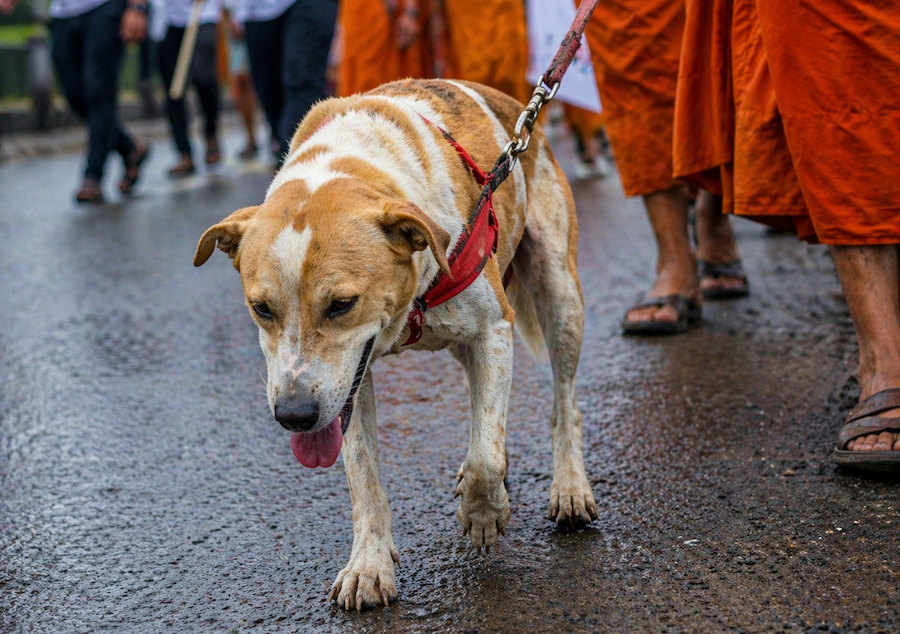
The proposed “Walk for Peace” in Sri Lanka, scheduled from April 21 to April 28, 2026, is not a symbolic or short ceremonial event but a multi-day public procession covering significant distance across public roads, beginning with observances in Anuradhapura and proceeding through Dambulla, Matale, Kandy, and several towns before concluding in Colombo . The march is expected to span approximately a week and involve continuous movement through populated areas, with participation from monks, followers, and public crowds, all under state-supported arrangements . Central to the controversy is the confirmed involvement of a rescue dog, “Aloka,” which has been described as accompanying the monks throughout the journey as a symbolic figure of the peace initiative .
From a legal standpoint, these factual elements are critical. The Prevention of Cruelty to Animals Ordinance No. 13 of 1907 establishes that cruelty includes not only direct harm but any act or omission that causes “unnecessary pain or suffering” to an animal . Section 2(1)(a) explicitly prohibits over-driving or ill-treating an animal, while section 2(1)(b) extends liability to any conduct that results in unnecessary suffering, regardless of intent . When applied to the present facts, a seven-day procession along public roads, involving prolonged walking, crowd exposure, and environmental stress, falls within a category of activity where fatigue, stress, and physical strain are reasonably foreseeable.
The Ordinance must be interpreted in light of the actual conditions of the event. The walk is not confined to controlled environments but takes place across “streets,” which the law defines broadly to include any public road or space accessible to the public . This places the entire route of the procession squarely within the scope of statutory protection. The presence of large crowds, noise, varying terrain, and climatic exposure over multiple days creates conditions that are inherently capable of causing distress to an animal, particularly one that is not demonstrably trained or conditioned for such sustained activity.
Further, section 5 of the Ordinance prohibits the use of any animal for labour if it is unfit by reason of any condition . The factual background of “Aloka” is legally relevant here. The dog is identified as a rescue animal of stray origin, previously exposed to injury and requiring medical intervention during earlier walks . Even if currently deemed healthy, the prior history of injury and the nature of the event raise a legitimate legal question as to whether the animal can be considered fit for continuous participation in a physically demanding, multi-day public march. The law does not require proof of actual harm; the use of an animal in circumstances where unfitness may reasonably arise is sufficient to trigger liability.
Section 3 further extends responsibility to any person in control or management of the animal if it is found in a condition of suffering due to neglect, exhaustion, or ill-treatment . In the context of this event, responsibility would not be limited to a single handler but could extend to organisers, coordinators, and any authority exercising control over the conditions of participation. The reported arrangements—such as veterinary supervision and even standby medical support for the animal upon arrival—demonstrate that risk to the animal’s wellbeing is not hypothetical but anticipated . In legal analysis, such anticipation strengthens, rather than weakens, the argument that the activity carries foreseeable potential for suffering.
The Ordinance also provides enforcement mechanisms that become relevant where such risk exists. Under section 13, a peace officer may detain an animal where there is reasonable cause to believe an offence has been committed, while section 9 empowers authorities to intervene decisively where suffering is severe . These provisions indicate that the law is not passive; it is designed to act preventively where conditions suggest that cruelty may occur.
Incorporating the actual facts of the proposed event into the legal framework leads to a clear conclusion. The planned procession is prolonged, physically demanding, conducted in uncontrolled public environments, and involves an animal whose participation is symbolic rather than necessary. The risk of unnecessary suffering is therefore not incidental but inherent in the structure of the event itself. Under Sri Lankan law, such circumstances fall within the statutory definition of cruelty, irrespective of the intention behind the activity.
Accordingly, the continued inclusion of the dog in the “Walk for Peace” raises substantial legal concerns. The most defensible position, consistent with both the letter and purpose of the Ordinance, is the removal of the animal from participation. Where the law imposes a duty to prevent suffering, symbolic value or public sentiment cannot operate as a legal justification for exposing an animal to foreseeable harm.
Download Ordinance
Prevention of Cruelty to Animals Ordinance No. 13 of 1907