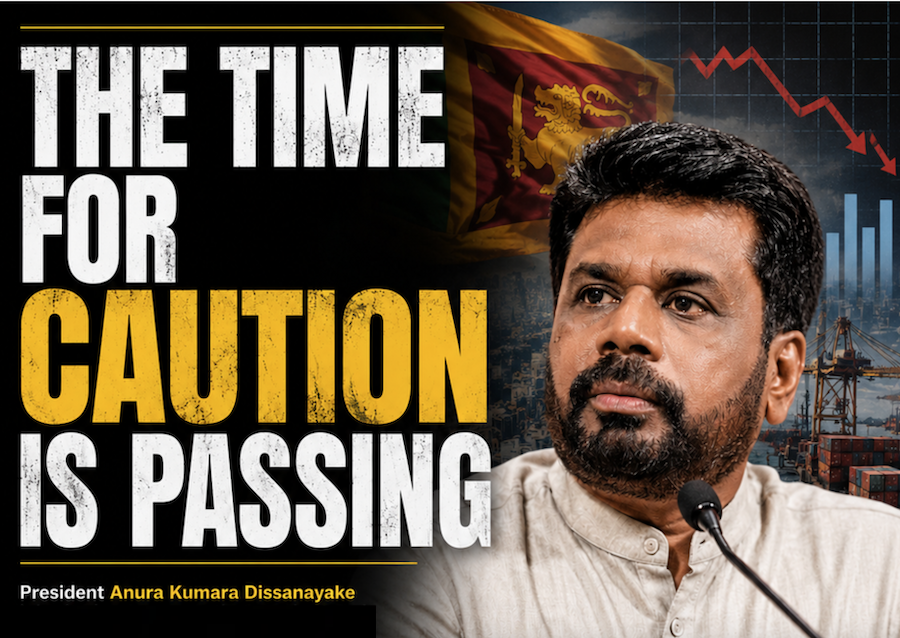
President Anura Kumara Dissanayake inherited an economy that was battered, indebted, fragile and dangerously close to collapse. No fair observer can deny that reality. Nor can anyone reasonably argue that restoring a measure of stability was not a necessary first step.
To that extent, the government deserves credit.
Inflation has been contained. Fiscal discipline has improved. International confidence has partially returned. The IMF programme negotiated under former President Ranil Wickremesinghe has provided a framework for recovery and, thus far, President Dissanayake has demonstrated near-religious adherence to its requirements. The problem is that stability alone is not an economic strategy.
Submit Your Press Release
Get your company news, announcements, launches, appointments and events in front of a wider audience.


At some point every government must move beyond balancing the books and begin creating wealth. Sri Lanka is now approaching that moment. Indeed, one could argue it has already arrived.
An economy cannot simply be taxed into prosperity. Revenue collection is important. Fiscal responsibility is essential. But neither generates growth on its own. Businesses must invest. Entrepreneurs must expand. Foreign capital must arrive. Jobs must be created. Productivity must improve.
Without those ingredients, Sri Lanka risks drifting into the most dangerous of economic conditions: stagnation accompanied by persistent hardship. In simpler terms, stagflation without the inflation.
That is the warning sign now blinking on the nation’s economic dashboard.
The Middle East crisis undoubtedly presents uncertainties. Global markets remain volatile. Geopolitical tensions continue to affect trade, shipping and energy prices. Yet governments cannot indefinitely cite external conditions as reasons for delaying difficult decisions. Leadership is tested precisely when circumstances are uncertain.
There is also an uncomfortable political reality confronting theadministration.
Many of the individuals entrusted with helping deliver the promise of a cleaner and more competent government have fallen short of expectations. Whether through inexperience, poor judgement, bureaucratic inertia or something more troubling, several controversies have dented the government’s image.
Facts are stubborn things. The public did not vote merely to replace one set of politicians with another. They voted to end corruption, end patronage and usher in a more effective style of governance. On that score, there have already been warning signs.
The President must now ask himself a difficult question. Has caution become a virtue, or has it become a constraint?
Sri Lanka’s economy today resembles a nation dancing on a razor’s edge. One misstep could prove costly. Yet refusing to move at all carries risks of its own.
President Dissanayake has shown little hesitation when exercising the powers available to him under existing laws, including the Prevention of Terrorism Act. He understands that leadership sometimes requires difficult decisions.
The same principle applies to economic management. Taking calculated risks to unlock investment, accelerate reforms, modernise state institutions and stimulate growth is not recklessness. It is governance.
No one is suggesting the President become a gambler.
What is required is intelligent risk management, backed by competent execution and clear accountability. The objective must be to grow the economy while preserving stability, not to sacrifice growth in pursuit of excessive caution.
Ultimately, the question is no longer whether President Anura Kumara Dissanayake inherited a difficult situation. Nobody disputes that he did.
The question is whether he can now transcend it.
Sri Lankans did not vote merely for stability. They voted for change. Stability was the first assignment. Growth is the second. Opportunity is the third. If those objectives are not achieved, public patience will eventually begin to erode regardless of how disciplined the government’s fiscal management may appear.
The President’s greatest political risk may not be making a bold decision. It may be failing to make one.
History is rarely unkind to leaders who take calculated risks in pursuit of national progress. It is often far less generous to those who mistake caution for strategy.
Trusted advisers, ministers and officials will come and go. Some will perform admirably. Others will inevitably disappoint. That is the nature of government. The responsibility, however, ultimately rests with one man.
President Dissanayake possesses powers and political capital that many of his predecessors could only dream of. Parliamentary control, a public mandate, international goodwill and a degree of credibility with ordinary citizens remain powerful assets.
Such opportunities do not last forever.
Be that as it may, the next election will not be fought on who inherited the crisis. It will be fought on who solved it.
If Sri Lanka is growing, creating jobs, attracting investment and restoring confidence, AKD’s political future will take care of itself. If it is not, neither caution nor good intentions will provide much comfort.
The country’s fortunes and the President’s fortunes are now inseparably intertwined.
The time for careful stewardship is giving way to the time for decisive leadership.