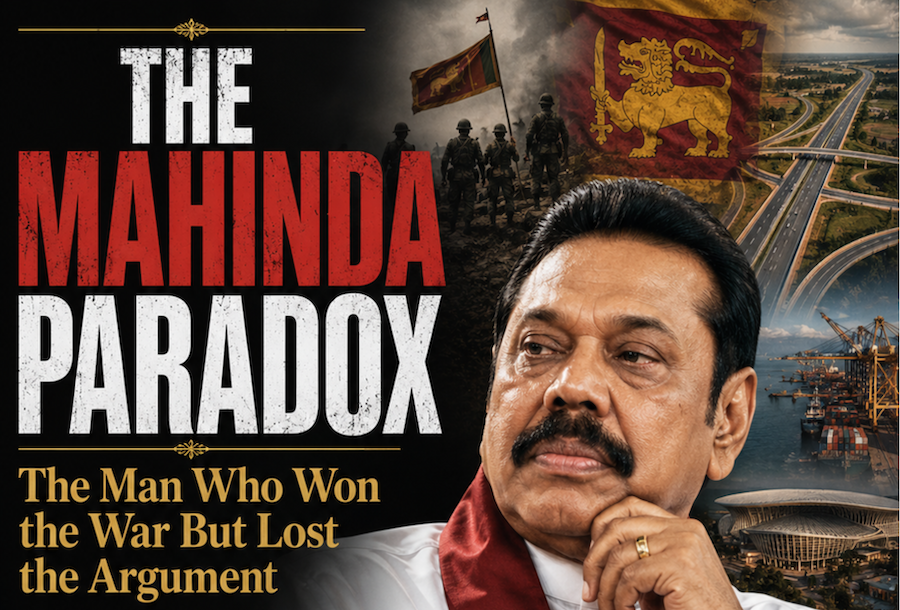
The Man Who Won the War But Lost the Argument
This is one of the most consequential questions in modern Sri Lankan history because it is not really a question about Mahinda Rajapaksa alone. It is a question about what future generations choose to value most.
History rarely delivers a single verdict. It tends to produce competing narratives that coexist for decades.
On one side stands the undeniable fact that Mahinda Rajapaksa presided over the military defeat of the Liberation Tigers of Tamil Eelam in May 2009. For a majority of Sri Lankans, particularly those who lived through nearly three decades of bombings, assassinations and war, this achievement alone secures him a place among the most consequential leaders the country has produced.
Many will argue that without that victory there would be no stable Sri Lanka upon which any subsequent debate about governance, corruption or economic policy could even occur.
That is not a small achievement. It was historic.
Unlike many leaders who inherited peace, Rajapaksa inherited a conflict that had consumed multiple presidents, prime ministers and military commanders. Previous administrations sought negotiations, ceasefires and military campaigns with varying degrees of success.
Under his presidency, the war was brought to a definitive conclusion.
For that reason alone, there will always be those who regard him as a national saviour.
Yet history does not stop in May 2009.
The second phase of the Rajapaksa legacy concerns what happened after victory.
His supporters argue that he understood something many Colombo policymakers failed to appreciate: that a nation emerging from war required visible development. Highways, ports, airports, convention centres, power projects and urban beautification schemes became the symbols of that ambition. The Southern Expressway, the expansion of the port, improvements in electricity generation and large-scale infrastructure investment changed parts of the country’s physical landscape.
Supporters therefore see him as a builder.
Critics, however, ask a different question.
Were these investments selected because they generated sustainable economic returns or because they generated political returns?
The debate surrounding projects such as the Mattala Rajapaksa International Airport, Hambantota Port (even if it is now a success story of sorts) and several large-scale debt-funded ventures remains unresolved in the public mind. Critics argue that many projects lacked sufficient economic justification and contributed to a debt burden that later became difficult to sustain. Supporters counter that all major developing countries invest ahead of demand and that infrastructure often takes decades to demonstrate its value.
History will ultimately decide which interpretation proves more accurate.
Then there is the corruption question.
This may prove to be the most contentious aspect of his legacy.
The Rajapaksa years became synonymous in the minds of many Sri Lankans with allegations of cronyism, nepotism and concentration of power. The prominence of family members in government, state institutions and strategic sectors created a perception that the state itself had become intertwined with one political family.
Yet perception and proof are not always identical.
While numerous allegations were made over the years, relatively few resulted in final criminal convictions against the central figures of the Rajapaksa administration.
His critics see that as evidence of institutional weakness. His supporters see it as evidence that allegations were often politically motivated. The historical record thereforeremainscontested.
What is not contested is that public dissatisfaction with governance, debt accumulation, economic management and political culture eventually culminated in the extraordinary events of 2022.
The public anger that swept through the country did not emerge in a vacuum. Fairly or unfairly, Mahinda Rajapaksa became one of its principal symbols.
That may become the defining complication of his legacy.
Many great leaders are remembered for one towering achievement. Rajapaksa may be remembered for two opposing realities.
He was the leader who ended the war and the leader whose political movement became associated with many of the governance failures that contributed to the country’s later economic collapse.
Very few leaders leave behind such contrasting images. How then will history remember Mahinda Rajapaksa? Perhaps not as a saint. Certainly not as a devil.
More likely as a transformational figure who achieved something that eluded generations of leaders, but who may also have missed a historic opportunity to convert military victory into lasting institutional reform.
Future historians may conclude that he won the peace militarily but failed to fully secure it economically and institutionally.
Be that as it may, if Sri Lanka fifty years from now is prosperous, stable and united, his role in ending the war will probably dominate his obituary.
If Sri Lanka remains trapped in cycles of debt, political patronage and economic fragility, historians may place greater emphasis on the governance model that emerged during his tenure.
The final verdict on Mahinda Rajapaksa has not yet been written because the story of Sri Lanka after Mahinda Rajapaksa is still being written.