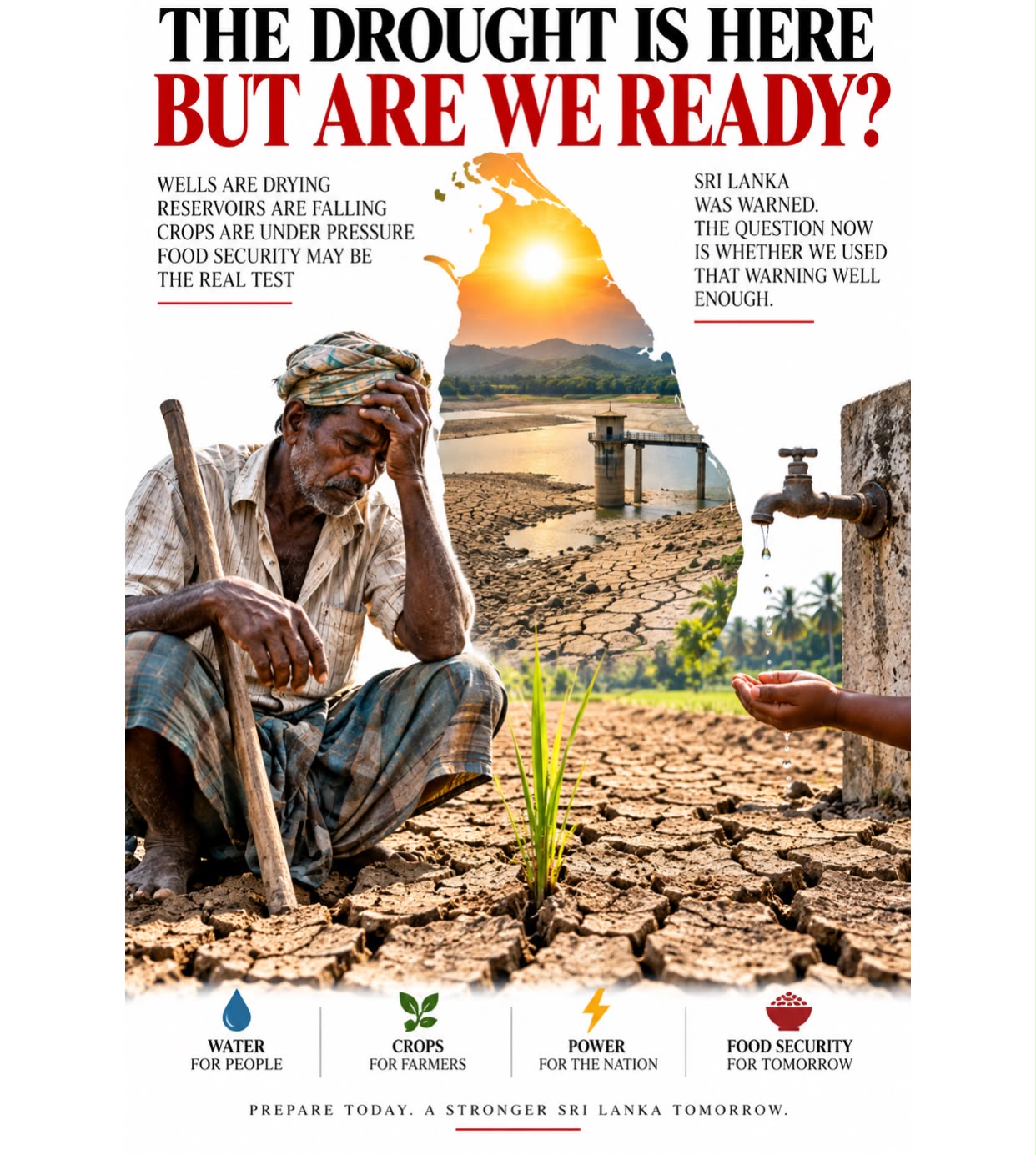
Wells are drying, reservoirs are falling and crops are under pressure. Government has been preparing for El Niño, but food security may become the real test if the dry conditions persist into 2027.
For months Sri Lanka has been warned to prepare for El Niño. Now wells are drying, tanks are shrinking and farmers are losing crops as severe dry conditions tighten their grip on parts of the Dry Zone, particularly Monaragala and Ampara.
Reuters, reporting from affected communities last week, found depleted wells, rivers and tanks, farmers losing crops and income and some families beginning to reduce meals as the drought works its way from the field into the household. In some badly affected areas, rainfall deficits have been extreme and tanks were reported at around 10 per cent of normal capacity.

The problem extends beyond those two districts. Dry conditions are affecting areas including Polonnaruwa, Batticaloa, Badulla, Hambantota and Ratnapura, while reservoir levels across much of the country have fallen substantially, with recent reporting indicating that most reservoirs were below 50 per cent capacity.
This creates a difficult competition for the same diminishing resource. Households need drinking water, agriculture needs irrigation, the electricity system relies partly on hydropower and wildlife requires water as natural sources disappear.
The important point is that the Government was not taken by surprise. President Anura Kumara Dissanayake chaired a high-level preparedness meeting in June bringing together meteorological, irrigation, Mahaweli, disaster-management, electricity and other agencies, while a ministerial subcommittee and officials’ committee were subsequently established to coordinate the response.
Agricultural authorities have urged farmers to conserve irrigation water, use shorter-duration paddy varieties where appropriate and improve soil-moisture retention. The National Water Supply and Drainage Board has also been increasing treatment capacity, drilling additional deep wells and preparing alternative supplies.
There has therefore been preparation. The more important question now is whether enough of it has moved from committees and plans in Colombo to the communities where water is actually disappearing.
The latest international assessment makes that increasingly urgent. The World Meteorological Organization says the current El Niño is already among the four strongest since 1950 and could become the strongest on record, with an exceptionally high probability that El Niño conditions will persist into early 2027.
Sri Lanka cannot consequently treat this simply as a difficult September. Government planning must extend through the coming agricultural seasons and take account simultaneously of drinking water, irrigation, electricity generation, food production and prices.
Food security is where these pressures eventually meet. Drought does not have to produce empty supermarket shelves to create hunger; destroying a farmer’s crop also destroys his income, leaving food available in the shop but potentially beyond his family’s ability to buy it.
There was already considerable vulnerability before the present drought. Recent reporting citing World Food Programme assessments suggests a significant proportion of Sri Lankan households continue to struggle to meet essential food requirements, making protection of agricultural production and rural incomes particularly important.
Sri Lanka’s normal insurance against a domestic production shortfall is the international market. But El Niño is not exclusively a Sri Lankan problem, with adverse weather affecting agricultural production elsewhere in Asia at a time when international food prices and geopolitical uncertainty are also placing pressure on supply.
India is particularly important. A sufficiently poor harvest there could affect production of rice, sugarcane, pulses and other commodities and potentially influence export policy, leaving Sri Lanka seeking additional supplies from a regional market that may itself be under pressure.
That is why food-security planning cannot begin after the harvest fails. Authorities should already have reliable estimates of existing rice and other essential food stocks, likely production during the next two cultivation seasons, the size of any potential deficit and the quantities that could be imported before shortages begin affecting retail prices.
There is an additional complication because El Niño does not necessarily mean uninterrupted drought. Meteorological authorities have also warned of the possibility of intense rainfall during the inter-monsoon, meaning some farming communities could face the extraordinary combination of prolonged water scarcity followed by damaging floods.
Accurate weather information reaching farmers before cultivation therefore becomes as important as irrigation itself. Tank rehabilitation, water allocation, drainage, crop selection and planting schedules are no longer separate agricultural matters but components of national food security.
Wildlife is also beginning to compete for the same diminishing water. Authorities have been restoring water holes and transporting water into some protected areas, while prolonged scarcity increases the possibility of elephants moving farther into surrounding villages and agricultural land.
The Government deserves credit for recognising El Niño early enough to establish a coordinated response. What matters now, however, is measurable preparedness: the drinking-water reserves secured, emergency wells operating, reservoir allocations, acreage already lost, expected Yala and Maha production and the quantity of staple food presently available to bridge any shortfall.
Those figures should be made public before a shortage develops, not afterwards. They would allow farmers, traders and consumers to understand whether Sri Lanka has sufficient reserves or whether imports must be ordered while supplies remain readily available and prices manageable.
The country has experienced often enough what happens when foreseeable shortages are addressed only after they become emergencies. El Niño cannot be prevented, but a drought becoming a food crisis is not necessarily inevitable.
Be that as it may, Sri Lanka was warned that the drought was coming. The real test is whether we used that warning well enough.