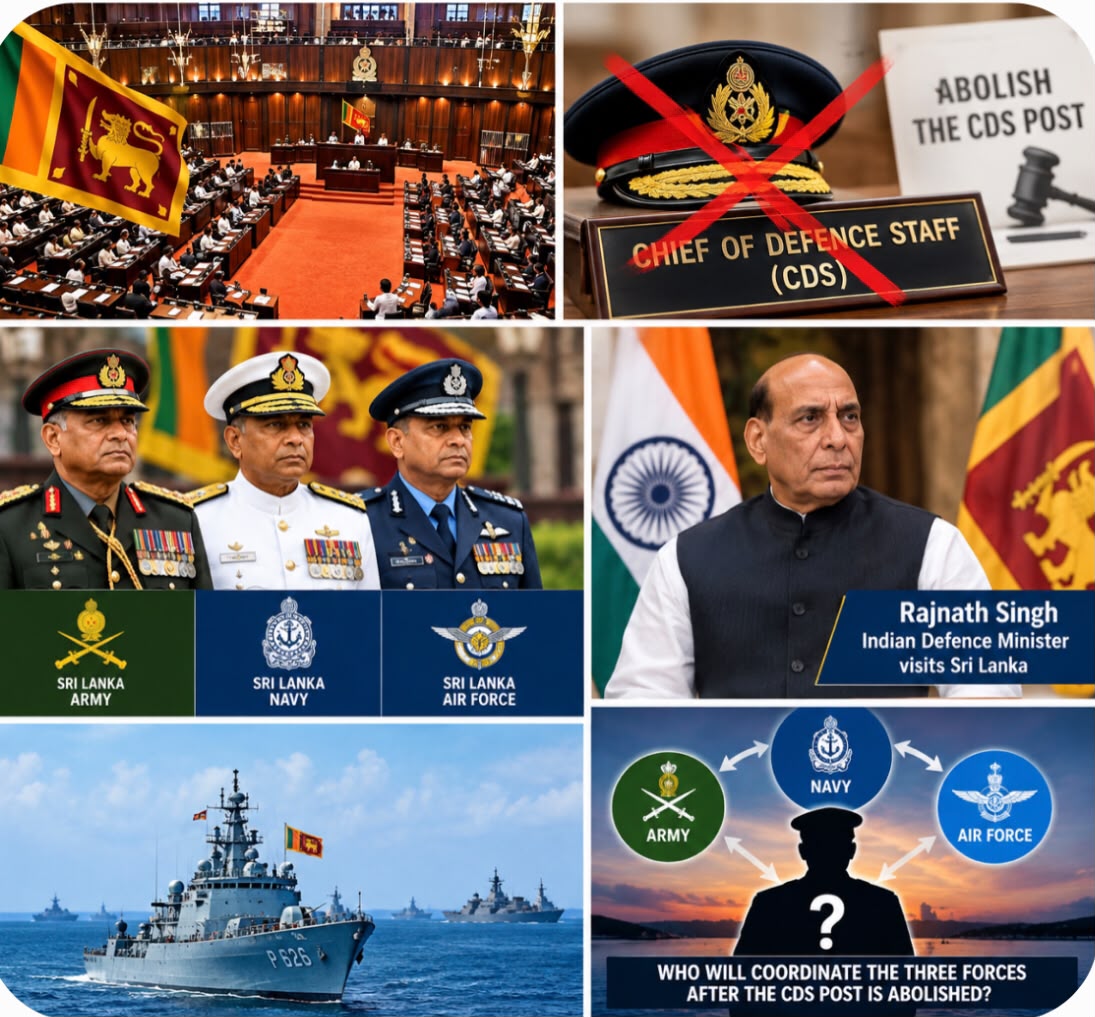
Parliament prepares to abolish Chief of Defence Staff post as Indian Defence Minister visits Colombo
Parliament is expected to vote on legislation abolishing the office of Chief of Defence Staff on Wednesday, September 9, in a potentially significant restructuring of Sri Lanka’s defence establishment.
The legislation is scheduled to come before Parliament during this week’s sittings with the vote expected on Wednesday afternoon.

The timing is interesting.
Indian Defence Minister Rajnath Singh will be in Sri Lanka at precisely the same time for discussions which include defence cooperation and maritime security.
There is no reason why Sri Lanka should preserve a military command structure merely because it already exists.
Defence structures must evolve with the threats, technology and strategic circumstances confronting a country.
But abolishing the country’s senior tri-service coordinating office is more than an administrative alteration.
The Chief of Defence Staff structure exists to facilitate coordination between the Army, Navy and Air Force.
If the office disappears, the important question is not merely who loses a title but where those responsibilities go.
Parliament should therefore be told what shortcomings the Government believes exist in the present arrangement, what structure will replace it and how coordination between the three armed services will function thereafter.
Those questions become particularly relevant as Sri Lanka faces an increasingly complicated maritime environment.
Reform may well be justified.
But before Parliament abolishes an institution concerned with national security, MPs ought to know exactly what is replacing it.